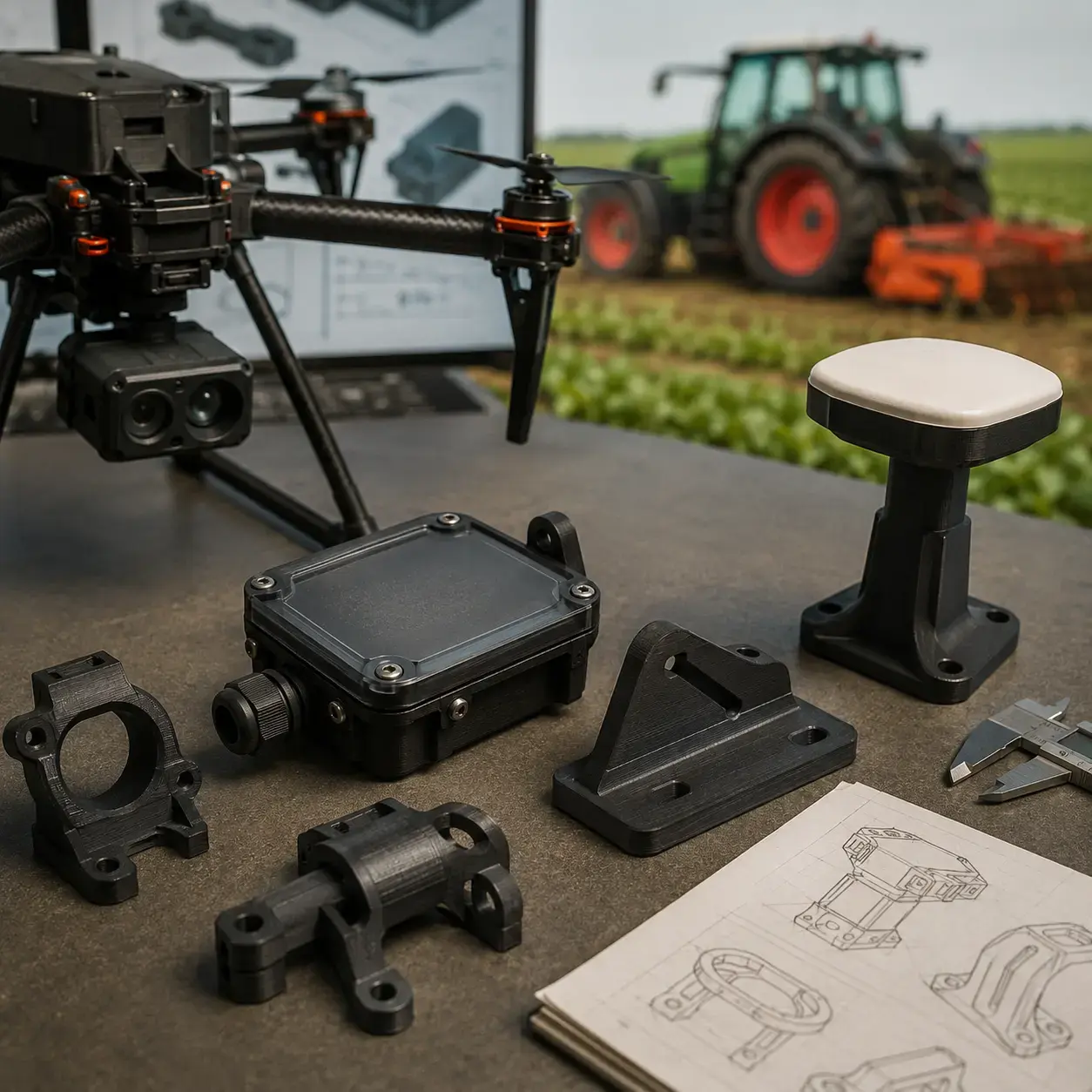
Precision agriculture is today one of the fastest-growing segments in the civil sector. Multispectral drones, IoT control units installed in fields, satellite guidance systems for tractors, sensors for monitoring soil moisture and automated irrigation systems are transforming the way agricultural activities are managed. However, many agritech projects face a common difficulty: much of the custom components needed aren't available off the shelf. You may need brackets designed to mount a sensor on a specific drone model, watertight housings for IoT control units exposed to the elements, mounts resistant to plant protection products and UV rays, or spare parts for older agricultural machines that are no longer available in stock.
Industrial 3D printing offers a concrete answer to these needs. It makes it possible to produce technical components for the agritech sector, even in small runs, using materials resistant to the environmental conditions typical of agriculture. All this with reduced production times, wide design freedom and a high level of customisation. On this page, we analyse the most requested components, the most suitable materials and the main operational advantages of 3D printing applied to agritech.
3D Printing and Precision Agriculture
Modern agriculture is increasingly based on data, connectivity and automation. Sensors distributed across fields, assisted-guidance machines, drones for crop monitoring and automated irrigation systems require specific technical components, often non-standard and produced in limited quantities. These elements must also withstand demanding environmental conditions, such as humidity, dust, UV rays, temperature swings and chemical substances.
In the agritech sector, traditional production presents three main limitations:
- Small runs don't justify moulds: 50–500 pieces of a custom sensor bracket have injection costs that are hard to sustain;
- Custom geometries change rapidly: if a drone manufacturer updates its models every year, investing in dedicated tooling risks generating high costs and rapidly obsolete tools;
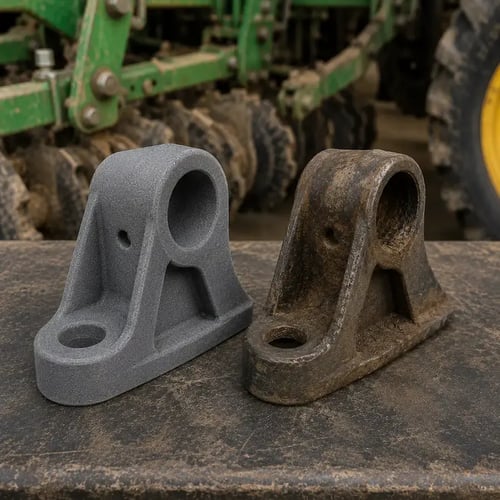
- Spare parts are no longer available: agricultural machines with several years of service may require small components that manufacturers and distributors no longer keep in stock.
Additive manufacturing makes it possible to overcome all three of these obstacles: zero tooling costs, delivery times in days (not months), quantities from 1 to thousands of parts and the freedom to put files back into production whenever needed, without tying up stock or physical spare parts.
Which Agritech Components Are Produced with 3D Printing
The main families of technical components for agritech made today through 3D printing involve practically the entire ecosystem of precision agriculture.
Components for agricultural drones
Drones intended for precision agriculture represent one of the most dynamic segments of the sector, with new models, sensors and configurations introduced every season.
3D printing makes it possible to develop:
- mounts and fastening systems for multispectral and hyperspectral sensors;
- housings for cameras, imaging cameras and vision systems;
- custom gimbals and stabilisation systems;
- propeller guards, rotor guards and quick-release attachments;
- casings for flight electronics, GPS and telemetry;
- nozzles, fittings and adapters for crop-spraying systems;
- arms, secondary frames and structural components for prototypes, small batches or special versions.
Field Sensors and Agricultural IoT
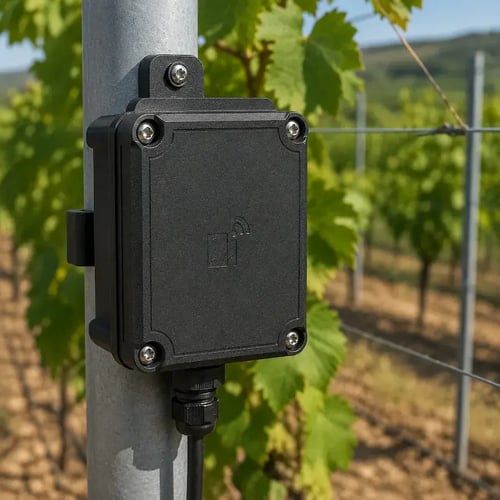
IoT stations in the fields must meet particularly rigorous requirements. The housings must be resistant to water, dust and UV rays, withstand years of outdoor exposure and adapt to different sensor configurations and fastening systems.
3D printing produces:
- watertight housings for weather stations and IoT control units;
- housings for soil moisture, pH and electrical conductivity sensors;
- mounts for fastening to poles, plants, walls or other infrastructure;
- casings for immersion sensors (nutrient solutions, water tanks);
- GPS and telemetry housings for tractors and agricultural machines;
- casings for LoRaWAN, NB-IoT and cellular network electronics;
- protective covers for antennas and radio components.
Components for Agricultural Machinery
Tractors, combine harvesters, seed drills and sprayers have particularly long life cycles and generate a constant demand for custom spare parts, secondary components and technical accessories. 3D printing covers:
- electronic housings in the cab (displays, control units, switches);
- mounts for GPS assisted-guidance systems and position sensors;
- rings, knobs, ergonomic levers with custom finishes;
- protective covers for electronic components and sensors;
- discontinued spare parts for older agricultural machines;
- small mechanical components (gears, brackets, spacers).
Actuators, valves and components for irrigation
Irrigation, fertigation and fluid distribution systems often require custom components in limited quantities, generally in the order of a few dozen or hundred pieces, ideal for additive manufacturing:
- custom fittings and joints with non-standard geometries;
- drippers and low-pressure distributors;
- components for control valves and zone control units;
- mounts for servomotors and actuators;
- brackets for low-power pumps and auxiliary hydraulic components.
Technical requirements of agritech components
A component intended for work in the agricultural field faces far harsher conditions than an element used in indoor environments. Four requirements influence the choice of material.
Resistance to UV rays
Prolonged solar exposure degrades most polymers: yellowing, embrittlement, loss of mechanical properties. For components intended for outdoor use, materials stabilised against UV rays or intrinsically resistant to solar radiation are needed. PA12 and PA11 with vapor smoothing offer good performance in outdoor applications; TPU and ASA are intrinsically excellent against UV.
Resistance to humidity and hydrolysis
Agriculture is an environment saturated with humidity: rain, condensation, irrigation, direct immersion. Some polymers, such as standard PA6 and PA66, can absorb significant amounts of water, resulting in dimensional changes and reduced stiffness. For agritech applications, materials characterised by lower absorption are therefore preferred, such as PA12 and PA11, PEEK and specific grades of hydrolysis-resistant TPU. Vapor smoothing can also reduce surface porosity and improve the water repellency and ease of cleaning of the component.
Chemical Resistance to Agricultural Agents
Plant protection products, fertilisers, soil improvers, oils, detergents: an agritech component is potentially exposed to many aggressive substances. PEEK and polypropylene offer high resistance to numerous chemical substances; PPS CF and Ultem guarantee excellent performance in the presence of solvents and aggressive agents; ESD PETG has good resistance to oils and hydrocarbons, but its compatibility with concentrated plant protection products must be assessed on a case-by-case basis.
Resistance to vibration and mechanical cycles
Tractors, combine harvesters, internal combustion engines and drones operate in environments characterised by continuous vibration. A mount that's too rigid or designed without considering fatigue can develop cracks and break prematurely.
There are two main design strategies:
- tough materials with high elongation at break: PA11 with 27.5% elongation is among the best for applications subjected to fatigue;
- flexible materials such as TPU (thermoplastic polyurethane), which absorb vibration through elasticity. Ideal for isolators, anti-vibration mounts, gaskets and components in contact with moving parts.
Recommended materials for agritech
Based on the environmental, chemical and mechanical requirements typical of the agricultural sector, it's possible to identify the most suitable materials for each agritech application.
|
Material
|
Technology
|
Strengths
|
Agritech use cases
|
|
PA12 nylon
|
MJF
|
Low hygroscopicity (0.7%), impact resistance; with vapor smoothing it becomes water-repellent and improves UV resistance
|
IoT housings, sensor mounts, spare parts for agricultural machines
|
|
PA11 Gen 2 nylon
|
MJF
|
Bio-based, very high ductility (A% 27.5) for components subjected to vibration; vapor smoothing for outdoor use
|
Components subject to vibration, drone mounts, tough flexible parts
|
|
PEEK
|
FDM
|
Exceptional chemical resistance, 0.4% moisture absorption, high temperatures
|
Components in contact with plant protection products, chemical environments
|
|
Polypropylene (PP)
|
FDM
|
Excellent chemical resistance, lightness, fatigue resistance
|
Irrigation fittings, containers in contact with chemical substances, fluid-management components
|
|
PPS CF
|
FDM
|
Resistance to solvents, aggressive chemistry, thermal stability
|
Tractor fuel systems, components in contact with solvents
|
|
ULTEM (PEI)
|
FDM
|
Exceptional resistance to solvents and agricultural chemistry, high temperatures
|
Components subjected to prolonged exposure to aggressive chemical agents, engine guards
|
|
ASA
|
FDM
|
Intrinsically UV-resistant, colours stable over time
|
Outdoor covers, outdoor housings, permanent outdoor brackets
|
|
TPU
|
FDM
|
UV-resistant, elasticity, vibration absorption, hydrolysis resistance
|
Anti-vibration isolators, gaskets, flexible guards
|
|
ESD PETG
|
FDM
|
Good resistance to oils and hydrocarbons, electrostatic dissipation
|
Housings for electronics, components in contact with oils
|
In the presence of particularly demanding conditions or prolonged chemical exposure, it's advisable to check the specific material grade with the technical team and assess the application of any additional protective treatments.
Customisation, series production and time-to-market
The real value of 3D printing for agritech isn't the individual part, but the development, production and management model it makes possible.
Customisation: every sensor, drone or agricultural machine has specific geometries, dimensions and fastening systems. With 3D printing, the mount or housing is designed around the device, without forcing the product to adapt to standard components. This makes it possible to develop perfectly integrated solutions, avoiding compromises on performance, ergonomics or the overall design of the system.
Economically sustainable small runs: Additive manufacturing makes it possible to produce from a single part to several thousand units without incurring initial costs for moulds or tooling. A pilot project consisting, for example, of 20 IoT stations distributed across a vineyard can use the same 3D printed housings that, if successful, can subsequently be produced in 2,000 units. The transition from prototype to series takes place without changing the production process or facing new investments in tooling.
Rapid iteration: To update a component, it's enough to modify the 3D file and start a new production run. Corrections, optimisations and adaptations can therefore be introduced quickly, following the pace of evolution typical of agritech projects. Development times are reduced and every new version can be tested directly in the field without waiting for the making of new moulds.
On-demand spare parts: Components can be stored as digital files and reprinted only when needed, eliminating the need to keep physical stock. This approach is particularly useful for specialised machines, drones produced in limited runs, older equipment and sensors no longer in production but still operational.
Delivery in a few days: The process can begin directly from uploading the 3D file, with immediate quoting and rapid start of production. With technologies such as MJF, many components can be produced in 1–3 working days, while special materials produced through FDM may require additional time. In this way, development cycles that with traditional processes would take months can be reduced to a few weeks.
A concrete case: a network of IoT control units for a vineyard
A startup specialising in the development of IoT control units for vineyard monitoring needed to produce 200 watertight housings for soil moisture sensors. The components had to guarantee resistance to UV rays for at least five years of outdoor exposure and integrate custom fastening systems for vineyard posts. Production through injection moulding would have required an initial investment of around €15,000 for the mould, as well as a minimum batch of 2,000 pieces: a solution incompatible with the volumes of the pilot phase.
MJF 3D printing in PA12, on the other hand, made it possible to obtain an online quote, immediately start production and receive the components within a week. The unit cost remained sustainable even for a limited run, with the additional advantage of being able to modify and optimise the design between the test season and the subsequent full-scale production.
Similar situations arise every day in the development of mounts for multispectral sensors installed on drones, brackets for irrigation control units, covers for LoRaWAN antennas, custom spare parts for sprayers and numerous other agritech applications.
Conclusion
Agritech is one of the sectors in which 3D printing best expresses its potential: small runs, customisation, on-demand spare parts, rapid iteration and materials resistant to outdoor environmental conditions. Whether it's mounts for multispectral sensors installed on drones, watertight housings for IoT stations, custom components for agricultural machines or spare parts for equipment no longer in production, industrial additive manufacturing offers solutions that are hard to achieve with injection moulding in the times and volumes required by the sector.
Thanks to MJF technology with PA12, PA11 and TPU nylon and industrial FDM printing with PEEK, ULTEM and other technical materials, it's possible to produce functional, resistant components that are ready for use in the field. With production times of 1–3 working days, developing a new agritech component today requires hours of design, not months of production preparation.
Do you have an agritech project that requires technical components resistant to UV, humidity and vibration?
Upload your file and get a quote
Frequently Asked Questions About Agritech

 Weerg staff: Oct 14, 2026