Polyethylene (PE) is the most widely produced polymer in the world: from grocery bags to gas pipes, from industrial tanks to hip replacements, this family of materials covers an extremely wide range of applications. Its strength lies in its versatility: by modifying the molecular structure, materials with very different properties can be obtained, ranging from flexible film to rigid sheets, which are even suitable for replacing metal in applications subject to high shear stress.
For designers and engineers, understanding the different types of polyethylene and their characteristics is essential. Choosing HDPE instead of UHMW PE, or using LDPE where HDPE is required, can result in components that wear out quickly or cannot withstand the expected loads. This guide explains what polyethylene is, its main types, key properties, and applications, with a particular focus on grades suitable for machining.
What Is Polyethylene?
Polyethylene is a thermoplastic polymer produced through the polymerisation of ethylene (C₂H₄), a gaseous hydrocarbon derived from petroleum or natural gas. Its chemical structure, one of the simplest among polymers, consists of long chains of carbon atoms bonded to hydrogen atoms, with no complex functional groups.
This structural simplicity gives rise to its main characteristics:
- chemical inertness: the absence of reactive groups provides good resistance to acids, bases, solvents and moisture;
- low cost: the raw material is inexpensive and the manufacturing process is well established;
- low density: ranging from 0.91 to 0.97 g/cm³, making it one of the lightest polymers and allowing it to float on water;
- good processability: it can be readily moulded, extruded and converted;
- recyclability: it is among the most widely recycled polymers, identified by recycling code 2 for HDPE and code 4 for LDPE.
Polyethylene is a semi-crystalline polymer consisting of ordered crystalline regions and disordered amorphous regions. The degree of crystallinity, which is primarily determined by chain branching, affects its properties:
- higher crystallinity = higher density, stiffness and strength;
- lower crystallinity = greater flexibility and transparency.
What determines the differences between polyethylene types
The differences between the various types of PE mainly depend on three parameters of their molecular structure:
- degree of branching: linear chains with few branches pack together more easily, resulting in higher crystallinity and density; more highly branched chains are less ordered and have a lower density;
- molecular weight: this indicates the length of the polymer chains. Longer chains increase mechanical strength, wear resistance and impact resistance;
- density: closely related to the degree of branching, density is the parameter traditionally used to classify the different types of PE.
Types of Polyethylene
The polyethylene family includes several grades, classified mainly according to density and molecular weight.
LDPE (low-density polyethylene)
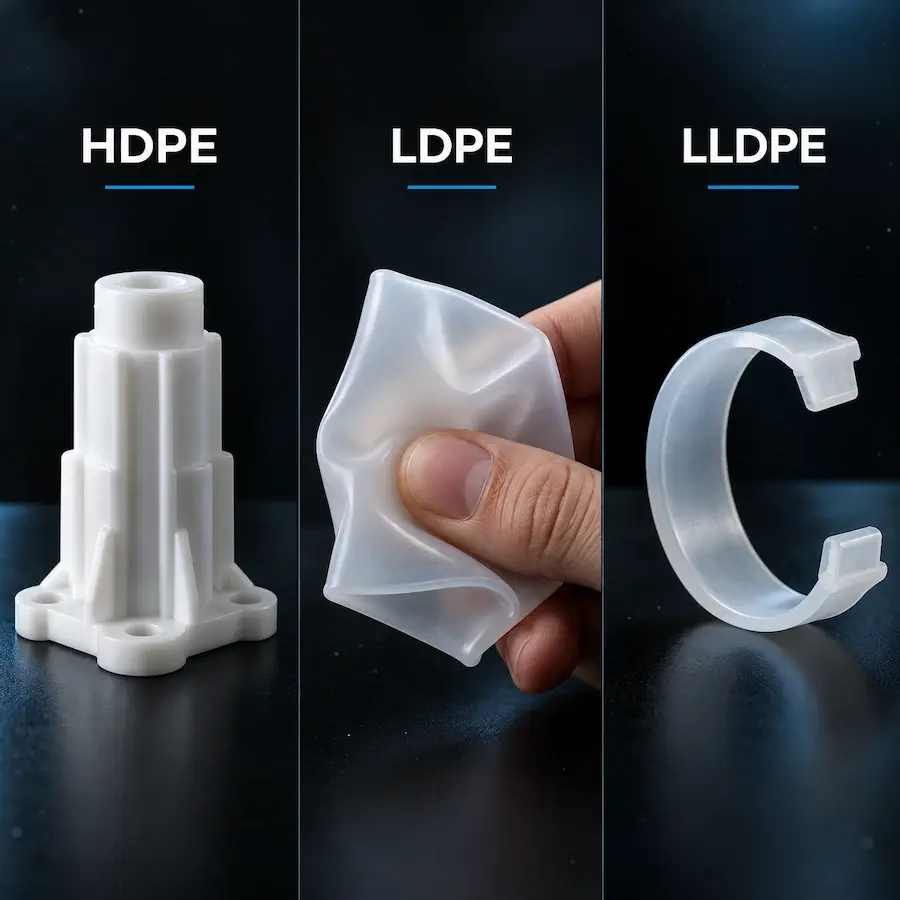
LDPE (Low-Density Polyethylene) has a density ranging from 0.91 to 0.94 g/cm³ and a highly branched chain structure, resulting in low crystallinity. It is flexible, soft, transparent and easy to process.
Characteristics: relatively low mechanical strength, high flexibility, good impact resistance even at low temperatures and excellent processability for film production.
Typical applications: packaging films, bags, flexible containers, cable insulation and toys.
HDPE (high-density polyethylene)
HDPE (High-Density Polyethylene) has a density ranging from 0.94 to 0.97 g/cm³ and only limited chain branching, which promotes a high degree of crystallinity. It is rigid, strong and opaque, offering better structural performance than LDPE.
Characteristics: good mechanical strength, excellent chemical resistance, low permeability, good wear resistance and a broad service-temperature range (−50 to +80 °C).
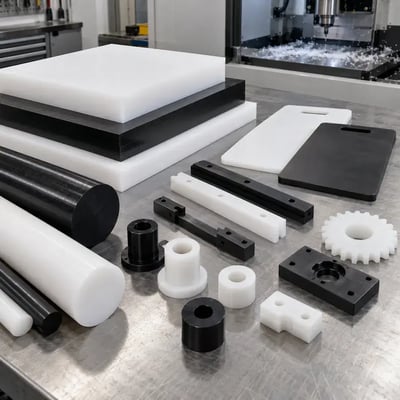
Typical applications: water and gas pipes, tanks, storage vessels, bottles, canisters, crates, pallets, industrial chopping boards, CNC-machined components and containers for food products or chemicals.
LLDPE (linear low-density polyethylene)
LLDPE (Linear Low-Density Polyethylene) has an intermediate molecular structure. Its density is similar to that of LDPE, but it features short, regular branches that improve its mechanical properties. Compared with LDPE, it provides greater puncture and tear resistance.
Applications: high-performance films, stretch films, coatings and components requiring flexibility and toughness.
UHMW PE (ultra-high-molecular-weight polyethylene)
UHMW PE (Ultra-High-Molecular-Weight Polyethylene), also known as PE1000, is characterised by an extremely high molecular weight, typically between 3 and 6 million g/mol, compared with indicative values of between 50,000 and 250,000 g/mol for HDPE. The exceptional length of its molecular chains gives the material particularly high performance characteristics.
Characteristics:
- exceptionally high wear and abrasion resistance, greater than that of many other polymers and, in some applications, even certain metallic materials;
- very low coefficient of friction, promoting smooth sliding and reducing the need for lubrication;
- excellent impact resistance, even at very low temperatures;
- excellent chemical resistance;
- biocompatibility, enabling its use in specific medical applications.
Typical applications: slide rails, wear strips, rollers, gears, bushes, wear-resistant components, hopper and conveyor linings, industrial chopping boards, components for the food-processing industry and joint prostheses.
HMW-PE and PE500
PE500 sits between HDPE and UHMW PE and belongs to the HMW PE (High-Molecular-Weight Polyethylene) family, with an indicative molecular weight of approximately 500,000 g/mol.
It provides a good balance between the machinability of HDPE and the wear resistance of UHMW PE, while generally being less expensive than PE1000.
It is used for mechanical components subject to moderate wear, chopping boards and slide rails where the higher performance of PE1000 is not required.
Comparison of Polyethylene Types
| Type |
Density (g/cm³) |
Tensile strength (MPa) |
Max. service temperature (°C) |
Stiffness |
Wear resistance |
Main application |
| LDPE |
0.91–0.94 |
8–20 |
~60 |
Low |
Low |
Films, flexible packaging |
| LLDPE |
0.91–0.94 |
15–25 |
~65 |
Low–medium |
Medium |
High-performance films |
| HDPE |
0.94–0.97 |
15–35 |
~80 |
Medium–high |
Good |
Pipes, tanks, CNC components |
| PE500 (HMW) |
~0.95 |
20–30 |
~80 |
High |
Very good |
Components for moderate-wear applications |
| UHMW PE (PE1000) |
0.93–0.94 |
20–40 |
~80 |
High |
Exceptional |
Slide rails, wear strips, prostheses, extreme-wear applications |
Indicative values. Source: Weerg technical data sheet.
Properties of polyethylene
Mechanical Properties
In absolute terms, polyethylene does not offer particularly high mechanical strength. Its main advantage lies in its combination of toughness, wear resistance and chemical resistance, together with relatively low cost.
Indicative values for HDPE are:
- tensile strength: 15–35 MPa;
- elastic modulus: 700–1,500 MPa;
- elongation at break: high, from 40% upwards;
- hardness: approximately 60–70 Shore D.
UHMW PE has a tensile strength similar to that of HDPE, but provides significantly better wear and impact resistance due to its very high molecular weight.
Chemical Properties
Chemical resistance is one of polyethylene's main strengths:
- resistant to acids, bases, salts, alcohols, water and numerous chemicals;
- not susceptible to hydrolysis;
- may be attacked by strong oxidising agents and certain aromatic or chlorinated hydrocarbons, particularly at elevated temperatures;
- not inherently UV-resistant without stabilisation; grades intended for outdoor use typically contain carbon black.
Thermal Properties
- melting temperature: 105–135 °C depending on the grade (LDPE ~110 °C, HDPE ~130–135 °C);
- continuous service temperature: up to approximately 80 °C for HDPE;
- minimum service temperature: excellent low-temperature performance, retaining toughness down to −50 °C and below; UHMW PE can be used at cryogenic temperatures;
- HDT: relatively low, approximately 45–80 °C; PE is not a high-temperature material.
Distinctive Properties
- low coefficient of friction, particularly in UHMW PE, which offers good self-lubricating properties;
- low density, making it one of the lightest polymers and allowing it to float on water;
- excellent electrical insulation properties;
- availability of numerous grades suitable for food-contact and medical applications;
- good weldability, for example using heat-fusion techniques in HDPE piping systems.
Polyethylene in CNC Machining
While LDPE and polyethylene films are generally manufactured by extrusion and blow moulding, more rigid grades such as HDPE, PE500 and UHMW PE (PE1000) are available in sheets, rods and blocks and can be machined using conventional material-removal processes.
Why machine polyethylene?
Rigid PE is suitable for CNC-machined mechanical components where the following properties are required:
- wear resistance and low friction, for slide rails, wear strips, bushes and rollers;
- chemical resistance, for components exposed to aggressive substances;
- suitability for food contact, for chopping boards and food-processing machinery components;
- low weight, for components where weight reduction is important;
- electrical insulation;
- good low-temperature performance, for applications in refrigerated or cryogenic environments.
Machining Characteristics
Polyethylene is relatively easy to machine, although certain precautions are required:
- very sharp cutting tools, as its toughness may cause tearing rather than producing a clean cut;
- high cutting speeds and moderate feed rates, to promote a good surface finish;
- effective chip evacuation, as the material tends to form long, continuous swarf;
- careful control of deformation, due to its low elastic modulus and high coefficient of thermal expansion, particularly in thin components or parts with tight tolerances;
- generally wider tolerances than for metals, owing to its lower dimensional stability.
Because of its extremely high molecular weight, UHMW PE can be more difficult to machine to very precise surface finishes, but it provides excellent performance in terms of wear resistance and component service life.
Polyethylene at Weerg
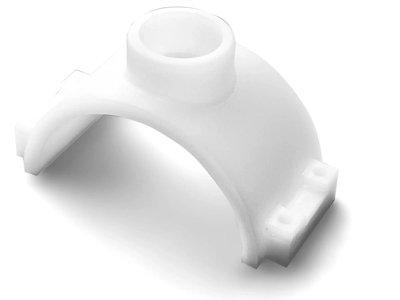
Weerg machines high-density polyethylene (HDPE) on CNC machining centres. HDPE is a widely used material for mechanical components requiring chemical resistance, low friction, food-contact suitability and low weight, while also being among the most cost-effective machinable engineering polymers.
The main specifications for CNC machining of HDPE at Weerg are:
- tolerances: ISO 2768-1, medium tolerance class (m), compatible with the dimensional stability typically associated with polyethylene;
- maximum machinable dimensions: 500 × 500 × 90 mm;
- production lead time: less than 4 working days;
- instant quotation: upload the 3D file to the online configurator for automatic calculation of price and lead time.
CNC-machined HDPE at Weerg is suitable for chopping boards and food-industry components, slide rails and wear strips, wear-resistant bushes, components in contact with chemicals, tanks and technical containers, insulators and, more generally, applications where chemical resistance, low friction and food-contact suitability provide an advantage.
For applications requiring the high wear resistance of UHMW PE (PE1000) or other engineering polymers, Weerg's technical team can assess the most suitable alternative from the materials available in the catalogue.
Comparison between polyethylene and other engineering polymers
How does polyethylene compare with other engineering polymers used for mechanical components?
-
PE vs POM (Delrin): POM provides greater stiffness, dimensional stability and machining accuracy. PE, particularly UHMW grades, offers better resistance to wear, impact and chemicals, generally at a lower cost.
For gears and precision components → POM
For wear-resistant slide components and parts exposed to chemicals → PE
-
PE vs PA (Nylon): Nylon provides higher mechanical strength and a higher service temperature. PE, however, offers better chemical resistance, virtually zero water absorption and a lower coefficient of friction.
For structural components → PA
For wet or chemically aggressive environments → PE
-
PE vs PTFE: PTFE has an even lower coefficient of friction and offers superior chemical and thermal resistance. UHMW PE, on the other hand, provides significantly greater wear and impact resistance at a lower cost.
For seals and high-temperature applications → PTFE
For wear- and impact-resistant applications → UHMW PE
Conclusion
Polyethylene demonstrates how a simple chemical structure can give rise to an extremely versatile family of materials: from flexible LDPE films and HDPE pipes and tanks to wear-resistant UHMW PE components.
Selecting the correct grade according to density and molecular weight allows the material to be matched to requirements for flexibility, stiffness, wear resistance, food contact and chemical resistance.
For CNC-machined mechanical components, HDPE, PE500 and UHMW PE offer a highly advantageous combination of wear resistance, low friction, chemical resistance and availability of food-contact-compliant grades, while remaining cost-competitive with many other engineering polymers.
Do you need to manufacture components in polyethylene or other plastics?
Upload your file and get a quote
Frequently asked questions about polyethylene

 Weerg staff: Oct 7, 2026