Metrology is the science of measurement and represents one of the fundamental pillars of modern industry. Without precise and reliable measurements, it would be impossible to guarantee product quality, compliance with tolerances, and the repeatability of manufacturing processes.
In particular, metrology applied to manufacturing enables companies to control and verify the dimensions, geometry and properties of components throughout the entire production cycle.
What is metrology
Metrology is the scientific discipline concerned with defining, developing and applying accurate and reliable measurement methods.
Its objective is to ensure that measurements are:
- accurate
- repeatable
- traceable to international standards
In an industrial context, metrology ensures that every manufactured component complies with the dimensional and functional specifications defined by the design.
UPLOAD YOUR FILE AND GET YOUR PARTS ACCREDIA-CERTIFIED
Types of metrology
Metrology is generally divided into three main categories.
Scientific metrology
This branch deals with the development of measurement systems and fundamental units (such as the metre, the second or the kilogram).
It forms the basis of international measurement standards.
Industrial metrology
This is the most important branch for manufacturing.
It focuses on the measurement and inspection of components during production processes.
Its purpose is to ensure that products meet:
- dimensional tolerances
- surface quality requirements
- design specifications
Legal metrology
This concerns measurements used in regulated contexts such as trade, healthcare or safety.
Examples include:
- commercial weighing scales
- certified measuring instruments
- medical devices.
What metrology means in manufacturing
Metrology in manufacturing involves the use of measurement tools and techniques to verify that produced components comply with design specifications.
During the production process, metrology makes it possible to:
- check component dimensions
- verify geometric tolerances
- identify machining defects
- ensure the quality of the final product
- improve the efficiency of the manufacturing process.
In practice, metrology is what makes it possible to move from a simple manufactured part to a certified and compliant component.
Why metrology is essential in industry
In the context of modern manufacturing, metrology is essential for:
-
Ensuring quality: It allows verification that each component complies with specifications.
-
Reducing waste: Identifying errors early helps prevent scrap and rework.
-
Improving productivity: Accurate inspection enables process optimisation.
Tools used in industrial metrology
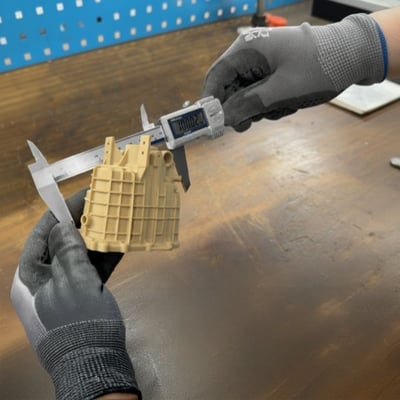
Various instruments are used to perform precise measurements.
Manual instruments
- callipers
- micrometers
- dial indicators
These are used for quick checks and basic dimensional verification.
Coordinate measuring machines (CMM)
Coordinate measuring machines allow extremely precise analysis of a component’s geometry.
They are used for:
- complex dimensional inspections
- verification of geometric tolerances
- reverse engineering.
3D scanners
3D scanners make it possible to rapidly digitise the geometry of an object and compare it with the CAD model.
They are widely used in:
- quality control
- reverse engineering
- prototyping.
Microscopes and optical instruments
Used for high-precision analysis of surfaces and microstructures.
Metrology and advanced manufacturing
With the rise of digital manufacturing, metrology has become even more important.
Technologies such as:
require increasingly precise measurement systems to ensure component compliance.
In this context, we often speak of digital metrology, which integrates measurement instruments with advanced analysis software.
Metrology and measurement certificates with Weerg
In industrial production, metrology is not only used to inspect components during machining but also to accurately certify the dimensional compliance of the finished part. For this reason, Weerg provides a measurement certificate, a document that allows precise verification of dimensions and tolerances of machined parts.
The certificate is issued using Accredia-certified measuring machines, ensuring:
- high dimensional accuracy
- measurement traceability
- reliability and repeatability of results
- compliance with the project’s technical specifications
This service is particularly useful for:
- critical or structural components
- parts with tight tolerances
- complex or high-precision projects
- quality control and dimensional validation of components
In this way, metrology becomes an integral part of the manufacturing process and represents a concrete guarantee of precision and quality for the end customer.

Conclusions
Metrology is a fundamental discipline for ensuring precision, quality and reliability in industrial manufacturing.
Thanks to increasingly advanced measurement tools and their integration with digital systems, metrology continues to play a key role in the development of modern manufacturing.
Without metrology, it would not be possible to produce complex components with the tolerances required by contemporary industry.
GET A FREE QUOTE AND USE CERTIFIED PARTS
FAQ

 Weerg staff: Oct 14, 2026