The melting point is one of the most consulted properties in the choice of a material, but also one of the most misunderstood. It's often confused with the maximum operating temperature or with softening. Furthermore, different parameters are sometimes compared, such as the melting point of metals and the HDT of polymers, as if they were equivalent.
Understanding this quantity helps to choose the correct material, predict its behaviour during machining and design more reliably. In this guide we'll see what the melting point is, how it's measured and what the values of the main industrial materials are.
What Is the Melting Point
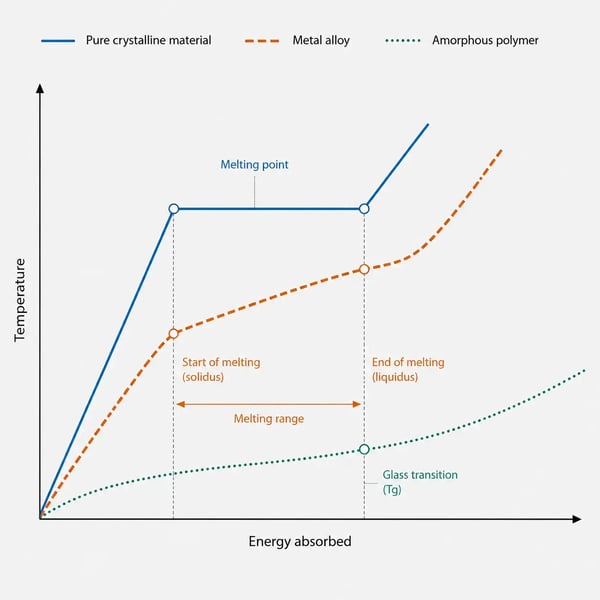
The melting point (abbreviated Tm or mp) is the temperature at which a material passes from the solid state to the liquid state, at a given pressure. During the process it absorbs energy in the form of latent heat and, in pure substances, the temperature remains almost constant until the melting is complete.
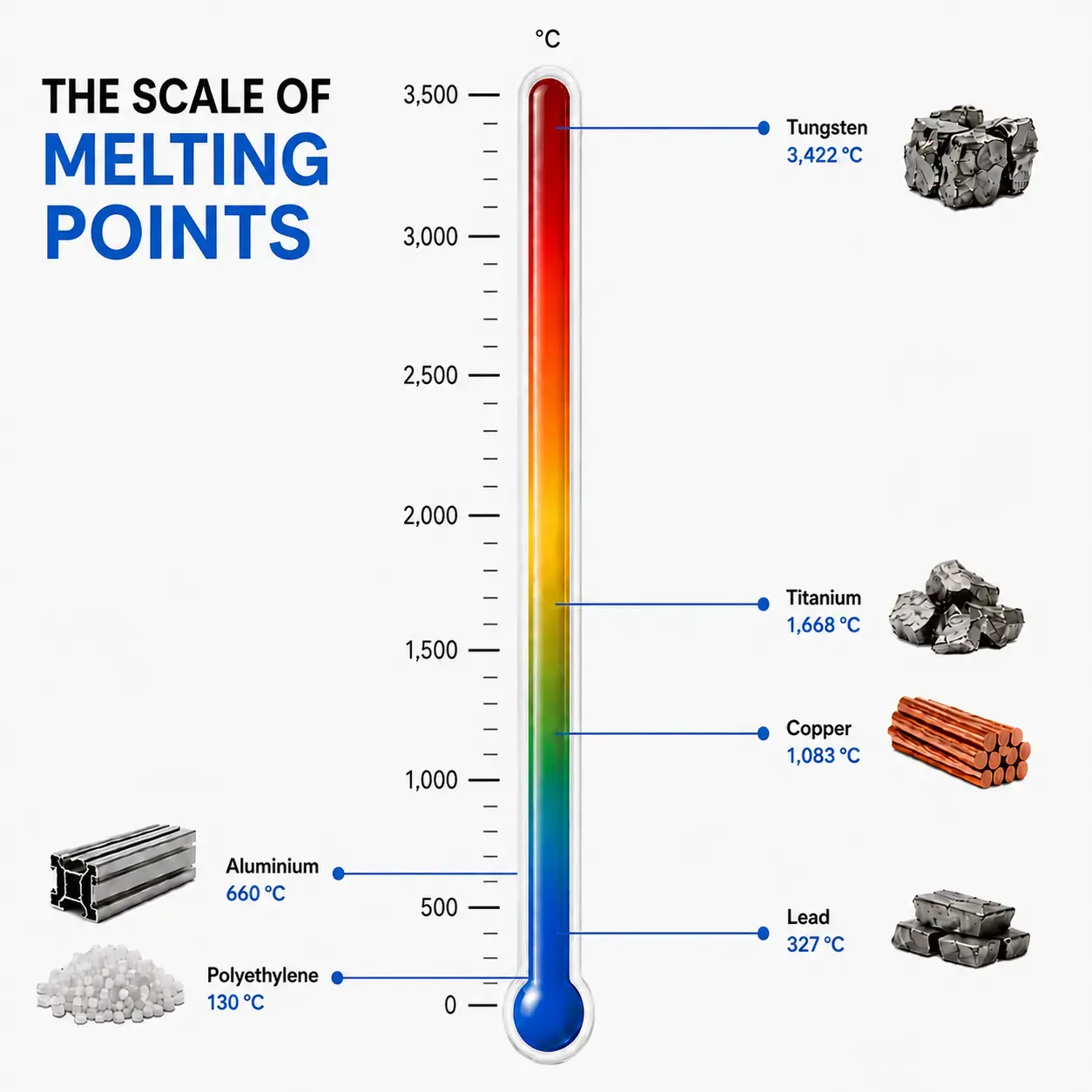
In pure crystalline materials, such as metals, ice and salts, this value is precise and reproducible. Water melts at 0 °C, pure aluminium at about 660.3 °C and pure iron at about 1,538 °C, at standard atmospheric pressure.
In metal alloys, on the other hand, the transition generally takes place in a range between the solidus, which indicates its beginning, and the liquidus, beyond which the material is completely liquid. A carbon steel, for example, can begin to melt around 1,425 °C and complete the process towards 1,530 °C, depending on the composition.
For polymers, the distinction is more marked:
- semi-crystalline polymers have a defined melting point, corresponding to the melting of the crystalline phase;
- amorphous polymers don't have a true melting point: as the temperature increases, they soften progressively and pass through the glass transition temperature (Tg).
How to Measure the Melting Point
The measurement methods vary according to the type of material.
Metals and alloys
For metals, the melting temperature can be determined through thermalanalysis (heating and cooling curves) or with differential scanning calorimetry (DSC). This technique measures the heat flow absorbed by the sample and detects the endothermic peak associated with melting.
In alloys, which generally melt in a range, DSC makes it possible to identify the solidus temperature (beginning of melting) and the liquidus one (complete melting). These values are particularly important in foundry, welding and heat treatment processes.
Polymers
For semi-crystalline polymers, DSC is commonly used, according to ISO 11357 or ASTM D3418. The sample is heated at a controlled rate (typically 10 °C/min) and the endothermic peak produced by the melting of the crystalline phase is recorded. The temperature at the top of the peak is generally indicated as Tm.
To assess the behaviour of polymers at high temperatures, other parameters are also considered:
- HDT (Heat Deflection Temperature), according to ISO 75 or ASTM D648: it indicates the temperature at which a specimen reaches a predefined deformation under load. It's commonly measured at 0.45 MPa or 1.8 MPa and provides an indication of the material's ability to maintain rigidity under certain conditions.
- Vicat temperature, according to ISO 306: it corresponds to the temperature at which a standardised indenter sinks 1 mm into the specimen subjected to a given load.
- Tg (glass transition temperature): it identifies the range in which the amorphous phase passes from a rigid, glassy state to a softer, more mobile one.
Melting point and operating temperature: they aren't the same thing
Confusing these two values is one of the most common and potentially most costly mistakes. The melting point indicates the temperature at which the material passes to the liquid state, while the maximum operating temperature is the limit within which a component can function while maintaining adequate performance and reliability. The latter is therefore always much lower.
For metals, the operating temperature is limited by creep (progressive deformation under load over time) and by oxidation, which manifest at temperatures lower than that of melting. A carbon steel melts at ~1,500 °C but loses structural strength before 500 °C.
For polymers, the reference figure is the HDT, not the melting point. A PEEK can have a Tm of about 343 °C, but an HDT at 1.8 MPa of about 152 °C in the case of a component printed in FDM and annealed. Similarly, a PA12 can have a Tm of about 187 °C and an HDT at 1.8 MPa close to 95 °C.
The rule of thumb for the designer is simple: never dimension a component on the basis of the melting point alone. Always use the HDT (for polymers) or the hot-strength data (for metals) to define the maximum operating temperature.
Melting Point values for the main industrial materials
Metals and alloys
| Material |
Melting point (°C) |
Notes |
| Tin (Sn) |
232 |
Base for solder alloys |
| Lead (Pb) |
327 |
Solder alloys (being phased out under RoHS) |
| Zinc (Zn) |
420 |
Galvanic coatings, die casting |
| Magnesium (Mg) |
650 |
Ultra-light alloys |
| Pure aluminium |
660 |
- |
| Aluminium alloys (6082, 7075) |
555-650 |
Solidus-liquidus range |
| Brass (CuZn37) |
900-920 |
Range |
| Pure copper (Cu) |
1,083 |
- |
| Bronze (CuSn8) |
880-1,000 |
Range |
| Carbon steels |
1,425-1,530 |
Solidus-liquidus range |
| Austenitic stainless steels (304, 316) |
1,400-1,450 |
- |
| Grey cast iron |
1,140-1,200 |
Range |
| Pure titanium (Gr2) |
1,668 |
- |
| Titanium Gr5 (Ti6Al4V) |
1,604-1,660 |
Range |
| Pure iron |
1,538 |
Reference |
| Nickel (Ni) |
1,455 |
Superalloys |
| Tungsten (W) |
3,422 |
Highest melting point among metals |
Polymers (semi-crystalline)
| Polymer |
Melting point Tm (°C) |
HDT 1.8 MPa (°C) |
| HDPE (high-density polyethylene) |
130-135 |
75 |
| PP (polypropylene) |
160-170 |
55-65 |
| PA12 nylon (MJF) |
187 |
95 |
| PA6 nylon |
220 |
55-80 |
| PA66 nylon |
260 |
70-100 |
| POM (polyacetal) |
175 |
110 |
| PBT |
225 |
60 |
| PEEK (annealed) |
343 |
152 |
| PEEK CF |
343 |
315 (0.45 MPa) |
| PPS |
280-290 |
260 |
Amorphous polymers (without a defined melting point)
| Polymer |
Tg (°C) |
Vicat (°C) |
| ABS |
105 |
95-110 |
| Medical ABS |
- |
104 |
| PC (polycarbonate) |
147 |
145-150 |
| PMMA (plexiglass) |
105 |
95-100 |
| PS (polystyrene) |
95 |
85-95 |
| ULTEM (PEI) |
217 |
210-215 |
For amorphous polymers there's no melting point: the Tg and the Vicat are the references for thermal stability.
The melting point in production processes
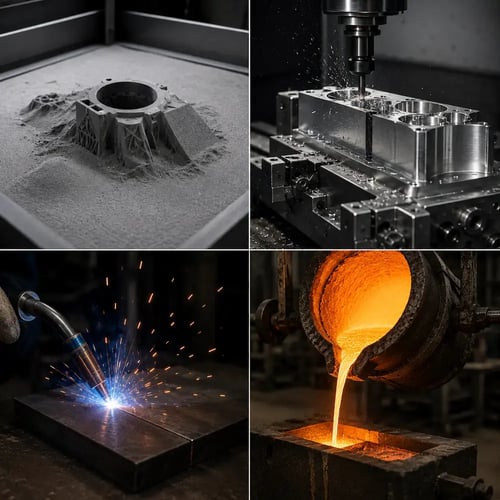
The melting point is a fundamental parameter not only in the choice of the material, but also in the definition of the processes by which it's transformed.
In 3D printing
In additive processes, the melting and softening temperatures contribute to defining the operating conditions:
- In MJF, the PA12 powder is preheated to a temperature close to melting (about 175 °C). The agents deposited on the powder bed then favour the absorption of energy and the selective melting of the areas to be consolidated.
- In FDM, the filament is extruded at temperatures above the Tm. The chamber must be thermally controlled to limit the gradients that can cause warping and delamination.
- In SLM/DMLS (metal 3D printing), the laser locally generates a melt pool in the powder, which solidifies rapidly, forming the component layer after layer.
In CNC machining
In chip-removal machining, the temperature in the contact zone between tool and part must be kept under control. Excessive heating can cause softening, metallurgical alterations or degradation of the material.
The phenomenon is particularly critical in polymers, which generally have a low thermal conductivity. The heat therefore tends to concentrate near the cutting edge, causing local melting, adhesion of the chip to the tool and a worsening of the surface finish.
In welding
The melting temperatures of the base material and the filler material influence the choice of welding parameters, including current, speed, shielding gas and preheating. An austenitic stainless steel (Tm ~1,450 °C) requires different parameters from an aluminium (Tm ~600 °C) and a titanium (Tm ~1,650 °C).
In casting and foundry work
In foundry work, the most relevant parameter is the liquidus temperature, to which an adequate superheating is added to guarantee the fluidity of the metal during pouring. These values contribute to determining the characteristics of the furnace, the ladle and the entire process.
Conclusion
The melting point is a fundamental property for understanding how a material is transformed, but it doesn't coincide with its maximum operating temperature. In pure metals it corresponds to a defined value, while in alloys melting generally takes place in a range between solidus and liquidus. In semi-crystalline polymers it's associated with the melting of the crystalline phase, while in amorphous polymers there's no true melting point.
To dimension a component correctly, it's therefore necessary to consider the HDT, the Tg, the Vicat temperature, the hot mechanical properties and the actual conditions of use.
Knowing the difference between these parameters makes it possible to choose the most suitable material, prevent design errors and engage with suppliers and laboratories more precisely.
Do you need to produce components with certified thermal properties?
Upload your file and get a quote
Frequently Asked Questions About Melting Point

 Weerg staff: Sep 30, 2026