The coefficient of friction (μ) measures the resistance to sliding between two surfaces in contact. It is a key parameter in mechanical design because it affects wear, energy efficiency, accuracy, noise and component lifetime, both in industrial 3D printing and in CNC machining.
Understanding and controlling friction means reducing costs, increasing reliability and improving performance.
How the coefficient of friction is calculated
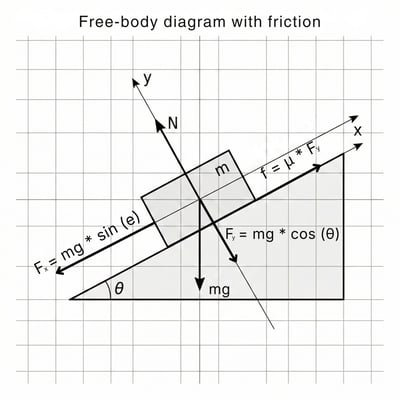
The coefficient of friction is a dimensionless value defined by the formula:
μ = Fₐ / Fₙ
Fₐ = friction force
Fₙ = normal force
Types of friction
-
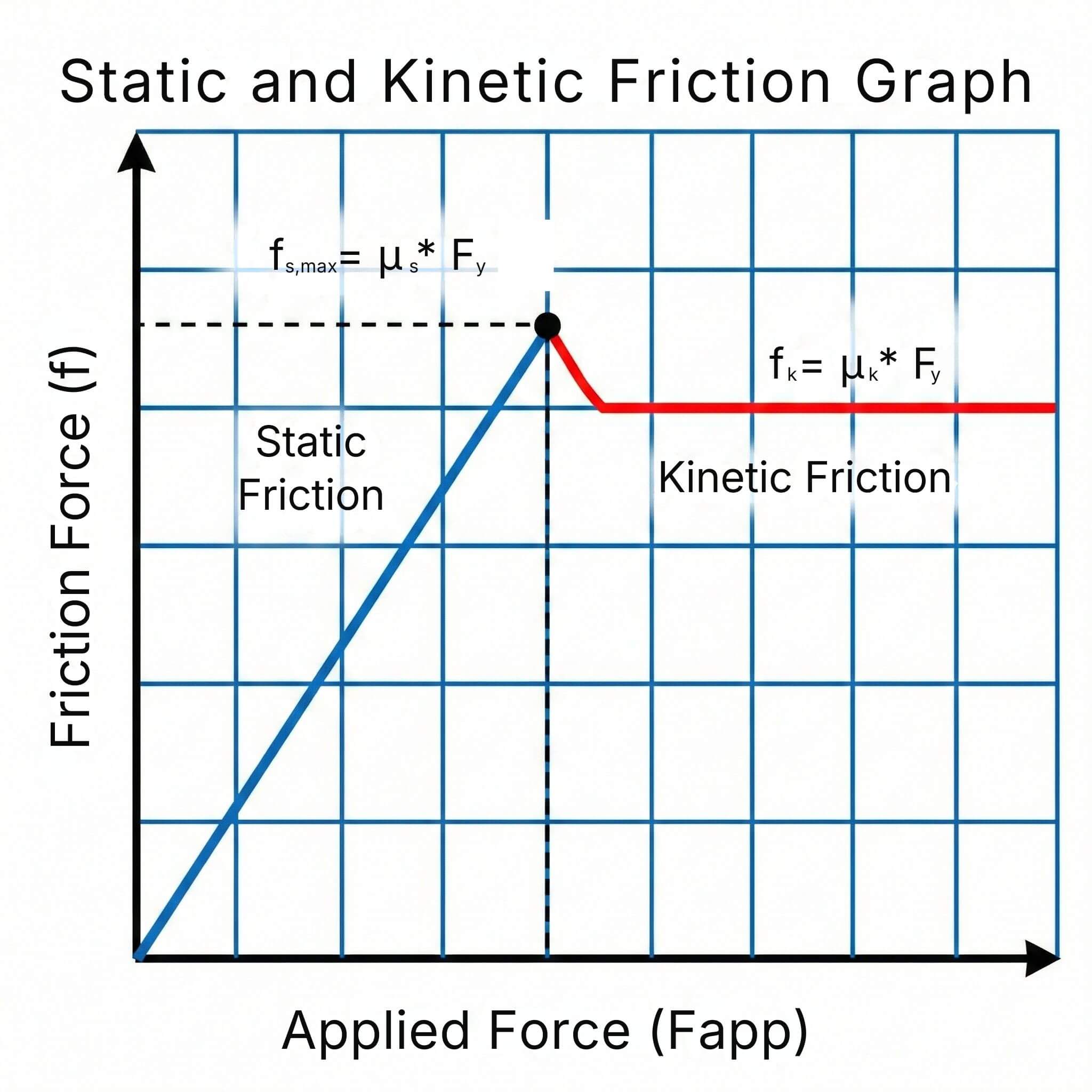
Static friction (μₛ): prevents the start of motion
-
Kinetic (dynamic) friction (μₖ): acts during sliding
-
Rolling friction: typical of wheels and bearings, much lower
Typical COEFFICIENT OF FRICTION VALUES (COMMON MATERIALS)
- Steel on steel (dry): 0.5 – 0.8
- PA12 on steel: 0.2 – 0.3
- PA11 on steel: 0.25 – 0.35
- TPU on metal: 0.3 – 0.6
- PTFE on steel: 0.04 – 0.1
Values vary depending on surface roughness, load, lubrication and temperature.
Coefficient of friction and 3D printing
In industrial 3D printing, friction also depends on the technology used:
-
MJF / SLS: uniform and isotropic friction
-
FDM: higher and directional friction
-
SLA: smooth surfaces but more brittle materials
For moving components, PA12 and PA11 produced with MJF offer the best balance between low friction and wear resistance.
How to reduce (or increase) friction
Reducing friction
-
Selection of low-μ materials (PA12, PA11, POM)
-
Improved surface finish
-
Lubrication or PTFE coating
-
Design that reduces contact pressure
Increasing friction
Why it MATTERS AT THE DESIGN STAGE
The coefficient of friction directly affects:
-
Energy efficiency
-
Wear and service life
-
Mechanical accuracy
-
Safety and grip
-
Operating costs
Correct material and manufacturing process selection prevents over-engineering and long-term issues.
Conclusion
The coefficient of friction is a key parameter in the design of CNC components and 3D-printed parts. Materials such as PA12, PA11 and TPU allow controlled friction, high wear resistance and geometric freedom, making them ideal for modern industrial applications.
Do you need components with optimised friction?
Weerg supports you in choosing the most suitable material and process, with instant quotation and certified industrial production
COEFFICIENT OF FRICTION FAQ

 Weerg staff: Aug 26, 2026