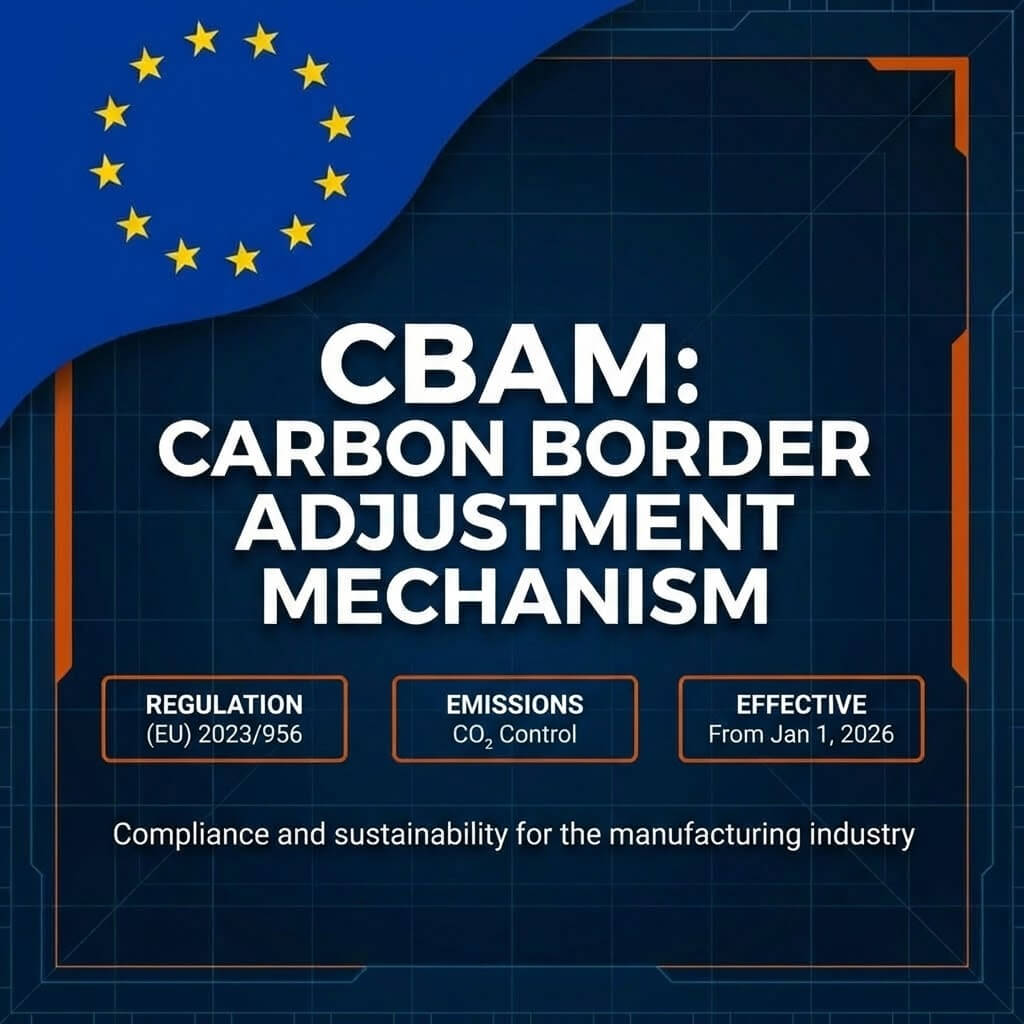
The CBAM regulation (Carbon Border Adjustment Mechanism) represents one of the key pillars of the European strategy for industrial decarbonisation and for protecting the competitiveness of companies that produce sustainably within the European Union.
Introduced by the European Union, CBAM has a direct impact on energy-intensive industrial value chains and on companies importing materials and semi-finished products from non-EU countries.
In this article we look at:
What is the CBAM regulation
CBAM is a carbon border adjustment mechanism whose objectives are to:
-
reduce global CO₂ emissions,
-
prevent carbon leakage (relocation of production to countries with less stringent environmental rules),
-
ensure fair competition between EU and non-EU producers.
In practice, CBAM introduces a carbon cost on imports of certain high-emission goods, aligning it with the cost already borne by European producers through the ETS (Emissions Trading System).
Which sectors are affected by CBAM
In its initial phase, the CBAM regulation applies to industrial sectors considered carbon-intensive, including:
-
steel and cast iron
-
aluminium
-
cement
-
fertilisers
-
hydrogen
-
electricity
These materials form the basis of many manufacturing value chains, including mechanical engineering, component manufacturing and contract production.
How the CBAM mechanism works
The CBAM mechanism is based on three key elements:
1) Calculation of embedded emissions
For each imported good, the amount of CO₂ emitted during production in the country of origin is estimated.
2) Mandatory declaration
Importers must periodically declare the embedded emissions of the imported goods.
3) Purchase of CBAM certificates
If emissions have not already been compensated in the country of origin, the importer must purchase CBAM certificates, whose value is linked to the price of CO₂ in the European ETS market.
CBAM REGULATORY TIMELINE
The regulation is being introduced progressively:
Transitional phase (2023–2025)
Operational phase (from 2026)
This makes 2026 a key year for compliance (data collection, systems, processes), even though the first financial outlay/certificate management begins in 2027.
What changes for manufacturing companies
CBAM does not only affect direct importers, but has an impact on the entire value chain:
-
increased attention to the origin of materials
-
demand for transparency in environmental data
-
preference for European or compliant suppliers
-
push towards more sustainable and traceable supply chains
For many companies, choosing production partners that are already compliant becomes a tangible competitive advantage.
Why Weerg IS COMPLIANT WITH THE CBAM REGULATION
Weerg operates according to a fully European production model, with facilities, processes and controls aligned with EU environmental regulations.
KEY ELEMENTS OF WEERG COMPLIANCE:
- Production located in Europe
→ no direct exposure to CBAM-critical imports
- Traceable and digitalised industrial processes
→ clear monitoring of materials, processes and energy
- Advanced manufacturing technologies
- industrial 3D printing (MJF, SLS, SLA)
-
- high-efficiency CNC machining
→ optimisation of consumption and reduction of waste
- Transparent supply chain
→ selection of materials compliant with EU standards
This allows Weerg to offer CBAM-compliant components, with no regulatory risk for customers.
Why CBAM compliance is a benefit to Weerg's customers
Choosing a CBAM-compliant manufacturing partner means:
-
avoiding bureaucratic complexity
-
reducing the risk of unforeseen costs related to certificates
-
ensuring continuity of supply
-
aligning with ESG and sustainability policies
-
protecting long-term competitiveness
In a context where sustainability is increasingly a market requirement, regulatory compliance becomes an integral part of service quality.
CBAM and digital manufacturing: a clear direction
The CBAM regulation accelerates a transformation already under way:
Digital manufacturing, the model on which Weerg is based, is naturally aligned with these objectives.
Conclusions
The CBAM regulation marks a fundamental step towards a more sustainable, transparent and competitive European industry.
From 2026, compliance will no longer be an option, but a necessary condition for operating without risk.
Weerg is already CBAM-compliant thanks to:
- European production
- efficient processes
- traceability
- focus on sustainability
Want CBAM-compliant components without the hassle?
UPLOAD YOUR FILE NOW AND RELY ON A PARTNER ALREADY ALIGNED WITH EUROPEAN RULES
CBAM regulation FAQ

 Weerg staff: Oct 14, 2026