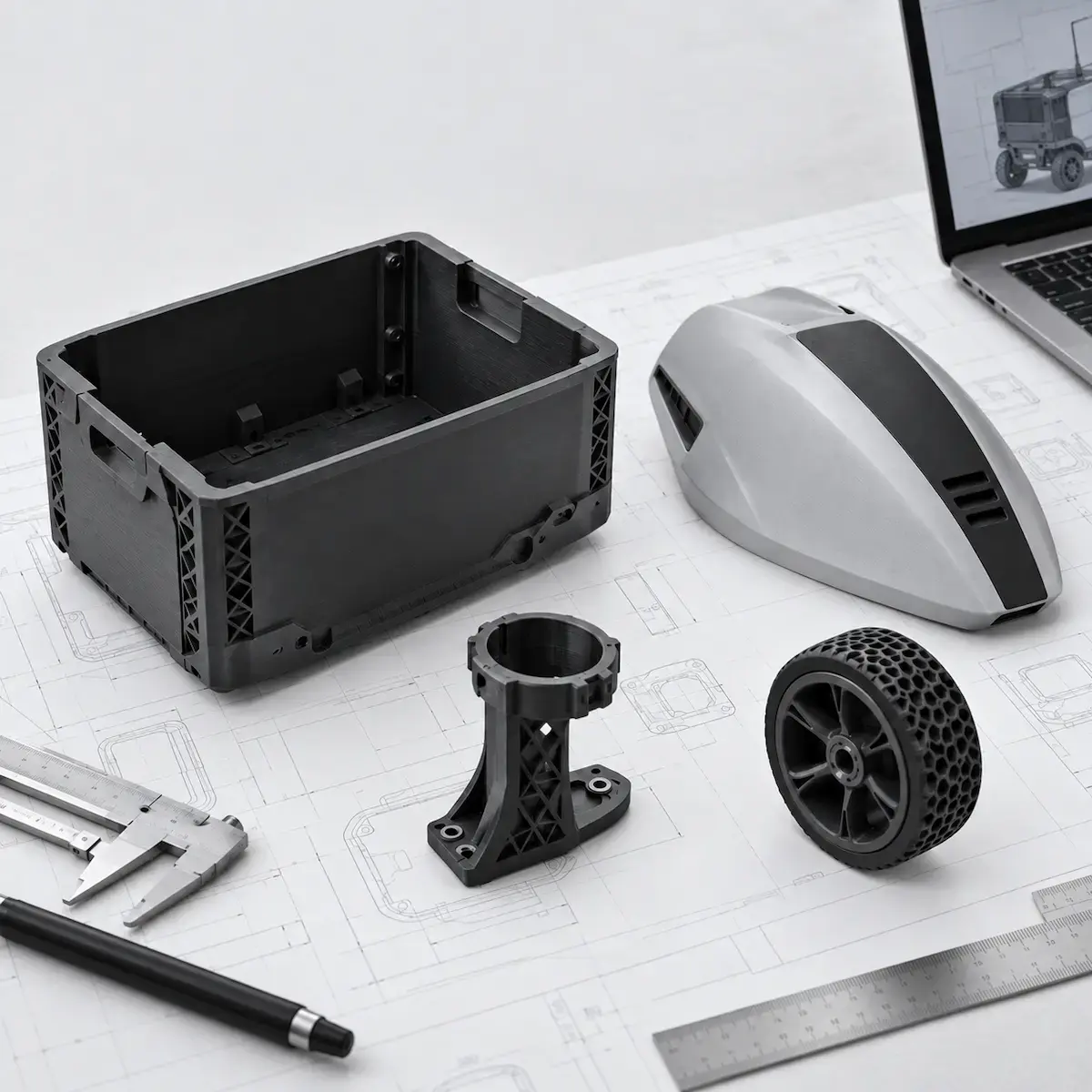
In recent years, 3D printing has made tremendous progress, evolving from an experimental technology into a strategic tool in fields such as medicine, automotive, industrial design and mechanical manufacturing.
One of the most surprising sectors in which it is emerging is sport itself.
Among the most talked-about innovations is the 3D-printed basketball, a revolutionary solution that could forever transform the design, production and use of sports equipment.
What Is a 3D-Printed Basketball?
“Airless” Basketballs: How They Work
How a 3D-Printed Basketball Is Made
The Role of TPU in 3D-Printed Basketballs
Advantages of 3D Printing for Basketballs
The Market for 3D-Printed Basketballs
What Is a 3D-Printed Basketball?
A 3D-printed basketball is a ball manufactured using additive technologies that deposit or sinter successive layers of plastic or elastomeric material.
The creation process starts from a digital CAD model, allowing millimetric precision and unprecedented customisation.
Each ball can be optimised in terms of:
The result is a unique product, tailor-made to meet the needs of an athlete or team.
“Airless” Basketballs: How They Work
These balls are often referred to as 3D-printed airless basketballs, meaning balls that contain no air.
Unlike a traditional basketball, they do not require any internal air chamber.
Their distinctive feature is the internal lattice structure, designed using generative design algorithms, which ensures:
The ball therefore does not need to be inflated: its resilience comes directly from the geometry of the lattice and the properties of the material.
This makes it a practical and durable solution, particularly useful in outdoor environments where traditional balls often suffer damage and lose pressure.
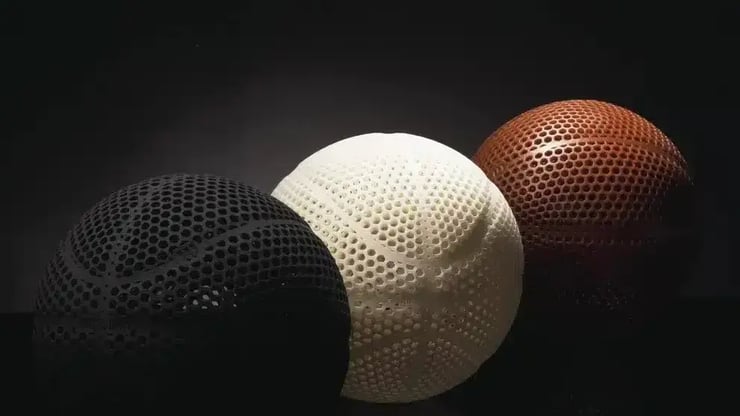
Image by Wired
How a 3D-Printed Basketball Is Made
The production of a 3D-printed basketball follows a highly technological process:
1. Digital Design
It begins with CAD modelling. Engineers define:
-
the internal lattice structure
-
variable geometries to adjust hardness and bounce
-
the surface texture for grip
2. Material Selection
Not all materials are suitable. They must offer:
-
elasticity
-
strength
-
shape memory
-
durability
For this reason, the best choice is almost always an elastomeric polymer such as TPU.
3. Layer-by-Layer 3D Printing
The ball is produced with technologies such as:
The process may take from a few hours to several days depending on complexity.
4. Quality Control
The ball is tested to verify:
-
bounce
-
flexibility
-
strength
-
uniformity of shape
Only after passing all standards is it considered complete.
The Role of TPU in 3D-Printed Basketballs
TPU (thermoplastic polyurethane) is the key material that has enabled these solutions to evolve from conceptual prototypes into fully functional products.
Why is TPU ideal?
TPU remains stable even after hundreds of deformations—an essential characteristic for a ball that must be repeatedly compressed and released.
Companies such as Weerg use high-quality TPU through MJF to create elastic, robust and reliable parts—perfect even for sports items such as airless basketballs.
Advantages of 3D Printing for Basketballs
- Total customisation
Shape, weight, internal density, grip—everything can be customised.
- Zero maintenance
No inflation required: the ball retains its shape throughout its lifespan.
- Superior durability
Resistant to punctures, impacts and abrasion.
- Sustainability
3D printing uses only the material required, reducing waste and environmental impact.
- Controlled performance
The lattice structure makes it possible to fine-tune bounce, elasticity and dynamic behaviour better than traditional foams.
- Rapid prototyping
Companies can test dozens of variants in days without expensive moulds.
The Market for 3D-Printed Basketballs
For now, these balls remain a niche product, used mainly for:
But the market is growing rapidly.
With advances in additive technologies and falling production costs, airless basketballs are likely to become mainstream—especially in outdoor and semi-professional settings.
Global sports brands are investing in research and development to bring these solutions to players worldwide.
Conclusions
3D-printed basketballs represent just the beginning of a broader shift: the entry of additive manufacturing into the world of sport.
They eliminate the air chamber, improve grip, ensure consistent performance and open the door to a level of customisation never seen before.
Leading this change is Weerg, which—thanks to advanced technologies and elastomeric materials such as TPU—can produce innovative, durable and fully customisable sports components.
Create your TPU components now

 Weerg staff: Sep 30, 2026