Yield strength is one of the most important mechanical properties of materials, especially in engineering, structural design, CNC machining and 3D printing.
It defines the limit beyond which a material begins to deform permanently. Knowing it is essential for designing safe, reliable and durable components.
WHAT IS YIELD STRENGTH?
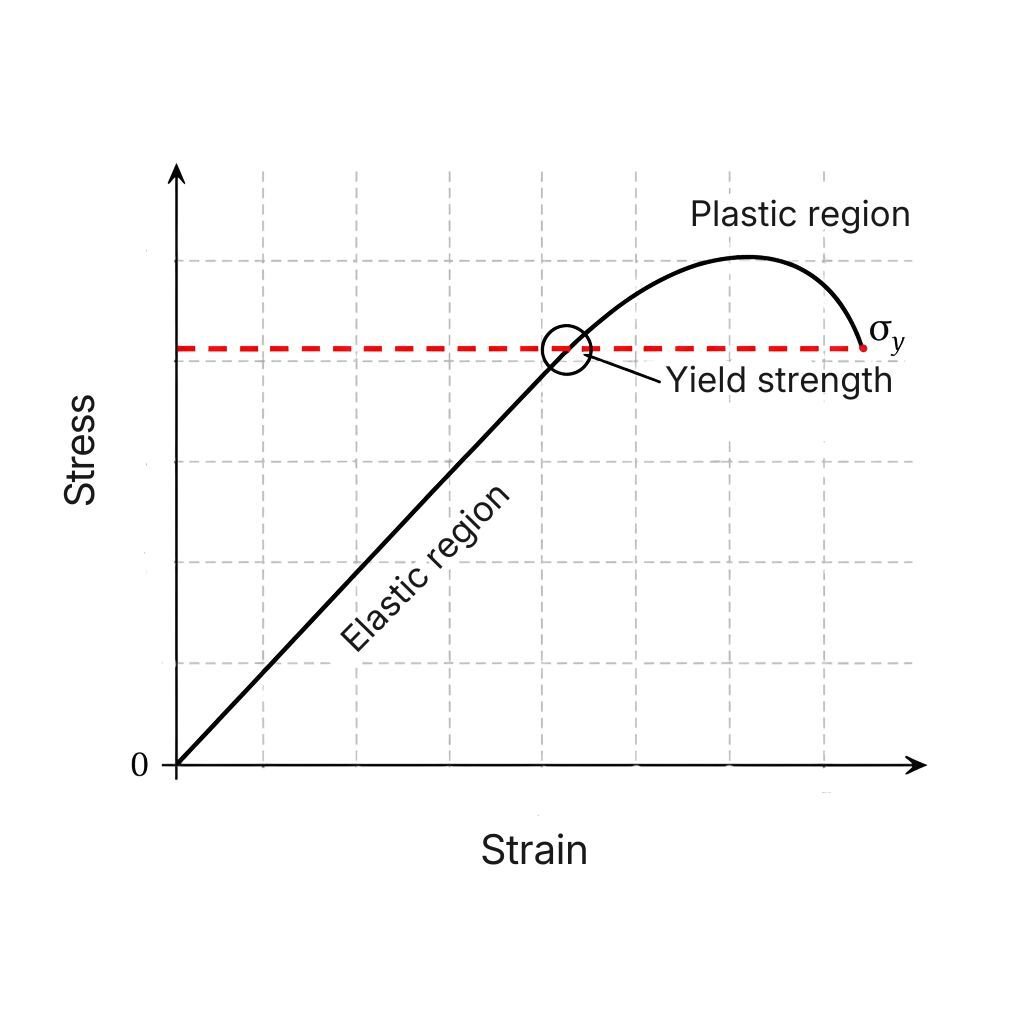
Yield strength (σᵧ) is the stress value at which a material transitions from elastic (reversible) deformation to plastic (irreversible) deformation.
In practice, it represents the safe operating limit for most structural components.
How is yield STRENGTH calculated?
1) Basic formula.
Yield strength is calculated as:
σᵧ = Fᵧ / A
Where:
- σᵧ = yield strength (Pa, MPa)
- Fᵧ = force at yielding (N)
- A = load-bearing cross-sectional area (mm² or m²)
2) Experimental method (tensile test)
In practice, yield strength is measured through a tensile test:
- The specimen is subjected to an increasing load
- The stress–strain curve is recorded
- The point where the curve ceases to be linear indicates yielding
3) 0.2% OFFSET method
For materials that do not show a clear yield point (such as many aluminium alloys), the 0.2% offset method is used. It identifies the stress corresponding to a permanent plastic strain of 0.2%.
- A line parallel to the elastic region is drawn
- With a strain offset of 0.2%
- Its intersection with the curve defines σᵧ (0.2%)
This is the most widely used method in industry.
UPLOAD YOUR FILE AND SPEAK WITH AN EXPERT
Units of measurement
Yield strength is expressed in:
- MPa (megapascal) → industrial standard
- GPa → very high-strength materials
- psi → imperial/Anglo-Saxon systems
Why is yield stress so important?
Yield strength is a key parameter because it:
- defines the maximum allowable service load
- prevents permanent deformation (bending, elongation)
- guides material selection based on application
- reduces the risk of failure and maintenance costs
- is the reference value for safety factors in structural calculations
In most designs, engineers work well below the ultimate strength, using yield strength as the main reference.
Comparison: yield STRENGTH VS tensile STRENGTH
It is important not to confuse these two values:
A material can:
- yield early but elongate significantly (ductile material)
- yield late but fracture suddenly (brittle material)
TYPICAL YIELD STRENGTH VALUES
Values depend on heat treatment, manufacturing process and material orientation.
Yield STRENGTH in 3D printing
In 3D printing, yield strength also depends on:
- technology (FDM, MJF, SLA)
- print orientation
- infill percentage
- post-processing
- material anisotropy
Examples:
- FDM → anisotropic behaviour, weaker along the Z axis
- MJF/SLS → more uniform behaviour
- SLA → higher values but increased brittleness
It is essential to consider both the material and the manufacturing process, not just theoretical data.
Yield STRENGTH AND SAFETY FACTOR
In design, the following is often used:
σₐₘₘ = σᵧ / FS
Where:
- σₐₘₘₘ = allowable stress
- FS = safety factor (1.5-3 or more).
This ensures the component always operates within the elastic range.
Common mistakes to avoid
- Confusing yielding with fracture
- Using theoretical values without considering manufacturing processes
- Ignoring anisotropy (especially in 3D printing)
- Neglecting temperature and operating environment
- Failing to apply an adequate safety factor
Conclusions
Yield strength is the key parameter for understanding when a material stops behaving elastically and begins to deform permanently.
It is essential for:
- structural design
- material selection
- component safety and reliability
- CNC machining and 3D printing applications
Designing below the yield strength means designing safely.
UPLOAD YOUR FILE AND CHOOSE THE MOST SUITABLE MATERIAL FOR YOUR PROJECT
Yield STRENGTH: QUESTIONS AND ANSWERS

 Weerg staff: Sep 30, 2026