Metallographic analysis is a fundamental technique used to study the microstructure of metals and alloys. By observing a specially prepared sample under a microscope, it is possible to assess:
- material quality
- internal defects
- heat treatments
- phase distribution
- grain size
- causes of fracture
It is an essential tool in quality control, research and development, failure analysis and materials certification.
What is metallographic analysis?
Metallographic analysis is the microscopic examination of a metal’s internal structure.
It allows the arrangement of crystals (grains), phases and inclusions within the material to be observed.
In other words, it makes it possible to “look inside” the metal to understand its mechanical behaviour.
Microstructure directly affects:
- hardness
- strength
- ductility
- toughness
- fatigue resistance
Upload your file and talk to an expert
What is metallographic analysis used for?
Metallographic analysis is used for:
Metallographic analysis is used for:
✔ Quality control
To verify that the material meets the required specifications.
✔ Verification of heat treatments
To check quenching, tempering, normalising or annealing.
✔ Fracture analysis (failure analysis)
To identify the causes of failures or cracks.
✔ Grain size assessment
A key parameter for mechanical properties.
✔ Study of inclusions and impurities
Relevant for structural steels and high-performance alloys.
How is a metallographic analysis carried out?
The analysis follows a precise procedure.
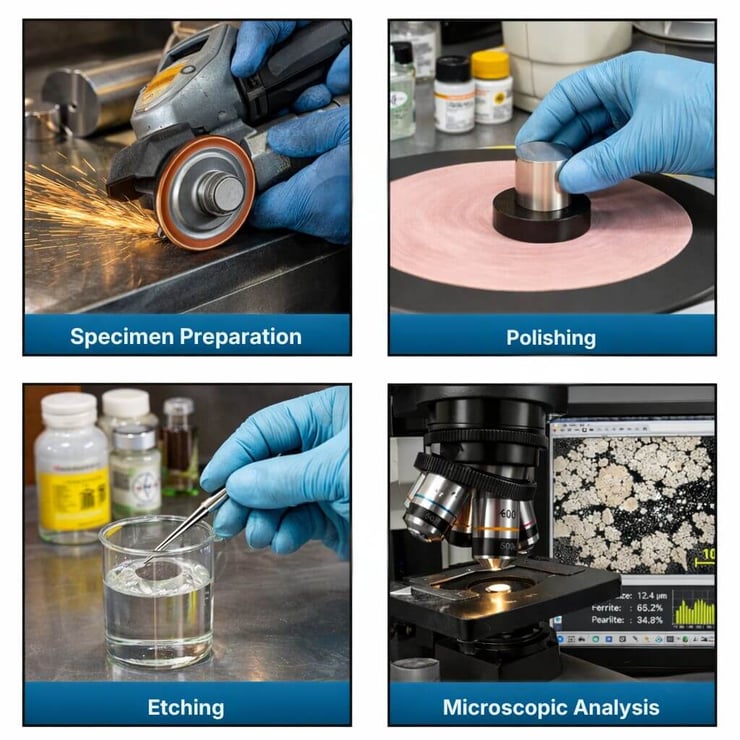
1. Sample removal
A representative portion of the component is cut.
2. Mounting
The sample is embedded in resin to make handling easier.
3. Polishing
The surface is ground and polished until a mirror finish is achieved.
4. Chemical etching
A chemical reagent (metallographic etchant) is applied to reveal the microstructure.
5. Microscope observation
An optical or electron microscope is used to analyse the structure.
What can be observed under the microscope?
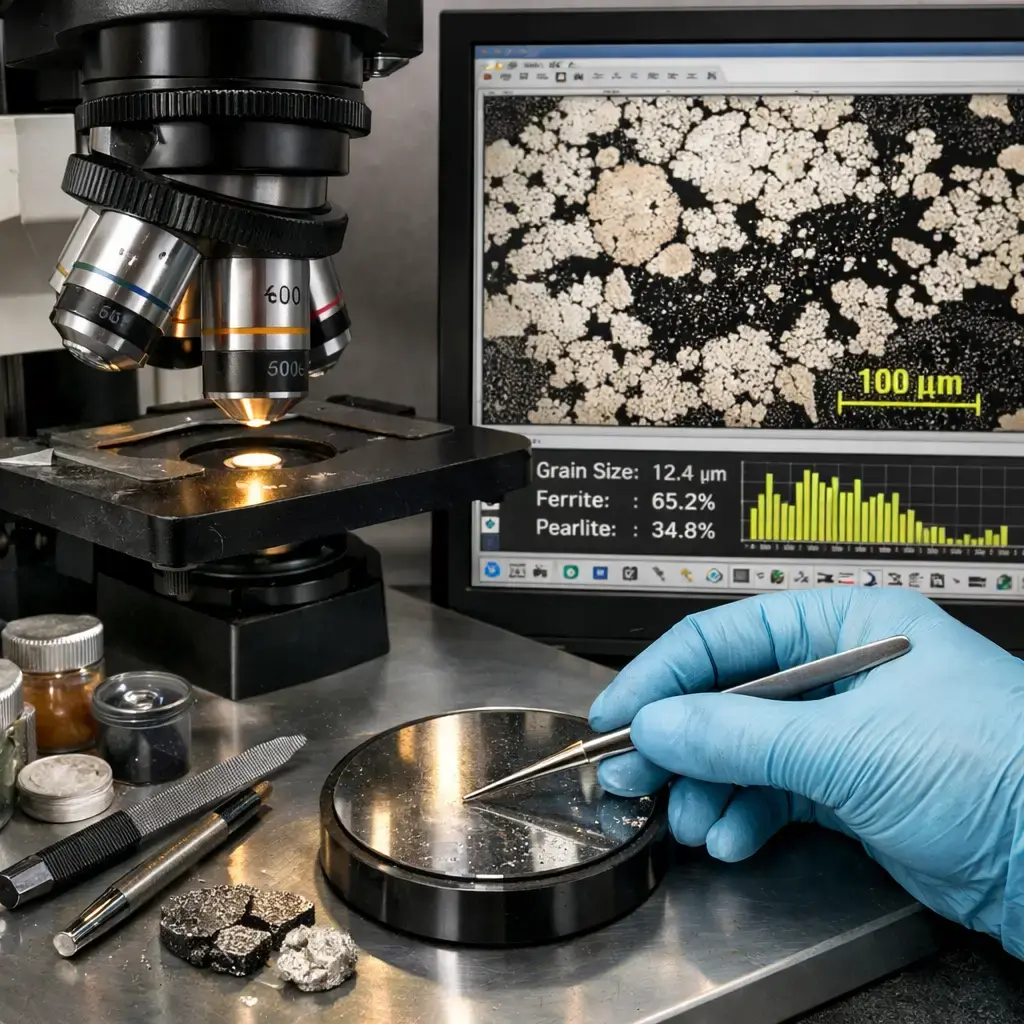
Through metallographic analysis it is possible to identify:
- grain size and shape
- metallic phases present (ferrite, pearlite, martensite, austenite, etc.)
- carbides and precipitates
- non-metallic inclusions
- porosity or casting defects
- signs of corrosion or fatigue
These features make it possible to correlate structure with mechanical properties.
Metallographic analysis and heat treatments
The analysis is fundamental for verifying the correct execution of:
- Quenching → presence of martensite
- Tempering → controlled phase distribution
- Annealing → more homogeneous microstructure
- Normalising → refined grain size
Instruments used: Optical vs electron microscope
Optical microscope
- analysis up to around 1000x
- most common use in industry
Electron microscope (SEM)
- very high magnifications
- local chemical analysis
- detailed study of cracks and defects
Reference Standards
Metallographic analysis is governed by technical standards, including:
- ISO 643 (grain size)
- ASTM E3 (sample preparation)
- ASTM E407 (chemical etchants)
Which sectors is it essential in?
Metallographic analysis is central to:
- steel industry
- automotive
- aerospace
- oil & gas
- CNC component manufacturing
- certification of structural materials
Difference between metallographic analysis and hardness testing
- Hardness test → measures resistance to indentation
- Metallographic analysis → observes the internal structure
The two techniques are often used together to obtain a complete picture of the material.

Why is it important in modern manufacturing?
In advanced production contexts (CNC, metal 3D printing, heat treatments), metallography:
- guarantees material quality
- prevents structural failures
- ensures regulatory compliance
- supports research and development
- reduces risks and the costs of non-conformity
Conclusions
Metallographic analysis is an indispensable tool for understanding the behaviour of metals at the microscopic level. It links internal structure and mechanical performance, ensuring safety and reliability in industrial components.
If you are developing or manufacturing metallic components, verifying the microstructure can make the difference between a reliable product and a potential failure.
Get a free quotation and use certified materials
Metallographic Analysis: Answers to Frequently Asked Questions

 Weerg staff: Oct 14, 2026