The Brinell test is one of the oldest and most reliable methods for measuring the hardness of materials, particularly metals.
Even today it is widely used in metallurgy, quality control, industrial production and research, especially when analysing heterogeneous or coarse-grained materials.
In this guide you will learn:
What is the Brinell test?
The Brinell hardness test is a mechanical test that measures a material’s resistance to penetration by a hard indenter under load.
The method is named after the Swedish engineer Johan August Brinell, who developed it in 1900 to analyse metallic materials used in industry.
In practice, the test evaluates how much a material deforms when it is pressed with force by a hard ball.
Brinell hardness formula
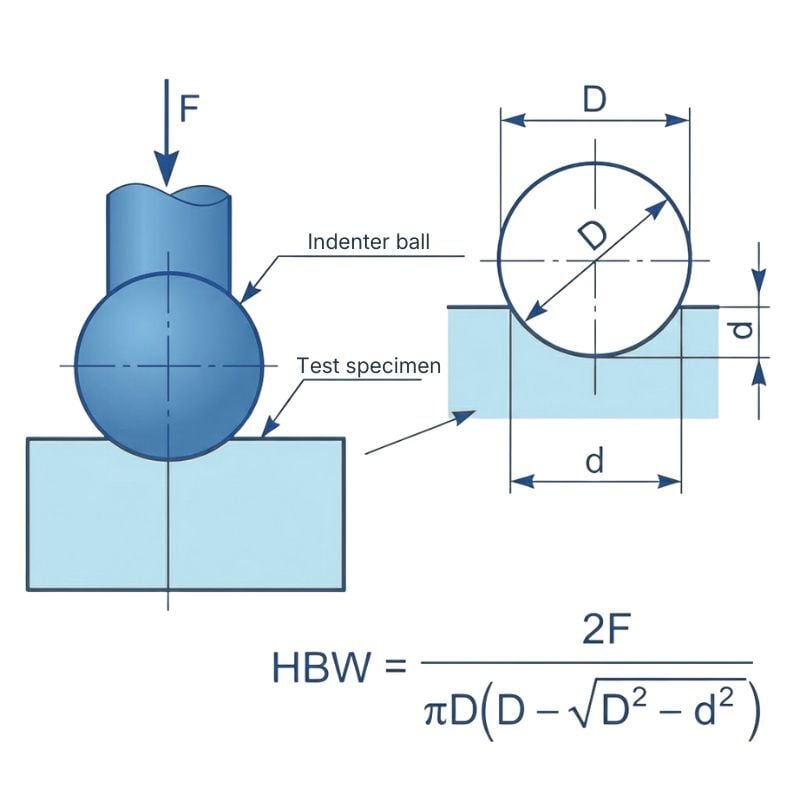
Brinell hardness is expressed as HB or HBW (when using tungsten carbide) and is calculated using the formula:
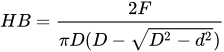
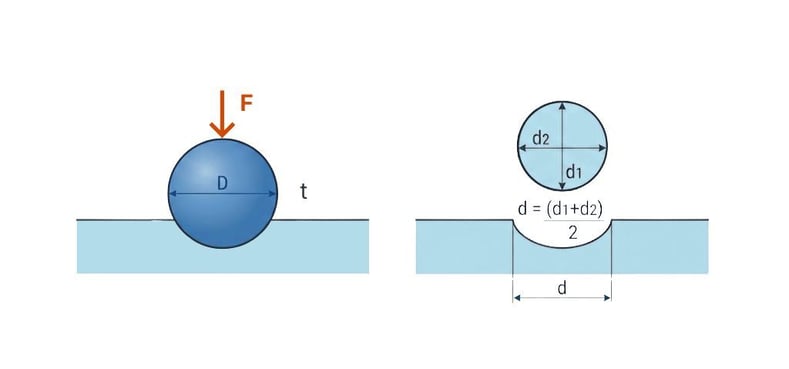
Where:
In industrial practice, the value is often read directly from tables or from the testing machine’s software.
What does Brinell hardness measure?
Brinell hardness measures the surface plastic resistance of a material, i.e. its ability to resist:
-
permanent deformation
-
indentation
-
mechanical wear
It does not measure:
-
tensile strength
-
toughness
-
impact resistance
However, it provides very useful information about machinability, wear resistance and the overall mechanical behaviour of the material.
How does the Brinell test work?
The test follows a standardised procedure:
-
A hardened steel or tungsten carbide ball is pressed against the surface of the material.
-
A constant load is applied for a defined time (typically 10–15 seconds).
-
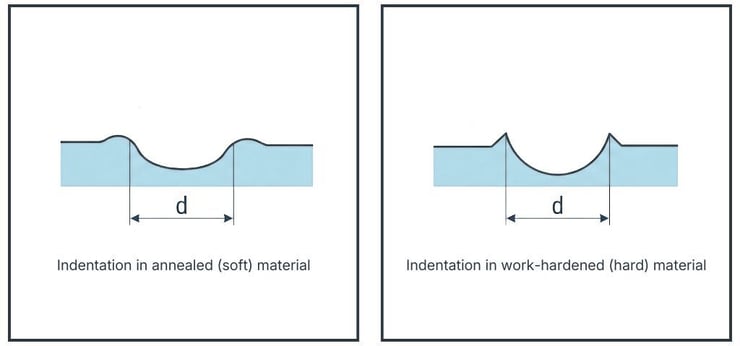
After removing the load, the diameter of the indentation left on the surface is measured.
-
From the indentation size, the Brinell hardness number (HB or HBW) is calculated.
Typical Brinell test parameters
-
Ball diameter: 1, 2.5, 5 or 10 mm
-
Applied load: from 500 to 3000 kgf
-
Dwell time: 10–15 seconds
Reference standards:
The choice of parameters depends on:
-
material type
-
expected hardness
-
specimen thickness
Which materials is the Brinell test used on?
The Brinell test is particularly suitable for:
Coarse-grained metals
heterogeneous materials
- castings
- materials with inclusions
- non-uniform structures
Not ideal for:
- very thin materials
- extremely hard materials
- very small surfaces
Brinell vs other hardness tests
Brinell vs Rockwell
- Brinell → large indentation, more representative
- Rockwell → small indentation, faster test
Brinell vs Vickers
- Brinell → ideal for soft/medium materials
- Vickers → more accurate, suitable for microhardness
Brinell is less precise than Vickers, but more reliable on heterogeneous materials.
|
Feature
|
Brinell (HB/HBW)
|
Rockwell (HR)
|
Vickers (HV)
|
|
Indenter type
|
Ball (steel or carbide)
|
Diamond cone or ball
|
Diamond pyramid
|
|
Indentation size
|
Large
|
Small
|
Very small
|
|
Reading method
|
Optical (indent diameter)
|
Direct (automatic scale)
|
Optical (diagonal measurement)
|
|
Accuracy
|
Medium
|
Medium
|
High
|
|
Test speed
|
Medium
|
High
|
Medium
|
|
Invasiveness
|
High
|
Low
|
Very Low
|
|
Ideal materials
|
Cast irons, castings, structural steels
|
Heat-treated steels, finished parts
|
Any material
|
|
Heterogeneous materials
|
Excellent
|
Limited
|
Limited
|
|
Thin layers/coatings
|
No
|
No
|
Yes
|
|
In-line quality control
|
Poorly suitable
|
Ideal
|
Poorly suitable
|
|
Main standards
|
ISO 6506 / ASTM E10
|
ISO 6508 / ASTM E18
|
ISO 6507 / ASTM E384
|
When Should you choose the Brinell test?
-
the material has a heterogeneous structure
-
a reliable average hardness value is required
-
the component is large
-
micrometric precision is not a priority
-
results must be compared with historical data
Conclusions
The Brinell test remains a fundamental tool for measuring metal hardness, especially when analyzing massive, heterogeneous or structural materials.
While not the most accurate method by any means, it offers a reliable and representative view of the mechanical behavior of the material, making it still an industry standard today.
The Brinell test remains a fundamental tool for measuring the hardness of metals, especially when analysing massive, heterogeneous or structural materials.
Although it is not the most precise method available, it provides a reliable and representative view of a material’s mechanical behaviour, making it an industrial standard even today.
Are you choosing a material for a structural component?
Upload your file and get technical support for the production of your component
Brinell test FAQ

 Weerg staff: Sep 30, 2026