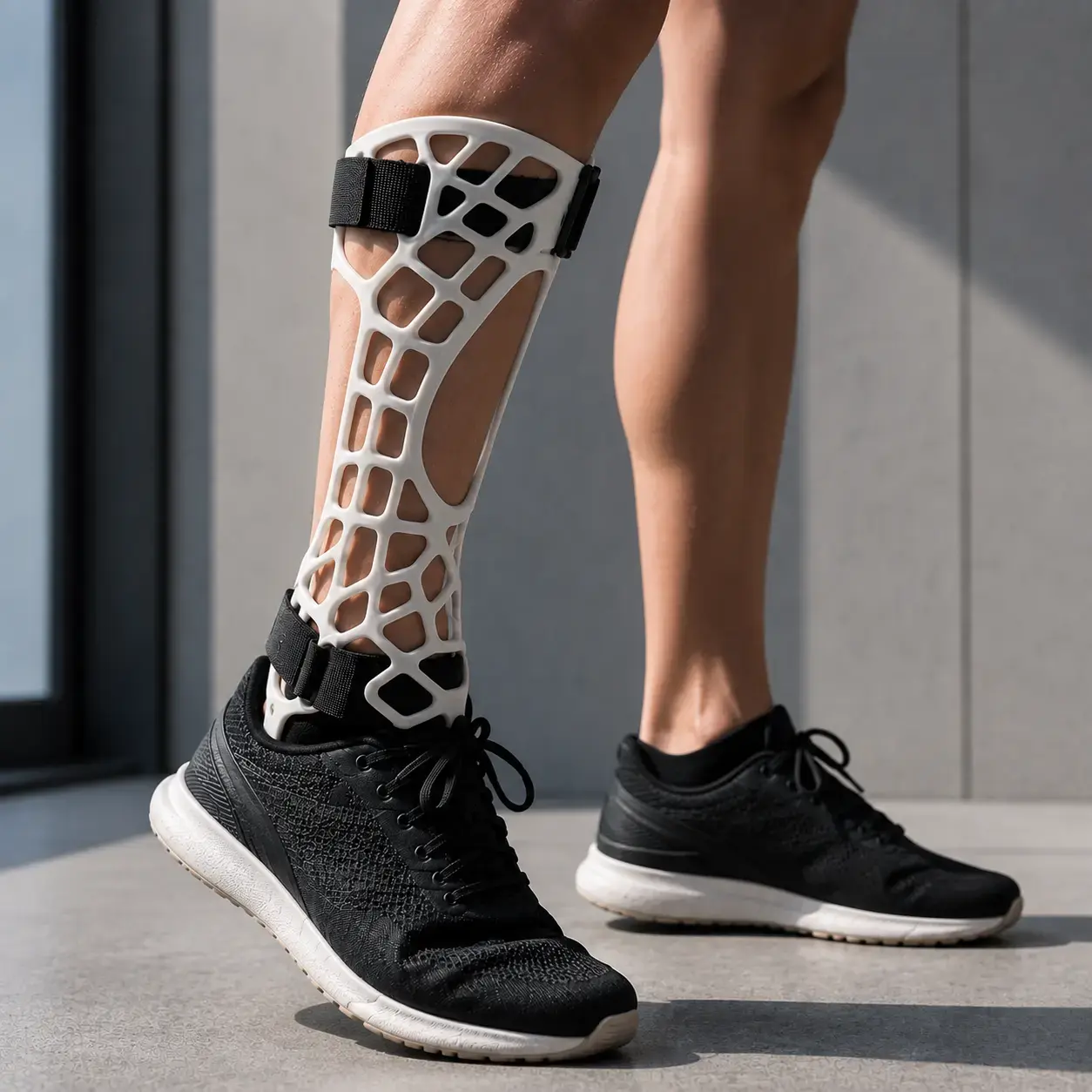
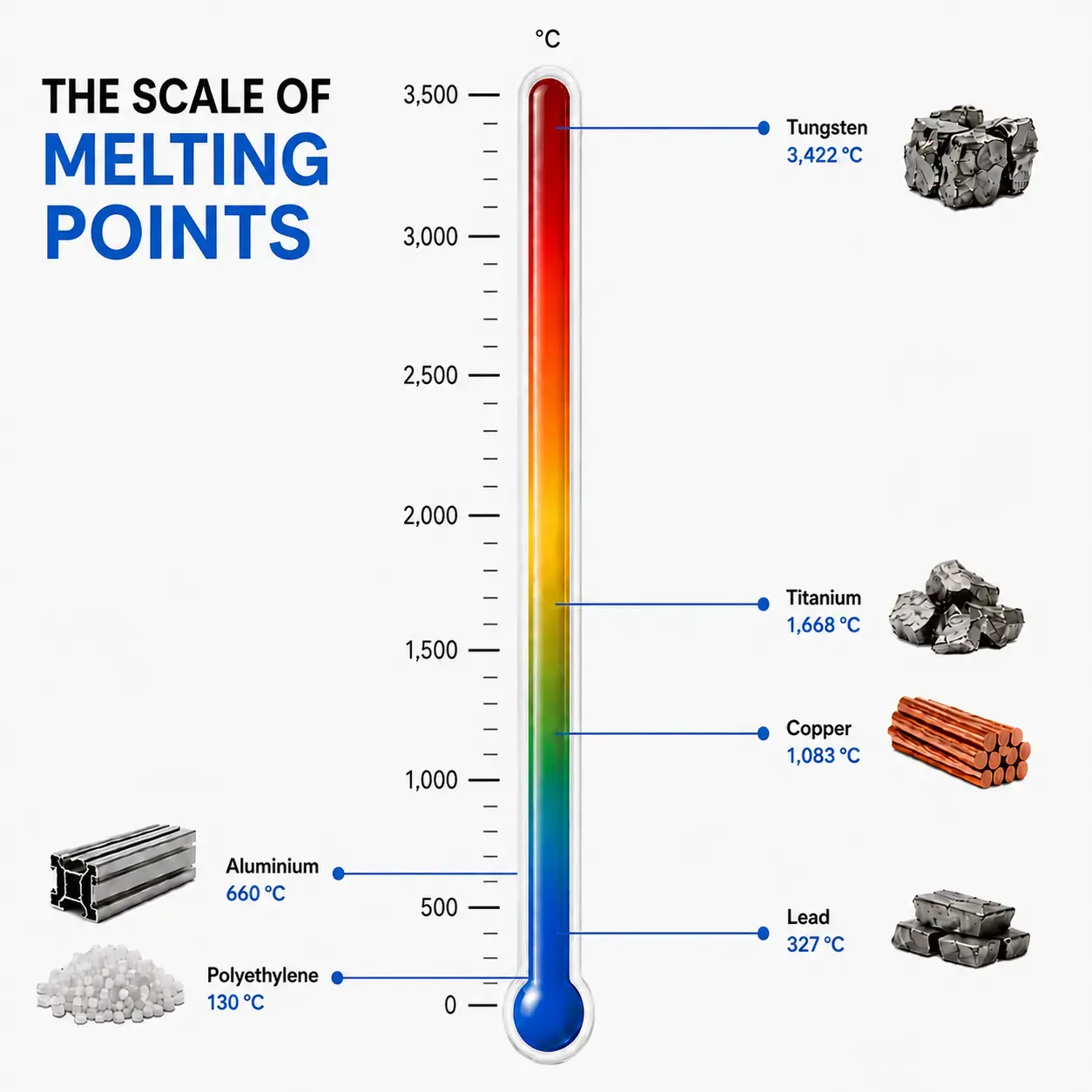
Autonomous logistics is one of the fastest-growing industrial sectors: AGVs, AMRs, last-mile robots and drones require numerous custom technical components hard to find off the shelf, such as load compartments, fairings, sensor mounts and optimised structural frames.
Industrial 3D printing makes it possible to develop them rapidly, using lightweight, strong materials and producing from a single piece to thousands of units without moulds.
This guide explores the most common components, the relationship between weight and load capacity, the most suitable materials and the production process for autonomous logistics systems.
Logistics and autonomous mobility: the scenarios
The market of autonomous mobility applied to logistics is articulated in four main scenarios, each with specific componentry needs.
Intralogistics: AGVs and AMRs
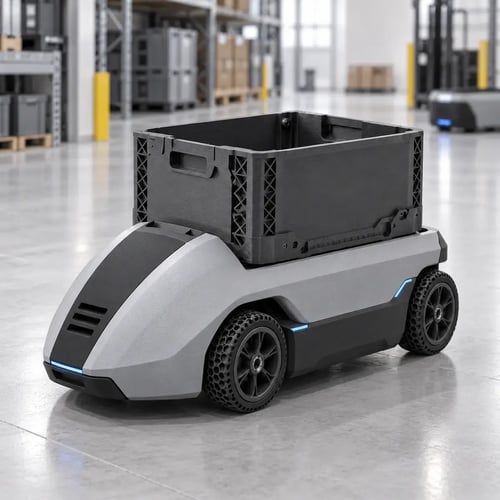
Automated guided vehicles (AGVs) and autonomous mobile robots (AMRs) operate in warehouses, production plants and distribution centres. AGVs follow predefined paths, while AMRs navigate autonomously thanks to sensors and AI, transporting goods between workstations, shelving and shipping areas. Volumes grow rapidly: a single warehouse can host dozens or hundreds of units.
Last-mile delivery: robots on wheels
Autonomous delivery robots travel along pavements and pedestrian areas to deliver parcels, food and medicines. They operate in urban contexts with stringent constraints of weight, size, resistance to weathering and safety.
Drone delivery
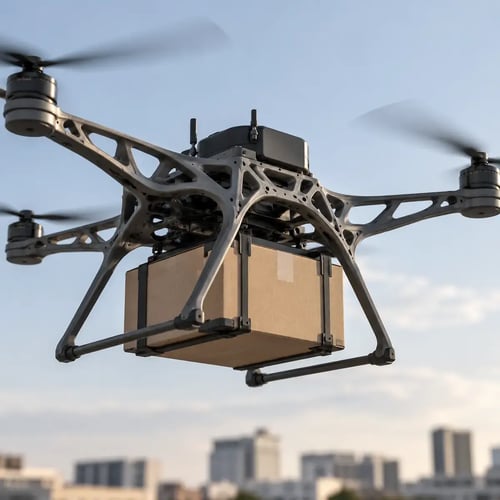
Drones for aerial delivery transport loads from a few hundred grams to several kilos over distances from a few hundred metres to tens of kilometres. Every gram subtracted from the payload reduces the range: the relationship between weight and capacity is therefore the main design constraint.
Specialised industrial logistics
Autonomous systems for specific environments: cold-storage warehouses (temperatures down to −30 °C), pharmaceutical cleanrooms, ATEX environments, automotive assembly lines. Each environment imposes additional requirements of temperature, hygiene or safety on the vehicle's components.
The critical components to customise
Load compartments and load-bearing structures
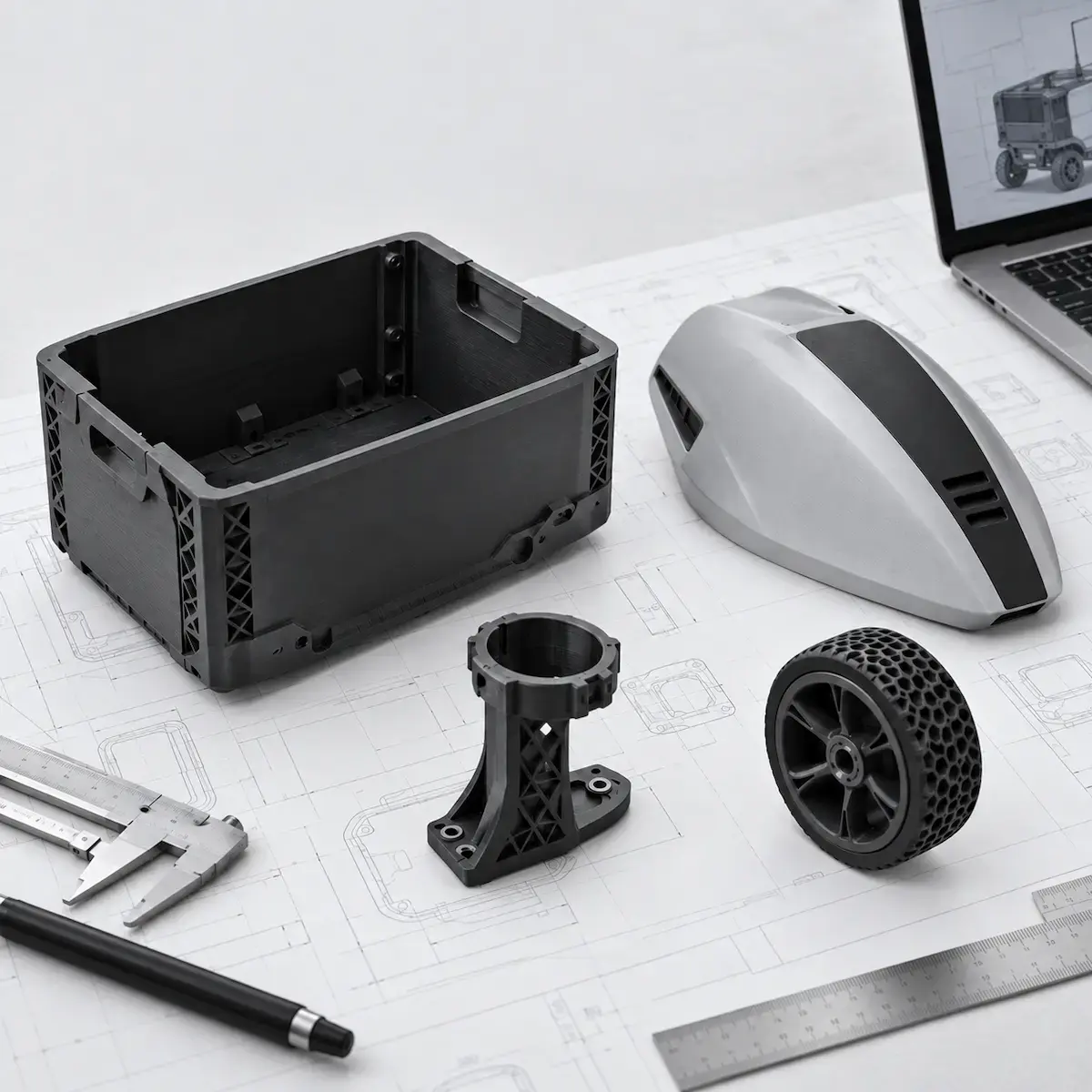
The load compartment is the functional heart of every logistics system: it must contain and protect the payload, integrate with the frame and weigh as little as possible. 3D printing makes it possible to create:
- load compartments dimensioned on the specific payload, for boxes, parcels, components and pharmaceutical trays;
- topologically optimised load-bearing structures, such as frames and subframes lightened while maintaining the required stiffness;
- quick-attach and quick-release systems, such as hooks, grippers and pull-out trays;
- internal dividers and modular housings for multiple loads;
- impact protections and bumpers in tough or flexible materials;
- absorption lattice structures to protect fragile loads during transport.
Fairings and Covers
The external fairings define the identity of the vehicle and influence its aerodynamics, in drones, and its protection from weathering, in ground robots. Among the main components:
- aerodynamic fairings for delivery drones optimised via CFD;
- protective covers for robots on wheels resistant to rain, dust, UV and impacts;
- custom OEM panels for branding and visual identity;
- covers for the sensors, such as LiDAR domes, protections for cameras and radomes for antennas;
- air intakes and ventilation systems for the cooling of electronics and batteries.
Mounts and supports for sensors
The sensors allow the vehicle to navigate autonomously and comprise LiDAR, stereo cameras, radar, ultrasound, RTK GPS and IMU. Each sensor requires a specific mechanical support:
- LiDAR mounts calibrated with precise orientation and centre distances;
- multi-camera supports for stereoscopic vision and surround view;
- brackets for radar and ultrasound integrated into the fairing;
- protected and shielded GPS and GNSS housings;
- anti-vibration supports in TPU for IMUs sensitive to vibrations.
Electronic and System Components
The onboard electronics, from navigation computers to BMS, motor controllers and radio modules, require dedicated housings:
- cases for navigation computers with passive or active cooling;
- BMS housings with a safety vent for lithium-ion batteries;
- custom cable ducts and grommets for the wiring;
- housings for motor controllers with heat dissipation;
- housings for 4G, 5G, LoRa and WiFi communication modules.
Wheels, tracks and mobility components
In ground robots, the mobility components too are often customised:
- TPU wheels with a profile and hardness suited to the operating surface, from the industrial floor to the pavement and outdoor environments;
- tracks and treads for uneven terrain;
- suspensions and shock absorbers printed in flexible materials;
- motor supports and brackets for gearboxes;
- encoder wheels and positioning discs.
The relationship between weight and capacity: why every gram counts
In autonomous mobility, the weight of the vehicle is a fundamental design constraint.
In delivery drones
A delivery drone has a maximum take-off weight, or MTOW, defined by the propulsion and the required range. Every gram destined for the structure is subtracted from the payload or the range.
A 5 kg MTOW drone with a structure and fairings of 2 kg has 3 kg of payload available. By reducing the structure to 1.5 kg through topological optimisation and lightweight materials, the payload rises to 3.5 kg, an increase of 17% in load capacity without modifying motors, batteries or electronics. Alternatively, the 500 g saved can translate into greater range, increasing the operating radius and the number of deliveries per cycle.
In AGVs and AMRs
For ground vehicles, the relationship between weight and performance takes different forms:
- a lighter AGV consumes less energy, increasing cycles per charge and productivity per shift;
- a lighter AMR is more agile, accelerates and brakes in less space and reduces cycle times;
- lighter components reduce inertias and improve positioning precision.
How 3D printing optimises weight
3D printing offers three particularly effective tools:
- topological optimisation, which reduces the material where it isn't needed while maintaining stiffness in the critical areas, with weight reductions from 30 to 60% for the same structural performance;
- lattice structures, internal lattices that replace solid material, reducing the mass and maintaining compressive strength and energy-absorption capacity;
- variable thicknesses, with thicker walls where greater strength is needed and thinner ones in the less stressed areas.
Materials for autonomous mobility
The choice of material follows a precise hierarchy: weight, strength, environment, cost. The most suitable materials offer the best relationship between stiffness and density compatible with the operating conditions.
| Material |
Technology |
Density (g/cm³) |
Strong point |
Application in autonomous mobility |
| PA12 nylon |
MJF |
1.01 |
The lightest, isotropic, USP Class VI, efficient batching |
Load compartments, fairings, electronics housings, standard load-bearing structures |
| PA11 Gen 2 nylon |
MJF |
1.04 |
Elongation 27.5%, resistance to fatigue and vibrations |
Components under continuous vibration, repeated snap-fits, flexible parts |
| PEEK CF |
FDM |
1.34 |
Maximum specific stiffness, high temperatures |
Critical load-bearing structures, drone frames, metal replacement |
| PEEK GF |
FDM |
1.35 |
Electrical insulation, stiffness, temperatures |
Components near motors and batteries, insulators |
| TPU |
MJF |
~1.15-1.25 |
Elasticity, impact and vibration absorption, UV |
Wheels, protections, padding, anti-vibration insulators, gaskets |
Rapid design iteration
Autonomous logistics systems are developed with very rapid cycles. A startup developing AGVs can go through 5 to 10 design revisions in a year, while a delivery drone can require a new fairing every month. 3D printing makes it possible to sustain this pace without making new moulds at every modification.
Typical iteration cycle with 3D printing:
- Monday: the engineering team updates the CAD of the load compartment after the previous week's tests.
- Tuesday morning: the file is uploaded to the production platform and the quote is generated.
- Thursday: the parts arrive printed in PA12 MJF, ready for assembly.
- Friday: the component is tested on the vehicle and the feedback feeds the next iteration.
With traditional injection, the same cycle takes 8 to 12 weeks between mould design, production, sampling and modifications. In the development phase, the speed of iteration therefore becomes a competitive advantage.
From prototyping to production without changing process: when the design is stabilised, the same MJF technology used for the prototypes can produce the series, from 10 to thousands of pieces. No new moulds or tooling are needed and there's no need to change production technology.
A concrete case: AMR startup for e-commerce warehouses
A startup develops AMRs for autonomous handling in e-commerce warehouses. The robot transports 200 kg mobile shelving on smooth industrial floors, navigating with LiDAR and stereo cameras. During development, the team updates fairings, load compartment and sensor supports every 3 or 4 weeks.
With 3D printing in PA12 MJF, the following are created: topologically optimised side fairings, with a 40% weight reduction compared with the first version in thermoformed ABS; a load compartment with integrated modular dividers, reducing the assembly from 12 components to 3 printed parts; a calibrated LiDAR mount and an anti-vibration support in TPU for the IMU.
Each iteration arrives in 3 or 4 working days, with a cost per part compatible with the production of 50 pilot units. When the series reaches 500 units, the same MJF process will be able to produce the components in batches without changing technology.
Series production for fleets
Autonomous logistics is a market of fleets. A warehouse can host 50 to 200 identical AMRs, a drone delivery service can operate with 20 or 100 drones of the same model and a last-mile operator can deploy hundreds of robots in a city.
MJF 3D printing adapts to this model thanks to batching, which makes it possible to produce hundreds of components in the same cycle. The cost per part decreases as volumes increase, while delivery times remain in the order of days.
For productions above 500,000 pieces of the same design, traditional injection becomes more competitive on unit cost, provided the design is stable, the mould amortisable and the start-up times acceptable. For many autonomous mobility startups, 3D printing remains cost-effective even at high volumes because the design continues to evolve, making it harder to amortise a mould.
Conclusion
AGVs, AMRs, last-mile robots, drones and specialised industrial systems require numerous custom components, from load compartments to fairings, from sensor supports to electronic housings. Industrial 3D printing makes it possible to design, iterate and produce these components in series with lightweight, strong materials, without the times and costs tied to traditional moulds.
PA12 MJF meets the needs of lightweight structures and efficient production, PEEK CF those of critical structural components, TPU those of protections and cushioning systems. With delivery times from 1 to 3 business days, the move from CAD to vehicle can take place in a few days.
Are you designing an autonomous logistics system and do you need lightweight, strong technical components produced in series?
Upload your file and get a quote
Frequently Asked Questions

 Weerg staff: Sep 16, 2026