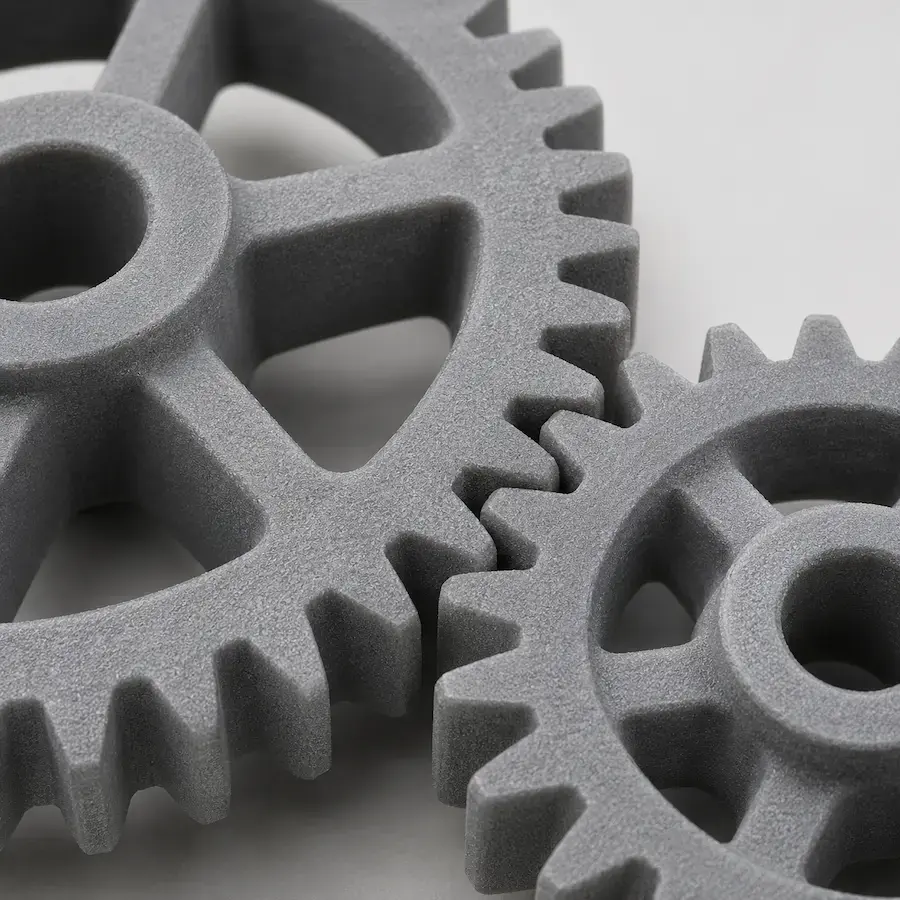
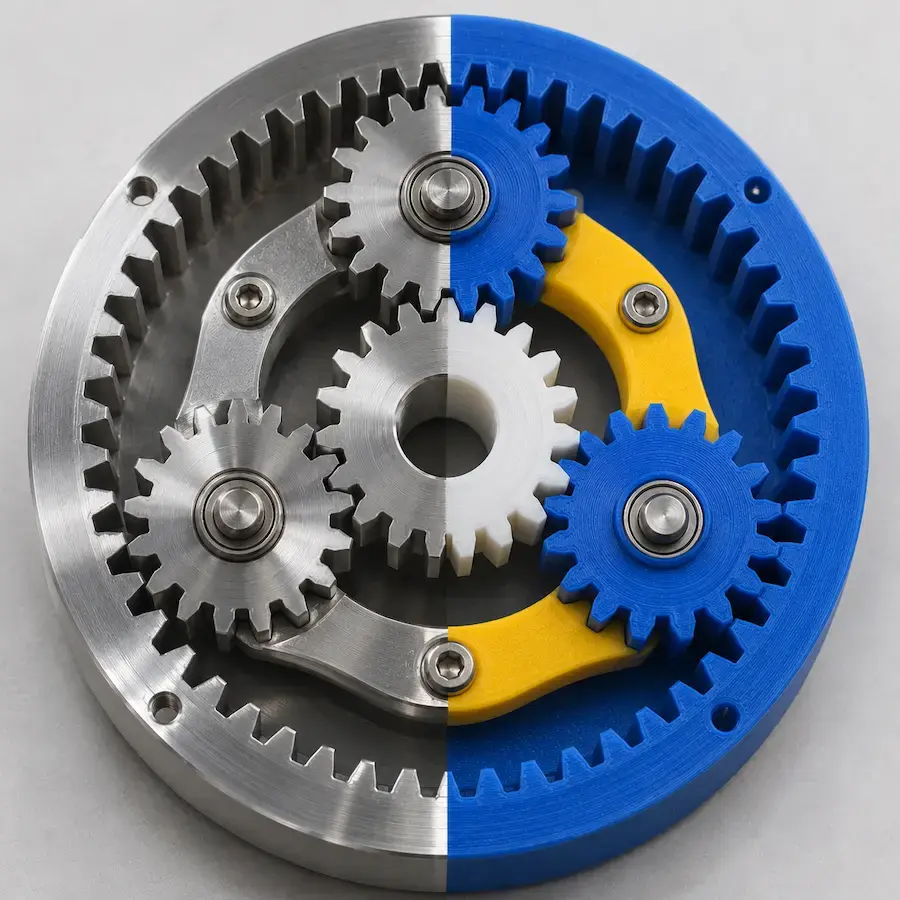
A metal gear is strong, precise and durable, but it can be noisy. In many applications, from household appliances to actuators, from robotics to consumer devices, noise and vibration are a fundamental design requirement. A reduction gear that hums, a mechanism that vibrates or a gear that whistles at certain speeds can make a product unacceptable, even when it works perfectly from a mechanical point of view.
This is where a technical polymer can outperform metal. Thanks to their physical properties, gears in technical plastic materials can offer significant advantages in reducing noise and vibration. This guide analyses the principles of NVH, the most suitable properties and materials, clarifying when to choose a technical polymer and when metal remains irreplaceable.
What Is NVH
NVH is the acronym for Noise, Vibration, Harshness and refers to the set of acoustic and vibratory phenomena of a mechanical system. In gears, the contact between the teeth and the variations in stiffness during meshing generate vibrations that are transmitted to the surrounding structures and propagate through the air in the form of noise.
There are three main factors responsible:
- Meshing impact: the collisions between the teeth, accentuated by the stiffness of the material and by geometric inaccuracies.
- Transmission errors: the deviations from the theoretical motion, due also to imperfections in the tooth profile, which generate vibrations.
- Resonances: the amplification of vibrations when the meshing frequency approaches a natural frequency of the system.
Thanks to their greater damping capacity and lower stiffness, technical polymers attenuate impacts, tolerate small imperfections better and limit the transmission of vibrations, helping to reduce the overall noise.
Why technical polymer outperforms metal in NVH
The advantages of technical polymers in reducing gear noise and vibration derive mainly from three physical properties.
1. Greater internal damping
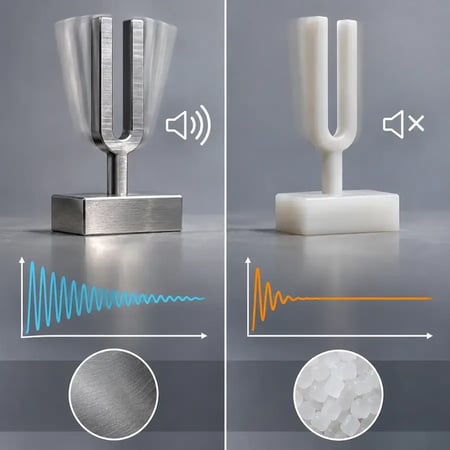
Damping is the ability of a material to dissipate vibratory energy by converting it into heat. In polymers it is generally higher than in metals. A metal component, if struck, can continue to vibrate for a long time, whereas a polymer tends to attenuate the oscillations quickly.
Thanks to this property, part of the energy generated during meshing is dissipated within the material, rather than propagating through the structure. The result is a reduction in vibrations and transmitted noise.
2. Lower elastic modulus and attenuated impacts
The elastic modulus expresses the stiffness of a material. In steel it is around 200 GPa, in aluminium 70 GPa, whereas in technical polymers for gears it is generally a few GPa. Nylon PA12 MJF has a modulus of around 1.7 GPa, POM (Delrin) around 3 GPa.
The lower stiffness allows the teeth to deform elastically during meshing, distributing the stresses over time and reducing the force peaks. Compared with metal teeth, which are stiffer, the contact is therefore less abrupt and potentially quieter.
3. Low friction and self-lubrication
Many technical polymers for gears, such as POM and certain polyamides, have good sliding properties and a low coefficient of friction. This helps to reduce the noise generated by the contact between the teeth and, under certain operating conditions, makes it possible to limit or eliminate external lubrication.
A further advantage is the ability of technical polymers to compensate for small misalignments and assembly inaccuracies thanks to their elasticity, attenuating vibrations that could be more marked in a metal transmission.
The materials for quiet gears
Technical polymers have different NVH properties. The choice requires a balance between quietness, torque transmission capacity, fatigue resistance and operating conditions. Among the materials available in the Weerg catalogue, the following are particularly suited to producing low-noise gears.
POM-C: precision and quietness
POM (polyacetal), available for CNC machining, is one of the benchmark materials for precision plastic gears. It combines an elastic modulus of around 3 GPa, high wear resistance, low friction, dimensional stability and good damping properties.
These characteristics make it possible to obtain quiet, precise and durable gears, with good self-lubricating properties. It represents an excellent compromise between noise reduction and torque transmission capacity, including for precision cams and bushes.
Nylon PA12 and PA11: quietness and geometric freedom
The polyamides produced by MJF 3D printing combine good NVH properties with a high degree of design freedom. Nylon PA12, with an elastic modulus of around 1.7 GPa, offers greater deformability than POM, promoting a less abrupt contact between the teeth and good absorption of vibrations.
Nylon PA11 Gen 2, thanks to its high elongation at break (around 27–28%), offers greater ductility and impact resistance, making it of interest for components subject to repeated stresses.
Both are suited to functional prototypes and low- to medium-torque gears, especially where complex geometries and low noise are required.
Nylon 6 + MoS₂: low friction and reduced wear
Nylon 6 compounded with molybdenum disulphide (MoS₂), CNC-machinable, is suited to components subject to sliding. The solid lubricant helps to reduce friction and wear, promoting quiet operation with reduced lubrication requirements. It is particularly suited to gears and bushes that require smooth running and long-term durability.
TPU: Vibration isolation
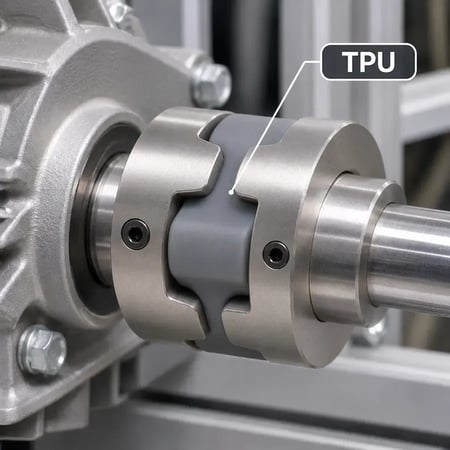
TPU (thermoplastic polyurethane), available in MJF printing, stands out for its high elasticity and its ability to absorb impacts and vibrations. While it is not generally suited to teeth subject to high loads, it finds application in the damping elements of transmissions. It is suited to flexible couplings, anti-vibration bushes and decoupling components, designed to limit the propagation of vibrations to the surrounding structure.
PEEK: quietness at high temperatures
PEEK, available for CNC machining and FDM printing, combines good tribological properties, chemical resistance and stability at high temperatures, with service values that can reach around 250 °C, depending on the application conditions.
It is suited to low-noise transmissions in thermally or chemically demanding environments, where materials such as POM and conventional polyamides might not guarantee adequate performance.
Technical polymers and metals compared in NVH
| Property |
Technical polymers |
Metals |
| Internal damping |
High, attenuates vibrations |
Low, promotes the propagation of vibrations |
| Elastic modulus |
Low (around 1.7–3 GPa) |
High (around 70–200 GPa) |
| Friction between teeth |
Generally low |
Higher without lubrication |
| Meshing noise |
Generally low |
Potentially higher |
| Compensation for inaccuracies |
Greater, thanks to elasticity |
Lower, owing to the high stiffness |
| Lubrication |
Sometimes unnecessary |
Generally necessary |
| Torque capacity |
Generally low to medium |
High |
| Service temperature |
Variable: around 90 °C for some PAs, up to 250 °C for PEEK |
Generally higher |
| Profile precision |
Good, especially with CNC machining |
High |
| Service temperature |
Variable: around 90 °C for some PAs, up to 250 °C for PEEK |
Generally higher |
| Profile precision |
Good, especially with CNC machining |
High |
When to choose a technical polymer and when to prefer metal
Choose a technical polymer when
- Quietness is a fundamental requirement: household appliances, consumer devices, actuators, service robotics and medical devices.
- The torque is low to medium: light automation, positioning mechanisms and small transmissions.
- Lubrication needs to be limited: applications in which greases and oils are undesirable, such as in the food and medical sectors.
- Weight is a decisive factor: technical polymer gears are considerably lighter than metal ones.
- Prototypes or small batches are needed: 3D printing in PA12 and PA11 makes it possible to produce functional gears quickly.
Prefer metal when
- Torque and loads are high: power transmissions and heavy industrial reduction gears.
- High precision and durability are required: applications with intense and prolonged stresses.
- Temperatures exceed the limits of polymers: thermal conditions incompatible even with high-performance technical polymers.
- Stiffness is essential: mechanisms in which even small deformations of the teeth are unacceptable.
The hybrid solution: combining technical polymers and metals
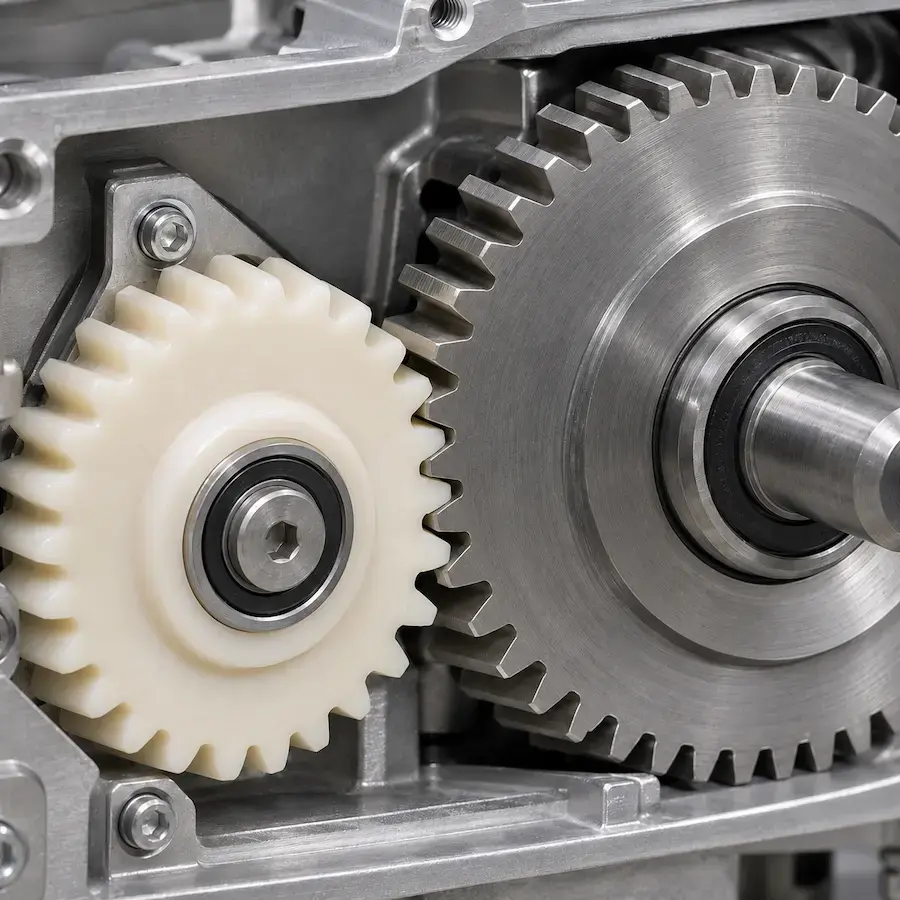
In many applications, the best solution consists of combining different materials: gears in POM or PA to reduce noise, elements in TPU to isolate vibrations and metal components where greater stiffness and load capacity are needed.
Design tips for quiet gears
Besides the choice of material, a number of design measures help to reduce noise and vibration:
- Helical teeth: they ensure more gradual and quieter meshing than spur teeth, reducing abrupt load variations.
- Module and tooth profile: accurate geometry limits transmission errors. In 3D printing, it is important to consider the process tolerances and allow for an appropriate clearance between the teeth (backlash).
- Prevention of resonances: avoid the meshing frequency coinciding with the natural frequencies of the system.
- Damping elements: use bushes or couplings in TPU to limit the transmission of vibrations to the structure.
- Material pairing: assess plastic-metal or plastic-plastic combinations according to the requirements for quietness, wear resistance and torque transmission capacity.
Conclusion
In reducing gear noise and vibration, technical polymers offer advantages over metals thanks to their greater internal damping, lower stiffness and low friction. When quietness is essential and loads are low, materials such as POM, PA12, PA11 and Nylon 6 + MoS₂ make it possible to produce lighter, quieter gears that can often be used without external lubrication.
Metal remains preferable for high torque, extreme temperatures and applications requiring maximum stiffness and precision. In many cases, a hybrid solution that combines technical polymer gears, anti-vibration elements in TPU and metal components offers the best balance between performance and quietness.
Do you need to produce quiet gears for your application?
Upload your file and get a quote
Frequently Asked Questions

 Weerg staff: Nov 25, 2026