For a quality manager in the medtech sector, choosing a 3D printing supplier isn't simply a technical assessment, but a decision linked to risk management. Every component produced can enter the medical device's technical file. Every non-conformity can generate a CAPA. Every MDR or FDA audit, sooner or later, can extend to the supply chain as well. The operational question, therefore, isn't: "Can you print in PA12?", but rather: "Are you able to demonstrate that the component received today will be equivalent to the one I'll receive in six months' time, and can you provide me with the documentation needed to support this evidence before my Notified Body?"
This article explains how Weerg guarantees traceability, repeatability and documentation in the 3D printing process for medical applications, from the ISO 9001 quality system through to the documentation available for each production batch.
Why traceability is critical in the medical field
In the medical sector, traceability — understood as the ability to reconstruct the origin, production history and destination of every individual component — isn't an accessory requirement, but a fundamental element of the regulatory control of the entire supply chain. Three reasons make it non-negotiable:
- Regulatory requirements
MDR 2017/745 in Europe and the FDA's 21 CFR Part 820 require the medical device manufacturer to qualify suppliers, maintain traceability records and demonstrate process control along the entire chain. 3D printing, like any other production process, falls within this scope.
- Management of recalls and non-conformities
If a batch of devices presents a defect in the field, the manufacturer must be able to trace back within a few hours to the materials used, the printing conditions, the operators involved and the checks carried out. In the absence of structured traceability, the management of a non-conformity or a recall can quickly turn into a regulatory and operational crisis.
- Verifiability of the supply chain
During an audit by a Notified Body, the FDA or a strategic client, the supplier's documentation may be subject to verification. A supplier that doesn't provide certificates, composition declarations and a traced production batch represents a weak point in the client's technical file and can generate a non-conformity along the supply chain.
For 3D printing, these needs translate into precise operational requirements: unique identification of the raw material batch, recording of process parameters, accurate quality control. It's within this scope that a quality system structured according to ISO 9001 makes it possible to manage traceability, repeatability and process control in an orderly and documentable way.
ISO 9001 and the Weerg Quality System
Weerg is ISO 9001 certified, the international standard for quality management systems. This isn't merely a formal attestation, but an organisational system that involves the entire operational flow: from order acceptance to file preparation, from production to post-processing, through to the final inspection and delivery of the component.
What this means in concrete terms for a medical client:
- Documented processes: every operation (order acceptance, file preparation, printing, finishing, inspection, shipping) follows a written, verifiable and repeatable procedure.
- Risk-based approach: the organisation identifies the risks that could compromise product quality and mitigates them with specific measures.
- Documentary traceability: every order is associated with a record that includes the material, the powder or filament batch, the machine, the operator and the inspection outcome.
- Non-conformity management: any defects detected in production or reported by the client are managed through a formal process of recording, analysis and treatment. This makes it possible to identify the cause of the problem, define the necessary corrective actions and document the closure of the non-conformity.
- Continuous improvement: internal audits, management reviews, corrective and preventive actions feed a documented optimisation cycle.
ISO 9001 isn't ISO 13485, which represents the reference standard for quality systems specific to the medical device sector. However, ISO 9001 constitutes the common basis of industrial quality systems and represents, for many medtech manufacturers, a minimum requirement in the qualification of suppliers. For a project in which the certification of the final device is the client's responsibility, an ISO 9001 supplier provides the process guarantees needed to support the manufacturer's MDR / FDA audit.
What's the difference between ISO 9001 and ISO 13485 for the supplier?
ISO 13485 is mandatory for the medical device manufacturer; for the supplier of parts or production services it's recommended but not always mandatory. The main difference is that 13485 introduces specific requirements for medical risk, while 9001 covers the general quality system. Many medtech manufacturers qualify ISO 9001 suppliers when the supplier isn't involved in the device design phase, but produces components or production services according to a controlled and traceable process.
MJF and FDM process control
Repeatability in 3D printing isn't an intrinsic characteristic of the process, but the result of systematic control of the variables that influence the quality of the final component.
How the MJF process is controlled
The MJF process is particularly sensitive to the control of three critical variables, all monitored and documented throughout the production cycle.
- Powder management: the PA12 powder used is a controlled mixture of virgin powder and recycled powder, regenerated according to a standardised procedure. Every incoming powder batch is uniquely identified and traced throughout the entire production cycle.
- Chamber temperature: the thermal processing window in the MJF process is narrow and directly affects the dimensional stability and quality of the component. For this reason, the chamber temperature is monitored continuously and recorded during production.
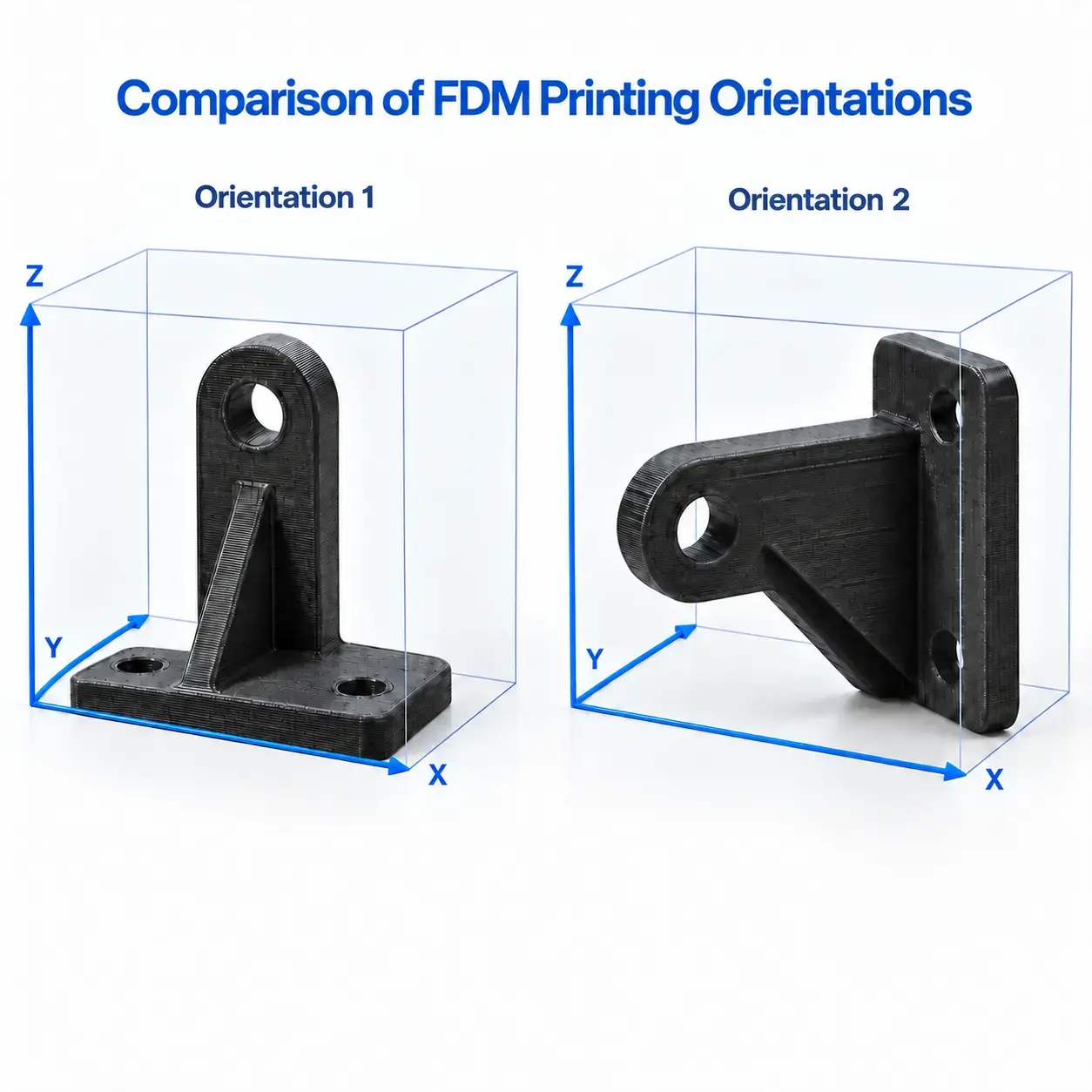
- Added to these is the documented print layout for each build, so that the orientation of a part within the chamber remains reproducible.
How the FDM process is controlled
The industrial FDM process has different variables, but similar logic:
- Filament management: spools identified by batch, storage in humidity-controlled cabinets (critical especially for PEEK and medical materials that degrade if they absorb moisture);
- Stable temperatures: extrusion, print bed and chamber temperatures set to parameters specific to each material, documented and repeatable;
- Print paths (G-code) derived from validated parameters, not modifiable in the production environment without quality control;
- Standardised post-processing: annealing, support removal and surface cleaning carried out according to procedure for each batch.
How repeatability between batches is achieved
Repeatability isn't guaranteed by a single measure but by the combination of four practices:
- Parameters qualified per material: For each material, specific process recipes are defined, based on controlled and qualified parameters. In production, these parameters aren't modified without a technical assessment and a formal check by quality.
- Periodic calibration of the machines according to a documented maintenance plan.
- Rigorous quality control: Quality control verifies that the components produced comply with the required specifications and are consistent with previous production runs. This step is essential especially in cases of reordering, where the client must be able to receive components equivalent to those already qualified or integrated into their own process.
- Recording of build parameters: For each print, the main build parameters and the relevant information of the production cycle are recorded. In this way, every component can be traced back to its own production history, including material, machine, process configuration and checks carried out.
Measurement and inspection of parts
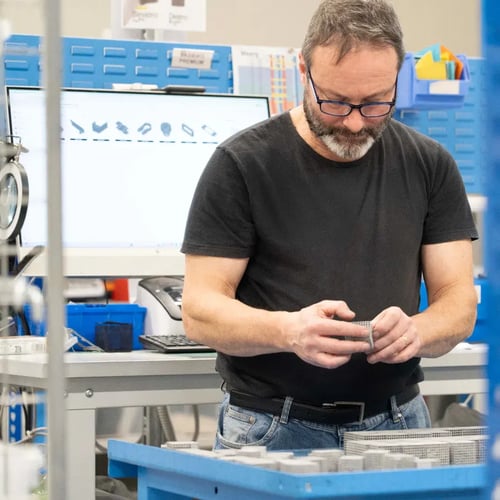
Quality control on the finished part is the phase in which the theory of the quality system becomes documentary evidence. The Weerg control flow on a medical order includes:
- 100% visual inspection on all parts produced, with reference to documented acceptance criteria (surface finish, integrity, visible defects, colour);
- Dimensional inspection with calibrated instruments (callipers, micrometers, dial gauges) based on the critical dimensions of the client's drawing, according to the control plan defined for the order;
- Inspection with advanced technologies using latest-generation AM-flow machinery;
- Batch control on repetitive runs or reorders, with the results of the checks recorded and archived in the order record, so as to maintain complete documentary traceability;
- Non-conformity management: if a part doesn't meet the acceptance criteria, it's isolated, recorded, analysed and, according to the procedures, reworked, replaced or reported to the client before shipping.
The documentation available for each batch
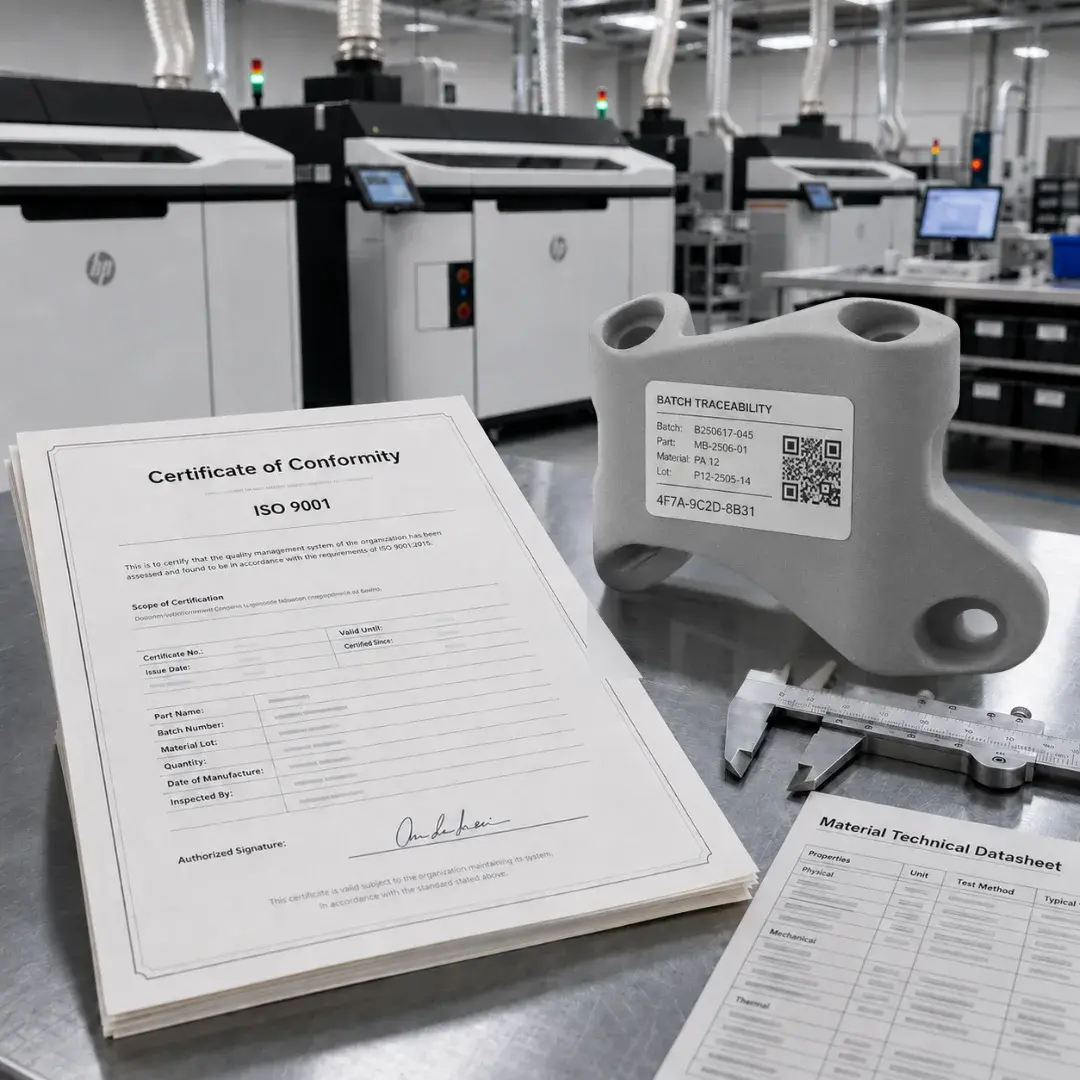
The documentation associated with the supply is one of the elements against which the solidity of a supplier for medical applications is measured. On request, Weerg can provide documentation to support the order, including:
- Material composition declaration: identification of the material used and its certificates (RoHS, REACH, USP Class VI where applicable);
- Batch traceability: reference to the powder or filament batch used, traceable to the manufacturer's certificate of analysis;
- References to the official technical data sheets of the material, with revision and date;
- Reference to the Weerg ISO 9001 certificate, available for supplier qualification audits;
- Traced invoicing and transport documents, with reference to the order.
On request, we can prepare additional documentation for the client's specific regulatory needs.
Your MDR / FDA audit: what to expect from the supplier
In the process of qualifying a supplier for a medical device, a Notified Body, the FDA or a strategic client may request objective evidence on process control and the documentary management of the supply.
Generally, the checks focus on elements such as:
- a valid ISO 9001 certificate;
- documented procedures for order acceptance, production, inspection, non-conformity;
- traceability evidence on a sample order;
- a calibration plan for the measuring equipment;
- a maintenance plan for the production equipment.
Weerg maintains these elements in documented and verifiable form within its ISO 9001 quality system. For high-risk projects, or in cases where the device manufacturer requires specific evidence, the Weerg quality team can provide additional references and support the client in the supplier qualification phase.
Conclusion
3D printing is today a production technology fully applicable to the medical sector. For a quality manager, however, the choice of a supplier cannot be based only on the technical ability to produce the component: it must be founded on the solidity of the process, on traceability and on the availability of documentary evidence.
An ISO 9001 certified supplier, with documented procedures, complete traceability, control of process parameters and a structured documentation package, provides the medical device manufacturer with the elements needed to support regulatory checks, qualify the supply chain and keep the technical file consistent and complete.
Weerg applies this approach to every order intended for medical applications, both for MJF technology and for FDM technology. Responsibility for the certification of the final device remains with the medical device manufacturer; however, for the part relating to the quality system, Weerg offers a documented, traceable supplier aligned with the ISO 9001 standards required by the sector.
Does your medical device require an ISO 9001 supplier?
UPLOAD YOUR FILE AND REQUEST A QUOTE
Frequently Asked Questions

 Weerg staff: Oct 14, 2026