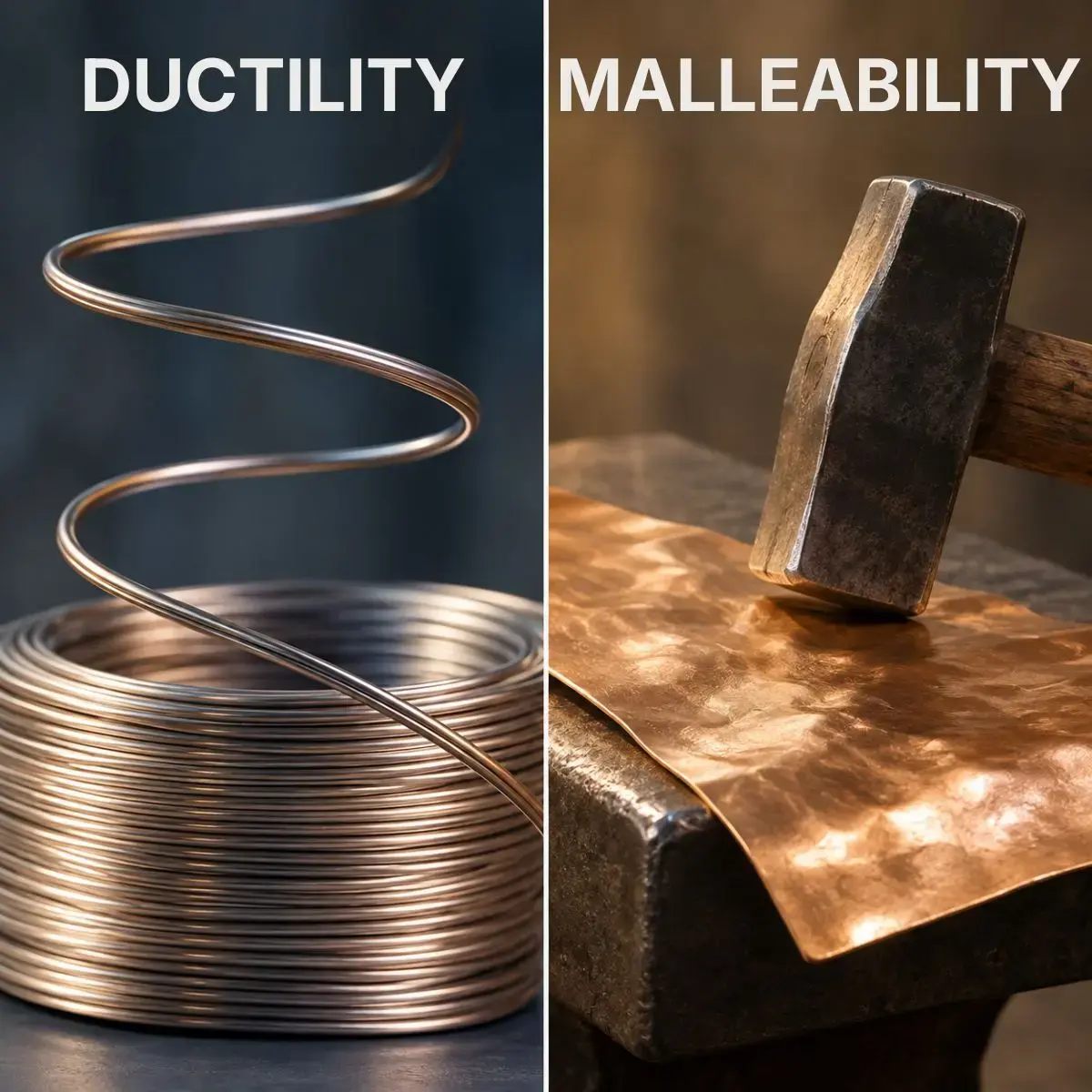
Elongation at break is one of the main parameters on material test certificates. It indicates how much a material deforms plastically before breaking under load and is a fundamental parameter for assessing its ductility. For the designer it's an essential piece of data: it makes it possible to distinguish materials that fail progressively, with visible deformation before breaking, from those that fracture suddenly. This value influences many design choices, from selecting a structural steel to assessing the formability of a sheet metal.
In this guide, we'll look at what elongation at break is, how it's measured according to the standards, what the difference is between the main symbols used (A5, A10, A80mm, Agt) and what the typical values are for the most common materials.
What elongation at break is
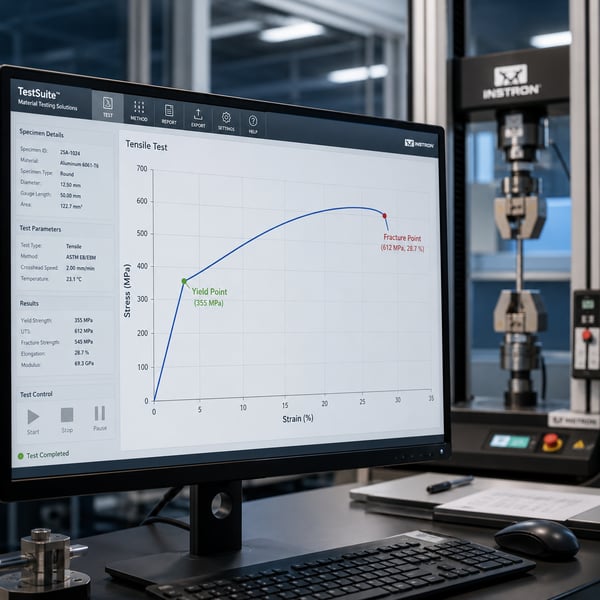
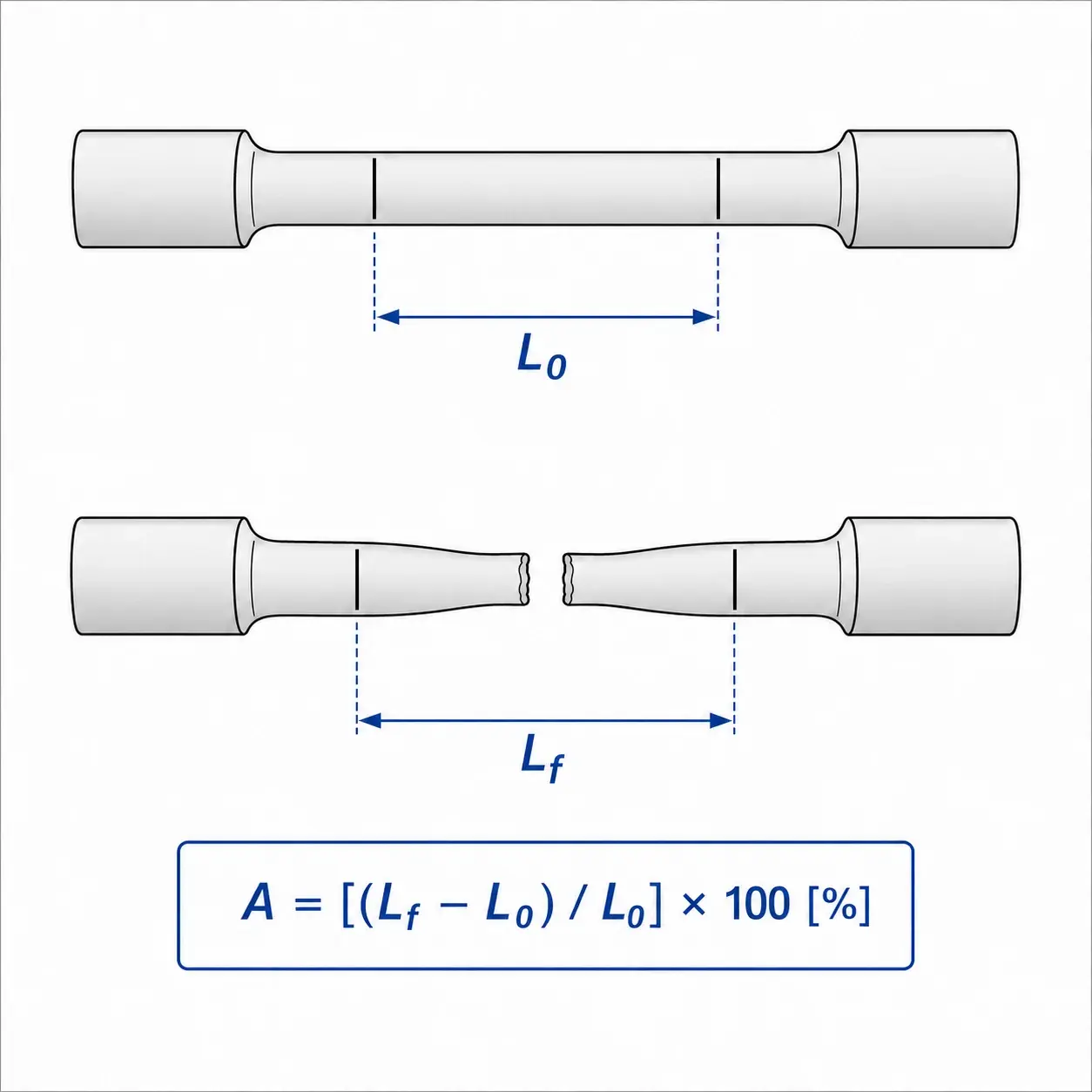
Elongation at break, indicated by the symbol A (or A%), is the permanent plastic deformation measured on a test specimen after breaking during a tensile test. It's expressed as a percentage of the initial length of the gauge section.
In practical terms, before the test two reference marks are made on the specimen and the initial distance between them is measured. The specimen is then subjected to tension until it breaks. At this point, the two pieces are fitted back together and the new distance between the same reference marks is measured. The increase in length, expressed as a percentage relative to the initial length, corresponds to the elongation at break.
The formula is:
A = [(Lf −L₀) /L₀] × 100 [%]
where:
- L₀ = initial length
- Lf = final length after breaking
Elongation at break has no unit of measurement: it's a dimensionless quantity, normally expressed as a percentage.
What's the difference between elongation at break and ductility?
The two terms are closely linked but not synonyms.
Ductility is the general ability of a material to deform plastically before breaking. Elongation at break, on the other hand, is the numerical parameter that makes it possible to quantify this ability during the tensile test.
Another important indicator of ductility is the reduction of area (Z%), which measures the percentage reduction of the specimen's cross-section in the fracture zone.
In general, a material with a high A% displays ductile behaviour, because it's able to deform appreciably before fracturing. Conversely, a material with a very low A%, typically below 5%, is considered brittle or poorly ductile, since it tends to break with limited plastic deformation.
How elongation at break is measured
Measurement is governed by the standards UNI EN ISO 6892-1 for metallic materials at room temperature, ISO 6892-2 for hot tests and ISO 527 for polymers. The standard procedure involves:
- marking the reference points on the gauge section of the specimen before the test, spaced L₀ apart;
- carrying out the tensile test according to the standard, until breaking;
- reassembling the two pieces of the specimen, correctly matching the fracture surfaces and keeping the specimen well aligned;
- measuring the distance Lf between the two reference points;
- calculating A with the formula indicated earlier.
In addition to manual measurement after breaking, today contact extensometers or optical systems, such as video extensometers, are increasingly used, recording the specimen's deformation continuously during the test. These instruments make it possible to automatically determine various elongation parameters, including elongation at break and more specific values such as Agt (total elongation at maximum force).
What do the symbols A5, A10 and A80mm mean?
Elongation at break depends on the gauge length L₀. For the same material, a specimen with a shorter L₀ tends to give a higher A% value, because the deformation localised in the necking zone has a greater impact on the total length considered.
For this reason, the elongation at break value must always be indicated together with the gauge length used. The most common symbols are:
- A5 → ISO proportional specimen with L₀ = 5d (k = 5.65·√S₀ for round and flat specimens). This is the European standard.
- A10 → specimen with L₀ = 10d. Older, still used in some specifications. For the same material, the A10 value is lower than A5.
- A50mm, A80mm → non-proportional specimens, with a fixed gauge length (50 mm or 80 mm). Used for thin sheets and products where the proportional geometry can't be applied.
- A4d (ASTM) → American standard, with L₀ = 4d. It generates slightly higher values than the ISO A5.
A% values measured with different gauge lengths aren't directly comparable. In specifications, technical data sheets and test certificates it's therefore always necessary to specify the reference adopted, for example A₅ ≥ 22% or A₈₀mm ≥ 18%.
Elongation at break, uniform elongation and elongation at maximum force
Various parameters related to elongation can appear on a material's test certificate, each referring to a specific phase of the tensile test:
- A (elongation at break): the residual plastic deformation measured after breaking on the reassembled specimen.
- Ag (plastic elongation at maximum force): the plastic deformation reached at maximum force, that is, before necking becomes dominant. It's measured with an extensometer.
- Agt (total elongation at maximum force): similar to Ag, but it also includes the elastic component of the deformation.
- Au (uniform elongation): indicates the deformation distributed homogeneously along the gauge section of the specimen, before the localisation of necking.
To assess the formability of sheet metal, for example in deep-drawing or bending operations, the parameters related to uniform deformation, such as Ag or Au, are particularly important, more so than elongation at break (A) alone. Once necking begins, in fact, the deformation is no longer distributed homogeneously: it concentrates in a restricted zone and the material is already locally compromised.
For structural checks and ductility requirements, on the other hand, the parameter to consider depends on the applicable standard and the type of product.
Typical elongation at break values for industrial materials
Below are the indicative A% values for the most common materials in their standard supply condition.
| Material |
Indicative A% |
Notes |
| Structural steel S235 / S275 |
24–26 |
Maximum ductility, excellent for welding |
| Steel S355 |
20–22 |
Standard for structural steelwork |
| Austenitic stainless steel AISI 304 |
40–60 |
Among the most ductile |
| Austenitic stainless steel AISI 316 |
40–50 |
Similar to 304, more corrosion-resistant |
| Quenched and tempered steel 42CrMo4 |
12–16 |
Strength/ductility compromise |
| Grey cast iron EN-GJL-250 |
< 1 |
Typically brittle |
| Ductile cast iron EN-GJS-500-7 |
7–10 |
Considerably more ductile than grey iron |
| Aluminium EN AW-6082 T6 |
8–12 |
Standard structural alloy |
| Aluminium EN AW-5083 H111 |
14–22 |
More ductile, used in welding |
| Copper Cu-ETP |
30–50 |
Very ductile, cold-formable |
| Brass CW508L (CuZn37) |
15–45 |
Wide range depending on the condition |
| Titanium Gr2 |
24–30 |
Good ductility of commercially pure titanium |
| Polyamide PA6 (DAM) |
20–50 |
Sensitive to humidity and test speed |
| Polyamide PA66 GF30 |
2–4 |
Rigid fillers drastically reduce A% |
| ABS |
15–30 |
Tough thermoplastic |
| Polycarbonate (PC) |
80–130 |
Very high elongation at room temperature |
The values should always be confirmed on the 3.1 certificates for the specific batch and refer to the test standard indicated.
What's the minimum elongation value for structural steels?
The Eurocodes and product standards impose minimum A% values to ensure the ductility necessary for structural behaviour. For structural steels S235, S275 and S355 according to EN 10025, the minimum elongation required is generally A ≥ 20–22% (on an ISO specimen L₀ = 5.65·√S₀), with the additional constraint Rm/Re ≥ 1.10 to ensure a margin of work hardening before breaking. For reinforcing steels for concrete (EN 10080), even more stringent requirements are provided for total elongation at maximum force Agt.
Factors that influence elongation at break
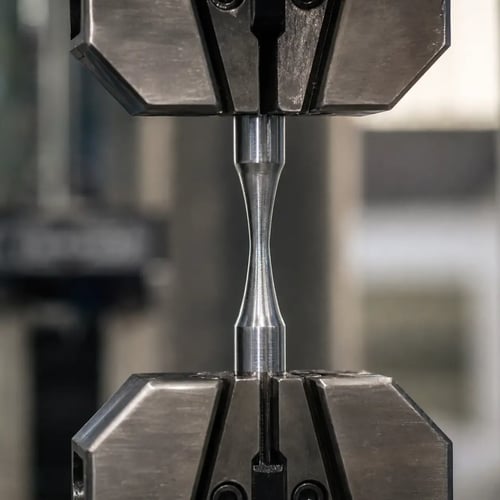
Elongation at break is a parameter much more sensitive to the test conditions and to the material's microstructure than the yield strength and the tensile strength. The main factors that influence it are:
- Gauge length L₀ → for the same material, A% values measured on different gauge lengths aren't comparable.
- Test temperature → In most metals, ductility increases as temperature rises. Conversely, in ferritic steels and cast irons, low temperatures can cause a ductile-to-brittle transition, with a consequent drastic reduction in A%.
- Strain rate → Higher strain rates generally tend to reduce elongation, especially in polymers and in alloys sensitive to strain rate.
- Heat treatment and supply condition → Heat treatment significantly affects ductility. For example, an annealed steel has a much higher A% than the same steel in the quenched and tempered condition; similarly, a work-hardened brass has a lower A% than the annealed one.
- Direction of specimen sampling → In rolled products, the elongation measured in the rolling direction is generally higher than that measured in the transverse direction and, even more so, than that measured in the through-thickness direction.
- Fracture position → a fracture outside the gauge section or too close to the reference marks invalidates the measurement according to ISO 6892-1.
- Metallurgical quality → Inclusions, segregations, porosity and internal defects can drastically reduce ductility, even when the other mechanical parameters comply with the specifications. An A% value lower than expected is often one of the first signs of a possible material quality issue.
Why elongation at break is important for designers
For the designer, elongation at break A% is much more than a simple value reported on the material certificate. It's a fundamental safety indicator.
A ductile material, before breaking, displays visible macroscopic deformation, which can signal an overload condition during service. A brittle material, on the other hand, can fail suddenly and catastrophically, without obvious warning signs.
For this reason, the Eurocodes and the main design codes, such as ASME, VSR and AD-Merkblätter, prescribe minimum elongation at break values. These requirements serve to ensure that the component has sufficient capacity to deform before collapse and that stresses can be redistributed to the most heavily loaded zones.
In the field of forming, A%, and even more so the parameters Au and Ag, help determine the feasibility of operations such as deep drawing, bending and stamping. A sheet with too low an elongation tends, in fact, to crack before reaching the final geometry.
In welding, a ductile material is generally better able to tolerate the residual stresses generated by the joint, reducing the risk of cracks and localised failures.
In failure analysis, the elongation measured on a sample taken from a failed component, and compared with the value expected from the material specification, is one of the most immediate diagnostic indicators. An anomalous value can signal material degradation, hydrogen embrittlement, incorrect heat treatment or non-conformity with the supply specification.
In summary, correctly reading elongation at break means choosing materials with an adequate safety margin, engaging knowledgeably with suppliers and preventing failures in service.
Conclusion
Elongation at break is one of the most significant parameters of the tensile test. It doesn't only measure the material's ductility, but provides valuable indications about metallurgical quality, the component's safety and its suitability for forming processes.
To interpret it correctly, it's essential to know the reference used, for example A5, A80mm or A4d, to compare it with the values expected for the specific material and to assess it together with the other tensile test parameters, such as yield strength, tensile strength and reduction of area.
When read in the correct way, A% becomes an essential tool for designing safer components, selecting reliable suppliers and identifying any material or service problems in good time.
Do you need components with certified elongation at break
and guaranteed mechanical properties?
UPLOAD YOUR FILE AND receive A QUOTE
Frequently asked questions About Elongation at Break

 Weerg staff: Sep 30, 2026