When designing components for sectors such as automotive, electronics, industrial, UAV, or medical, material selection cannot be based solely on mechanical properties. It is essential to also consider safety regulations and certifications, such as UL94 and the so-called Blue Card (UL Yellow Card).
These standards ensure that the materials used are safe, reliable, and compliant with international regulations, particularly in terms of fire behaviour.
What is UL94 and what it certify
The UL94 standard for flame resistance
The UL94 standard (Standard for Safety of Flammability of Plastic Materials) is the international reference for classifying the combustion resistance of plastic materials. Developed by UL (Underwriters Laboratories), it is recognised and required in the electronics, aerospace, automotive, rail, and medical sectors.
UL94 classes: how to read the certification
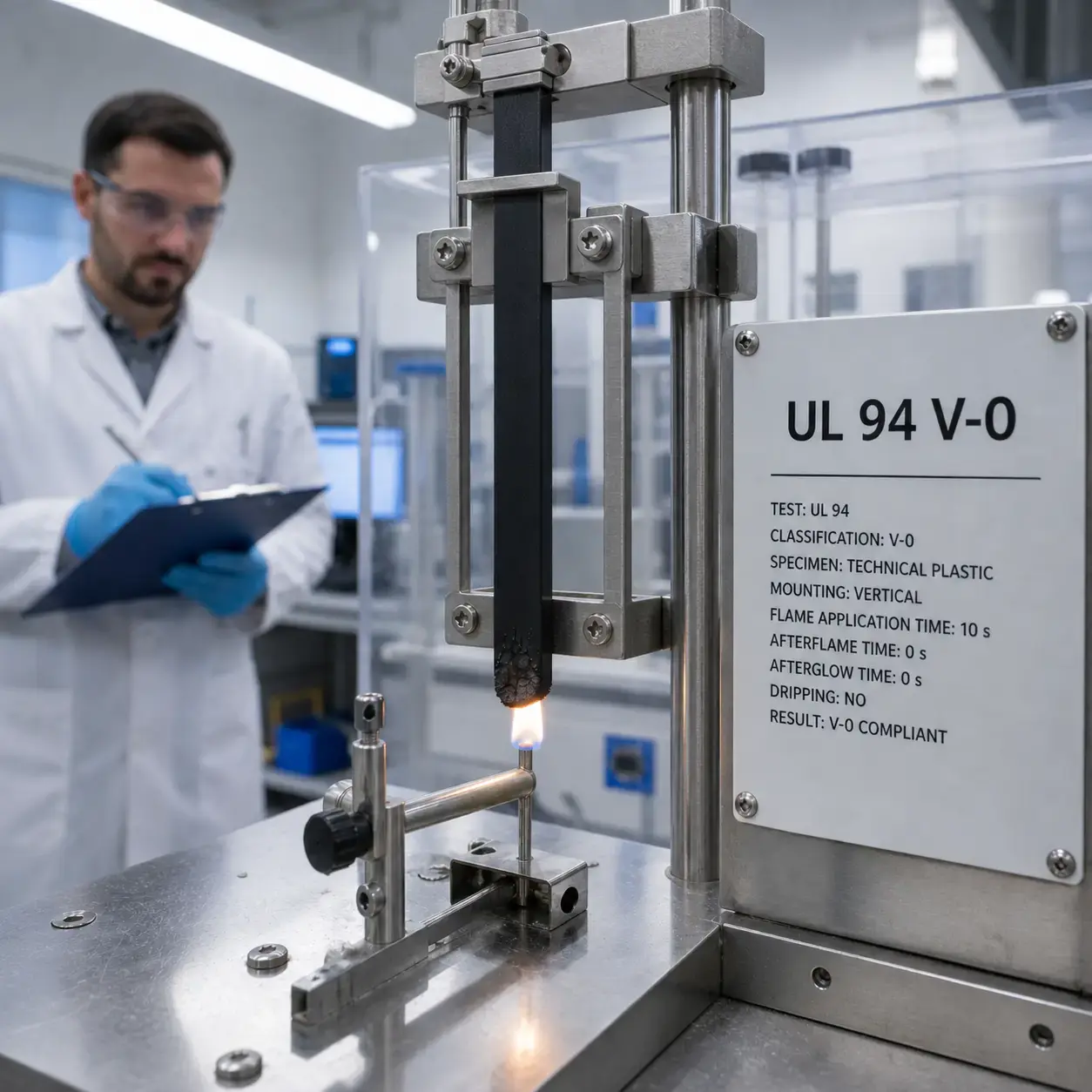
The UL94 classification is based on standardised tests that measure how quickly a material ignites, how fast it burns, and whether it drips flaming material. The main classes for vertical tests are:
- HB: slow horizontal burning, base class
- V-2: self-extinguishing within 30 seconds, flaming drips permitted
- V-1: self-extinguishing within 30 seconds, no flaming drips
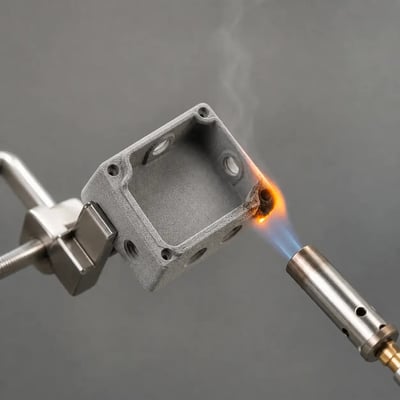
- V-0: self-extinguishing within 10 seconds, no dripping — the most restrictive class
Yellow Card vs Blue Card: a key distinction
The UL Yellow Card is the document most designers are familiar with: it certifies the flammability classification of a conventional plastic material (pellets, sheets, extrudates) based on the thickness tested.
The Blue Card was created to address a specific need in additive manufacturing: materials for 3D printing do not exist as standard sheets or pellets — they exist as powders, resins, or filaments that are transformed into a part through a complex production process. That process directly influences the final properties of the component, including flame resistance.
The Blue Card therefore certifies the UL94 classification of the finished printed part, produced with a specific technology (in the case of Weerg's PA12 FR: HP Multi Jet Fusion) and with a specific material. It is proof that the component coming out of the machine will actually possess the declared fire-retardant properties — not just the starting powder.
How to read the UL94 Blue Card for PA12 FR
The three classifications by thickness
The Blue Card for HP-certified PA12 FR material — available on Weerg — lists three distinct classifications based on the thickness of the printed component:
|
Thickness
|
UL94 classification
|
Dripping
|
|
1.0 mm
|
HB
|
-
|
|
1.8 mm
|
V-2
|
Permitted
|
|
2.5 mm
|
V-0
|
Absent
|
Orientation and reproducibility
The Blue Card certifies fire behaviour in all three print orientations (XYZ), confirming that the fire-retardant properties are isotropic and uniform throughout the component.
What the Blue Card does not certify
The Blue Card attests the UL94 classification under standardised test conditions. It does not replace any final product certification required by sector-specific regulations (e.g. EN 45545 for rail, DO-160 for aerospace). It is, however, an essential documentary prerequisite, often contractually required by clients and system integrators.
Why the Blue Card is relevant for industrial 3D printing
The problem of certifications for additive materials
Until a few years ago, those wishing to use 3D printing for components in regulated sectors faced a documentary gap: the materials existed, the machines produced functional parts, but the Yellow Card certification was not directly applicable to additive processes.
The Blue Card resolves this problem. It provides designers with a formally recognised qualification tool at international level, making it possible to incorporate 3D-printed components into products that must comply with certified fire safety requirements.
Applications where the Blue Card is required or recommended
UL94 and the Blue Card for PA12 FR are particularly relevant in the following fields:
-
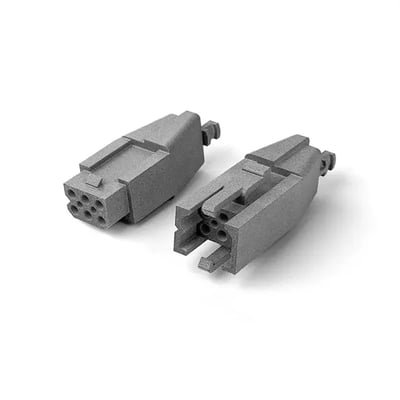
Electronics and power electronics: PCB enclosures, high-voltage connector supports, battery housings.
-
Professional drones and industrial UAVs: drones used for industrial inspections, infrastructure monitoring, and logistics applications incorporate high-energy LiPo batteries and critical electronic components. UL94 V-0 certification on structural components and battery compartment covers adds a documented layer of passive safety, also relevant to EASA certification processes in the "specific" category.
-
Automotive and transport: supports and housings for electronic components in vehicles where fire safety is a type-approval requirement.
-
Rail: the EN 45545 standard requires certified documentation on the fire behaviour of materials. The Blue Card constitutes a formal starting point for the qualification process.
-
Aerospace and defence: internal components, structural supports, and avionics housings where weight must be minimised without compromising safety.
Weerg's PA12 FR: the Blue Card as a process guarantee
Why the process is as important as the material
Having the Blue Card does not simply mean using the right material — it means producing it in the right way. HP's certification for PA12 FR is specifically linked to Multi Jet Fusion (MJF) technology and the process parameters controlled by HP and certified service providers.
Weerg produces PA12 FR using certified HP machines, following the process parameters validated by HP to maintain the certified fire-retardant properties. This means that every component ordered on Weerg in PA12 FR inherits the documentary coverage of the Blue Card.
Technical characteristics of Weerg's PA12 FR
In addition to UL94 certification, PA12 FR maintains the typical mechanical properties of PA12.
The material is also Halogen-Free: the flame-retardant additives do not release halogens during combustion, in compliance with the most recent environmental and safety regulations (RoHS, REACH).
Conclusion
UL94 and the Blue Card are the tools that transform 3D printing from a prototyping technology into a certified solution for industrial components in regulated sectors. Understanding the difference from the Yellow Card — and knowing exactly what it does and does not certify — is the starting point for every designer or procurement manager who needs to qualify fire-retardant components.
Weerg's PA12 FR is one of the few 3D printing materials with HP-certified Blue Card and UL94 V-0, a traceable production process, and delivery in under 4 days.
UPLOAD YOUR 3D FILE AND RECEIVE AN INSTANT QUOTE FOR YOUR PA12 FR COMPONENTS
Frequently asked questions on UL94 and Blue Card

 Weerg staff: Sep 23, 2026