Laser cutting is one of the most widespread and efficient production technologies for transforming a metal sheet into a finished component. A concentrated beam of light cuts the metal with precision and speed, without mechanical contact, following the profiles defined in a digital file.
For designers and technicians, understanding how laser cutting works, which factors influence its cost, which materials and thicknesses can be worked and when to prefer it over other technologies is fundamental to choosing the most suitable process. This guide illustrates the operation of laser cutting, the factors that determine its cost, the materials available for online laser cutting at Weerg and the differences compared with CNC machining.
What Laser Cutting is
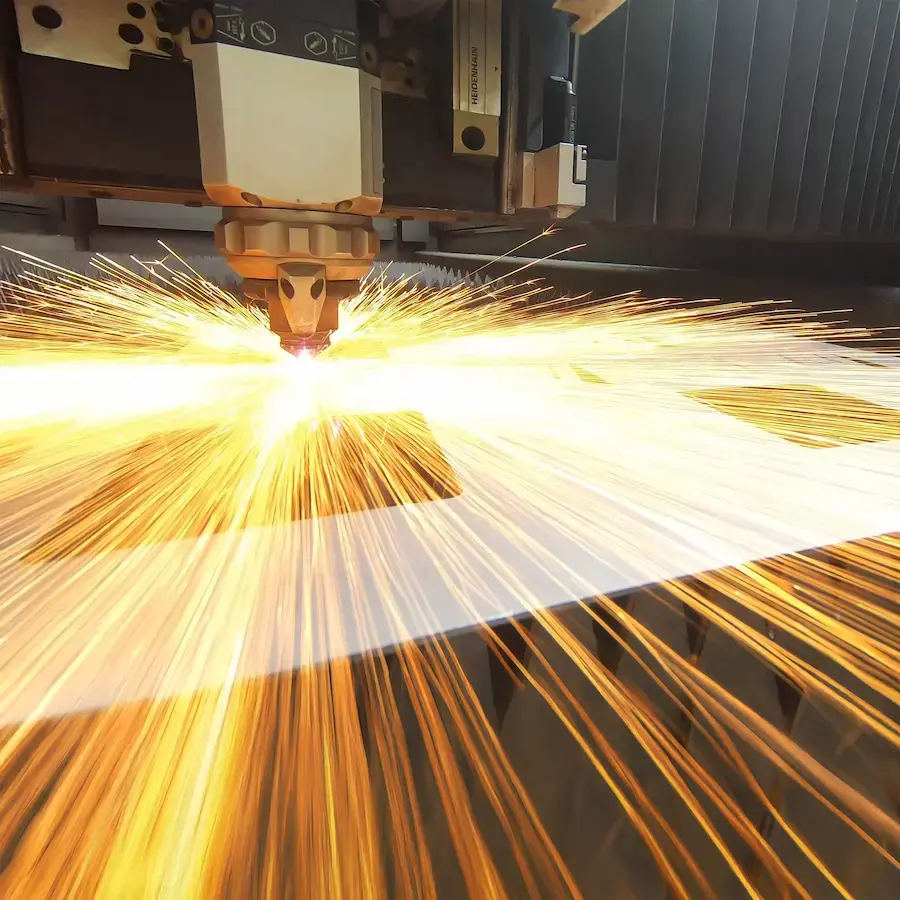
Laser cutting is a thermal process that uses a high-energy-density laser beam to melt, vaporise or burn the material along a defined path, obtaining clean, precise cuts. The term “laser” is the acronym for Light Amplification by Stimulated Emission of Radiation and indicates a technology that generates a coherent, monochromatic beam of light, focusable on a point of a few tenths of a millimetre.
Laser cutting is a two-dimensional process that works flat sheets, obtaining shaped profiles without modifying their thickness. Unlike CNC machining, it doesn’t allow the creation of three-dimensional geometries such as pockets, reliefs or threaded holes, but it offers high speeds and contained costs in the production of flat components.
The main advantages of laser cutting are:
- High precision: it creates complex profiles with tight tolerances.
- Absence of mechanical contact: the beam doesn’t exert forces on the part, reducing the risk of mechanical deformations even on thin sheets.
- Speed: it cuts metres of profile per minute and makes it possible to obtain hundreds of parts from a single plate.
- Geometric versatility: it allows any 2D profile to be obtained, from simple shapes to decorative fretwork.
- No tool wear: the laser beam isn’t consumed like a cutter or a drill.
- Clean edges: with adequate gas and cutting parameters, the edges often don’t require further finishing.
How the Laser Cutting Process Works
The laser cutting process is articulated in four main stages.
1. Generation and focusing of the beam
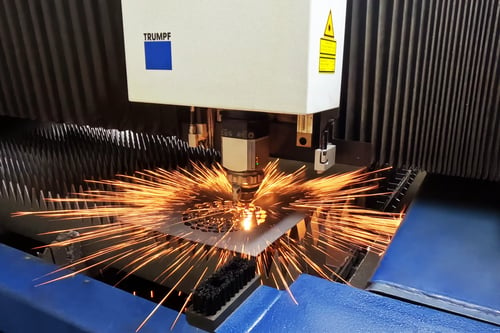
For cutting metals, fibre lasers are predominantly used, which have progressively replaced the traditional CO₂ lasers thanks to their greater efficiency and high cutting performance. The beam reaches the cutting head, where a lens focuses it on a point of a few tenths of a millimetre, concentrating a high power density.
2. Melting and vaporisation of the material
At the focal point, the energy of the beam is so concentrated that it melts and partially vaporises the metal almost instantly. The cutting head follows the path programmed from the CAD file, keeping the beam focused on the material.
3. Expulsion of the molten material with assist gas
A jet of assist gas, coaxial with the beam, expels the molten metal from the cutting slot, called the kerf. The choice of gas depends on the material and the desired finish:
- Nitrogen: it avoids oxidation and leaves a clean, shiny edge. It’s used above all for stainless steel and aluminium when an oxide-free edge is required.
- Oxygen: it reacts with the metal, accelerating the cutting of thicker carbon steels, but it leaves an oxidised edge.
- Compressed air: it represents an economical solution for various materials and medium thicknesses.
4. Movement and completion of the cut
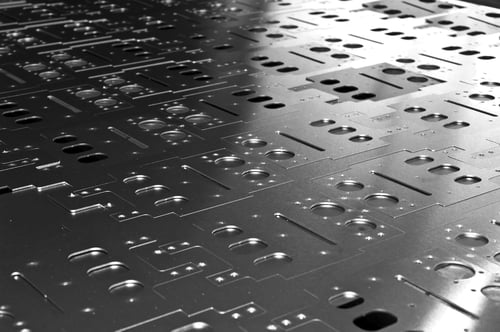
The cutting head follows the contours of the part and of the internal holes, separating the components from the sheet. Before machining, a nesting algorithm optimises their arrangement on the plate to reduce scrap and maximise the number of parts obtainable.
The heat-affected zone (HAZ)
Being a thermal process, laser cutting generates along the edges a heat-affected zone (HAZ), a thin band in which the heat can modify the microstructure of the metal, influencing its hardness, residual stresses and, sometimes, colouring. With nitrogen the HAZ is generally contained, while with oxygen it can turn out more marked. In most applications its effects are negligible, but they should be considered when uniform properties up to the edge are required.
How much laser cutting costs
The cost of laser cutting depends on different factors than CNC machining or 3D printing. Understanding them helps to design more economical components.
The factors that determine the cost
- Length of the cutting perimeter. The cost depends largely on the total length of the cut, which includes the external perimeter and that of all the internal holes. The longer the path of the laser, the greater the machine time. For the same size, a component with few holes costs less than one with complex profiles and numerous fretwork.
- Thickness and type of material. As the thickness increases, the cutting speed decreases and the cost per metre rises. The material too has an influence: carbon steel is generally cut faster than aluminium and brass, characterised by high reflectivity and thermal conductivity. To the cost of the machining is added that of the sheet.
- Quantity produced. Laser cutting is particularly competitive in series production. Making several parts makes it possible to distribute the machine set-up costs, reducing the unit price.
- Scrap and nesting. Scrap is the part of the sheet that isn’t used to make the components. Efficient nesting optimises the arrangement of the parts on the plate, reducing waste and material consumption. Geometries that leave large empty spaces, on the other hand, increase costs.
How to design to reduce the cost of laser cutting
To find out the cost of the machining, simply upload the file to Weerg’s online configurator: the quote is calculated automatically according to geometry, material, thickness and quantity.
The materials for laser cutting at Weerg
Weerg offers online laser cutting for four metals, each with specific properties and maximum thicknesses. All provide maximum cutting dimensions of 1200 × 800 mm and tolerances compliant with the ISO 2768-1 standard, class c.
Stainless steel 304 (X5CrNi18-10)
304 stainless steel is one of the most versatile austenitic alloys, thanks to its excellent corrosion resistance and ease of welding, machining and sanitisation. It’s particularly indicated for food, pharmaceutical, architectural and industrial applications.
- Tensile strength: 520 MPa
- Elongation at break: 35%
- Yield strength: 185 MPa
- Density: 8 g/cm³
- Maximum cutting thickness: 12 mm
Typical applications: equipment for the food industry, mechanical components, architectural elements for exteriors and stainless steel structural work.
Pickled iron (carbon steel)
Pickled iron is a carbon steel subjected to a treatment that removes the rolling oxides, leaving a clean surface ready for painting or other treatments. Economical, strong, easily machinable and weldable, it’s widely used in structural applications.
- Tensile strength: 450 MPa
- Elongation at break: 10%
- Yield strength: 235 MPa
- Density: 7.8 g/cm³
- Maximum cutting thickness: 12 mm
Typical applications: coverings, automotive components, household appliances, metal structures for construction and structural steelwork.
Aluminum 5754 (Al-Mg)
Aluminium 5754 is an alloy of aluminium and magnesium characterised by lightness, good machinability and excellent corrosion resistance, even in aggressive environments such as the marine one.
- Tensile strength: 190 MPa
- Elastic modulus: 70 GPa
- Density: 2.67 g/cm³
- Maximum cutting thickness: 5 mm
Typical applications: naval sector, pressure vessels, lorries, tankers and lightweight corrosion-resistant components.
Brass OT63 (CW508L / CuZn37)
Brass OT63 is a lead-free alloy of copper and zinc, NSF/ANSI 372 certified, that combines good mechanical properties and a characteristic golden finish. Thanks to its compliance with the requirements on lead content for drinking water, it’s suited to various aesthetic and functional applications.
- Tensile strength: from 350 to 440 MPa
- Elongation at break: 19%
- Density: 8.5 g/cm³
- Thermal conductivity: 120 W/mK
- Maximum cutting thickness: 1.5 mm
Typical applications: metal structural work, furniture, window/door fittings, electrotechnical industry, advertising design, precision components, musical instruments and jewellery.
Laser cutting vs CNC machining: when to choose one or the other
Laser cutting and CNC machining are two complementary technologies. The choice depends mainly on the geometry of the component and the machining requirements.
When to Choose Laser Cutting
- The component is flat and must be obtained from a sheet.
- Complex profiles, holes, fretwork or decorative geometries are required.
- It’s necessary to produce series of identical parts, optimising times and costs.
- Speed and economic convenience are priorities.
- The thickness of the sheet falls within the laser’s machining limits.
When to choose CNC machining
- The component presents three-dimensional geometries, such as pockets, reliefs or surfaces at different depths.
- Threaded holes are needed, which laser cutting can’t make directly.
- Very tight tolerances are required, even below ±0.1 mm.
- The surfaces must have a finish with a controlled roughness.
- The part must be obtained from blocks or bars of solid material, rather than from a sheet.
Comparison between laser cutting and CNC machining
| Aspect |
Laser cutting |
CNC machining |
| Dimensionality |
2D, from sheet |
3D, also from block or bar |
| 3D geometries |
No |
Yes, including pockets and reliefs |
| Tolerances |
ISO 2768, class c |
Indicatively from ±0.05 to ±0.1 mm |
| Speed in series production |
Very high thanks to nesting |
Variable according to the geometry |
| Threads |
No |
Yes |
| Thicknesses and dimensions |
Limited by the sheet and the cutting capacity |
Depend on the machine and the material |
| Cost of flat components |
Generally contained |
Generally higher |
| Materials |
Metal sheets |
Metals and plastics |
|
Conclusion
Laser cutting is an ideal solution for producing flat metal components with complex profiles, holes and fretwork, combining precision, speed and contained costs, especially in series production. Thanks to the absence of mechanical contact and the optimisation of the nesting, it makes it possible to efficiently make both single parts and large quantities.
For components with three-dimensional geometries, threads or particularly tight tolerances, CNC machining represents the more suitable choice. The two technologies can also be combined, using the laser to obtain the profiles and CNC to complete the more complex machining.
Knowing the advantages, the available materials and the limits of each process makes it possible to identify the most suitable solution for each project.
Do you have a flat component to cut by laser?
Upload your file and get a quote
Frequently Asked Questions

 Weerg staff: Oct 21, 2026