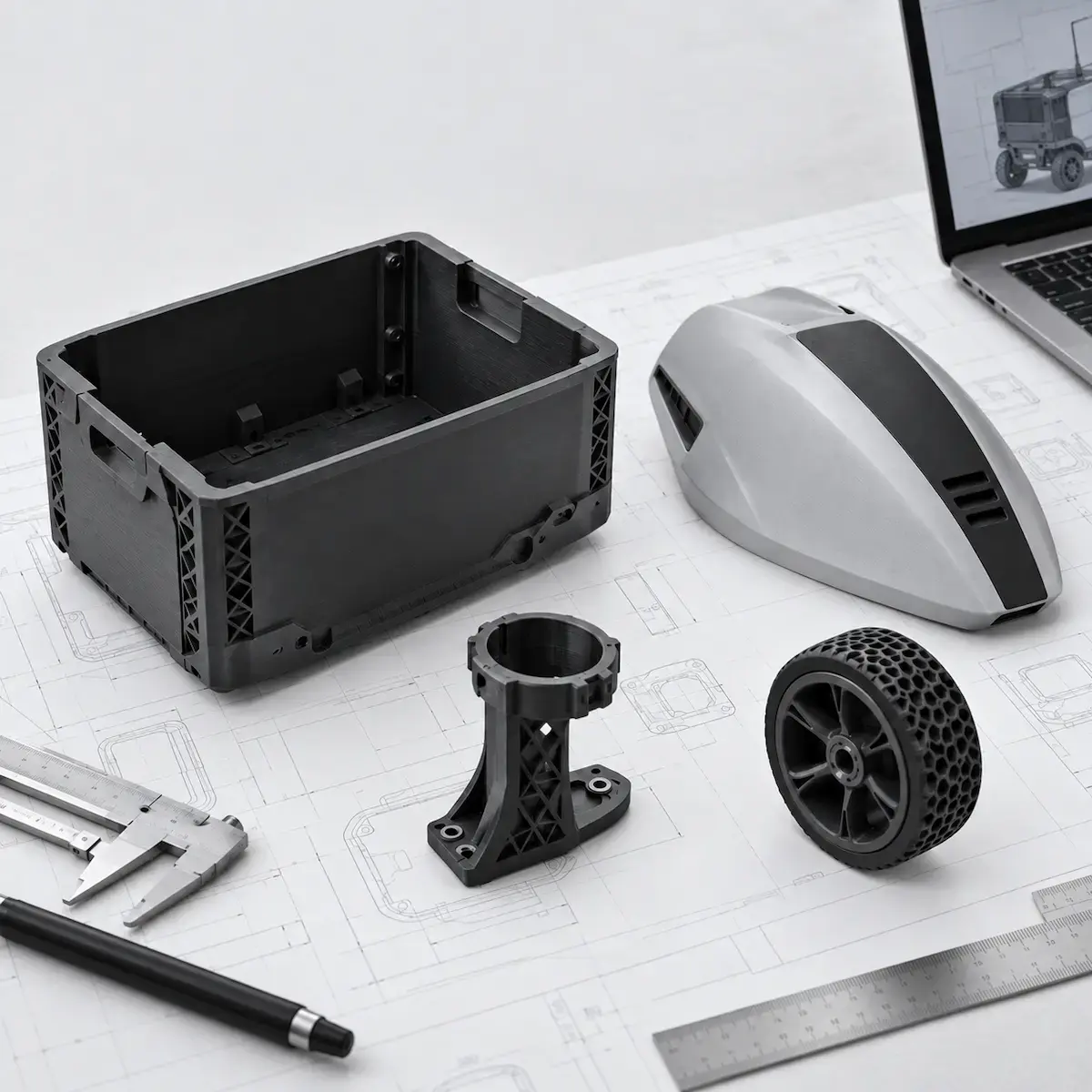
Polyamide, commercially known as nylon, is one of the most widely used engineering polymers in industry.
In this guide, we examine the main types of polyamide (PA6, PA66, PA11, PA12 and filled grades) their key properties and the practical criteria for selecting the right grade.
What is polyamide?
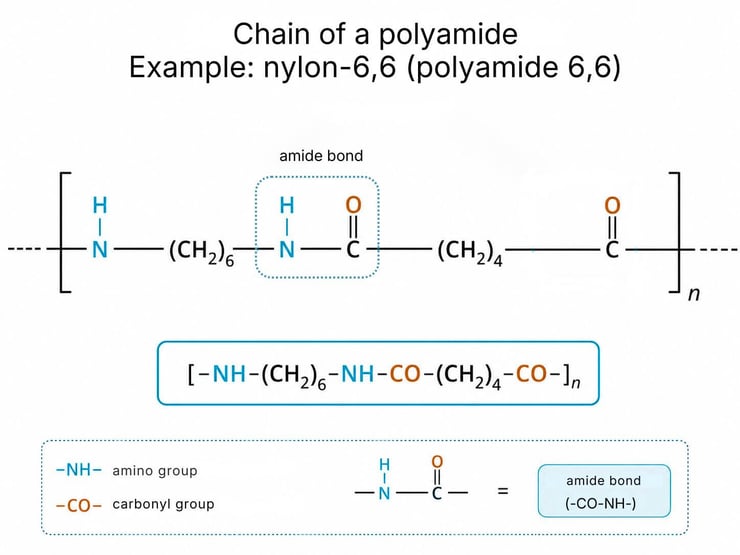
Polyamide is a semicrystalline thermoplastic polymer characterised by the presence of amide groups (–CO–NH–) in the main chain. These groups give the material high mechanical strength, good toughness, wear resistance and chemical stability.
The most common polyamides are divided into two chemical families:
-
PA “AB”, obtained from a monomer that already contains both the amino group and the carboxylic group, such as PA6, PA11 and PA12;
-
PA “AABB”, obtained by polycondensation of a diamine and a dicarboxylic acid, such as PA66, PA46, PA610 and PA612.
The standard nomenclature is straightforward: the number indicates the number of carbon atoms in the monomer, so PA6 means 6 carbon atoms. In double-number grades, AABB, the first number indicates the carbon atoms in the diamine and the second those in the dicarboxylic acid. PA66 therefore means a six-carbon diamine plus a six-carbon dicarboxylic acid.
What are the general properties of polyamide?
Polyamide offers an excellent balance between performance and cost:
-
high mechanical and fatigue strength for an unreinforced polymer;
-
wear resistance and a low coefficient of friction, making it suitable for moving parts;
-
good chemical resistance to oils, greases, hydrocarbons and many solvents;
-
continuous service temperature up to 80–100 °C for PA6/PA66, and above 150 °C for PA46;
-
good dry dimensional stability, although this is affected by moisture absorption.
The main types of polyamide
There are dozens of polyamide grades available on the market, but five cover more than 90% of industrial applications.
PA6 (polyamide 6)
Produced by polymerisation of caprolactam, PA6 is the most widely produced polyamide in Europe. Key characteristics:
-
melting temperature of approximately 220 °C;
-
excellent toughness and impact strength, even at low temperatures;
-
higher moisture absorption than PA66, up to 9–10% at saturation.
It is the preferred grade for bushes, moderately loaded gears, extruded semi-finished products such as rods and sheets, connectors and automotive components.
PA66 (polyamide 66)
PA66 is a polymer produced from hexamethylenediamine and adipic acid. Compared with PA6, it has a higher melting temperature, around 260 °C, greater stiffness, better creep resistance and slightly better dimensional stability. Conversely, it is more expensive and less tough at low temperatures.
Typical applications include highly loaded gears, mechanical parts operating in hot environments, under-bonnet components, cable ties and technical fasteners.
PA11 and PA12 (“long-chain” polyamides)
PA11 and PA12 are produced from long-chain monomers, partly from bio-based sources. PA11 is derived from castor oil. Their distinctive characteristics are:
-
very low moisture absorption, around 1–2% at saturation compared with 9–10% for PA6, resulting in excellent dimensional stability;
-
excellent chemical and hydrolysis resistance;
-
high flexibility and fatigue strength, even at low temperatures.
They are the standard choice for flexible tubing in fuel and compressed-air circuits, coatings, under-bonnet automotive components, medical applications and additive manufacturing, including MJF.
For further detail, read our guide: PA12 vs. PA11: What Are the Differences?
 PA46
PA46
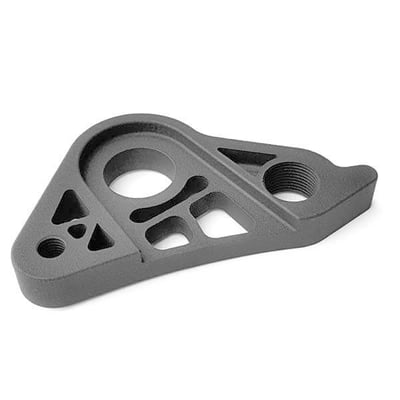
PA46 is a polyamide with high thermal performance, a melting temperature of approximately 295 °C and very rapid crystallisation. It is used for under-bonnet parts close to the engine, high-temperature gears and electrical components in hot environments. Its cost is significantly higher.
It should be noted that, despite its excellent high-temperature behaviour, PA46 is the most hygroscopic of the polyamides considered here. In very humid environments, the effect of water uptake must therefore be assessed.
Filled polyamides
The addition of mineral fillers or fibres can drastically modify the properties of the base polymer:
- PA6 GF30 / PA66 GF30 (30% glass fibre): doubles mechanical strength and almost triples the elastic modulus; drastically reduces creep and elongation at break. It is the standard material for low-cost structural components as an alternative to light alloys.
- PA12 GB (glass beads): unlike fibres, glass beads are spherical fillers that improve stiffness and dimensional stability while maintaining isotropic properties. This is the reference material for applications requiring uniform mechanical behaviour.
- Carbon-fibre-filled PA (CF): even stiffer and lighter, used where weight reduction and performance justify the cost, such as sport, aerospace and robotics.
- PA with MoS₂ or PTFE: improves the coefficient of friction and wear resistance, making it suitable for self-lubricating bushes and gears.
- Mineral-filled PA (talc, mica): improves dimensional stability and surface finish at contained cost.
Moisture absorption: the critical point of polyamides
Unlike other engineering polymers such as POM, PEEK and PBT, polyamide is hygroscopic: it absorbs moisture from the environment, producing two opposing effects.
The positive effect is an increase in toughness and impact strength. A moisture-conditioned polyamide performs better under dynamic loads than a freshly moulded one.
The negative effect concerns dimensional stability and mechanical properties. Water acts as a plasticiser, reduces the elastic modulus and hardness, and causes the part to swell, up to 0.5–1% in linear dimensions for PA6.
For the design engineer, this means three things:
-
tolerances must be specified while taking the operating environment into account; PA6 in a saturated environment expands more than PA12 with the same geometry;
-
specifications must state whether the required properties refer to DAM (Dry As Moulded, i.e. dry polymer) or conditioned material (at equilibrium with 50% relative humidity); depending on the condition, the elastic modulus can vary by 30–50%;
-
surface finishes that seal surface microporosity and make the part water-repellent, such as vapor smoothing, should be considered. The surface becomes sealed against liquid water, while the bulk polymer remains hygroscopic with respect to atmospheric humidity.
Comparison of the Main Polyamides
|
Type
|
Tm (°C)
|
Rm (MPa)
|
E modulus (GPa)
|
H₂O Absorption (24h, %)
|
Notes
|
|
PA6
|
220
|
70–85
|
2.8–3.2
|
1.5–2
|
Tougher, lower cost
|
|
PA66
|
260
|
80–90
|
3.0–3.3
|
1.2–1.5
|
Stiffer, more stable at temperature
|
|
PA11
|
190
|
50–60
|
1.0–1.4
|
0.3
|
Bio-based, flexible, stable
|
|
PA12
|
178
|
50–60
|
1.2–1.6
|
0.25
|
Excellent dimensional stability
|
|
PA46
|
295
|
100
|
3.3
|
3.5
|
High-temperature applications
|
|
PA6 GF30
|
220
|
170–180
|
9–10
|
1.3
|
Structural, low cost
|
|
PA66 GF30
|
260
|
190–200
|
10–11
|
1.1
|
Structural, high temperature
|
Indicative values for DAM (Dry As Molded) material. The absorption column reports the value after 24 hours of immersion and should not be confused with the saturation values cited in the text, which are significantly higher, for example 9–10% for PA6. Conditioned properties are significantly lower, especially for PA6 and PA66.
How to choose the right polyamide
To identify the most suitable polyamide for a given application, the following factors must be assessed:
- Operating temperature
up to 80 °C → PA6;
up to 100–120 °C → PA66;
over 150 °C → PA46 or filled grades.
- Mechanical loads
moderate loads → unfilled PA6/PA66;
structural loads → GF30 or CF grades.
- Environment
Humid environment or in contact with fluids → PA11/PA12;
dry environment → PA6/PA66.
- Dimensional Stability
Tight tolerances → PA12 or filled PA;
Wide tolerances → PA6.
- Cost
PA6 is the most lowest-cost option;
PA46 and carbon-fibre-filled PA are premium grades.
- Compliance
For food contact, automotive and medical applications, specific approvals must be checked, such as FDA, USP Class VI and UL.
Why understanding polyamide matters for design engineers
Selecting the wrong polyamide grade is one of the most costly mistakes in polymer component design. The problem is that it often does not appear immediately, but only after weeks or months of service: PA6 used in a very humid environment can absorb water, change dimensions and lose stiffness; PA66 replaced by PA6 in a gear can fail due to creep; a GF30 polyamide specified as “DAM” may show a much lower modulus under real operating conditions than expected, potentially falling by as much as half.
Conclusion
Polyamide is the most versatile engineering polymer in the industrial sector.
Selecting it correctly means starting from the design requirements and translating them into the right grade, with DAM or conditioned properties properly specified. When this is done, polyamide is one of the most reliable and efficient materials a design engineer can use.
Do you need to manufacture polyamide components with guaranteed properties?
UPLOAD YOUR FILE AND GET AN INSTANT QUOTE
Frequently Asked Questions About Polyamide

 Weerg staff: Sep 30, 2026