The tensile test is the most widely used mechanical test in the world for characterising materials. A single test provides the data that every engineer uses on a daily basis: elastic modulus, yield strength, tensile strength and ductility.
In this article, we examine what the tensile test is, how it is performed according to ISO and ASTM standards, which laboratory best practices should be followed and why this data is crucial for design and quality control.
What Is the Tensile Test?
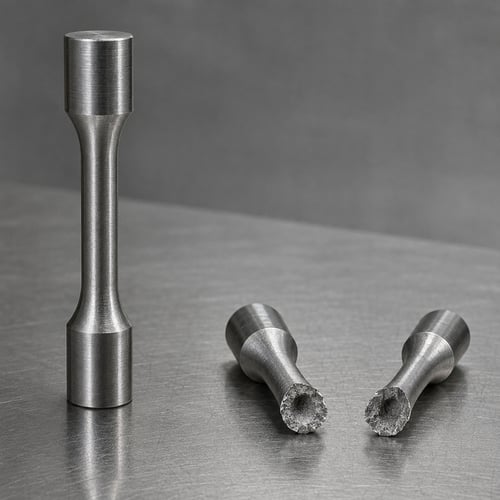
The tensile test is a destructive mechanical test. A specimen with a standardised geometry is “pulled” along its axis under an increasing load until it breaks.
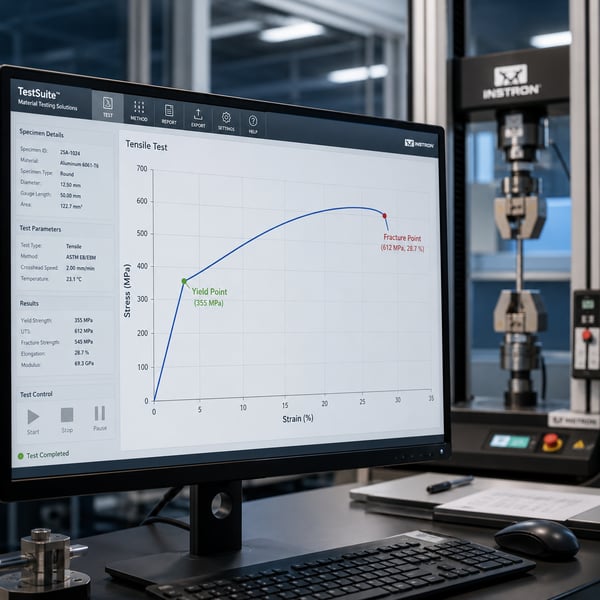
During the test, the machine continuously records the applied force and the elongation of the specimen. From this data, the stress-strain curve is obtained: the material’s true mechanical identity card.
In summary, the tensile test answers three fundamental questions:
- How stiff is the material? → Young’s modulus (E)
- How much load can it withstand before deforming permanently or breaking? → yield strength (Rp0.2) and tensile strength (Rm)
- How ductile is it? → elongation at break (A%) and reduction of area (Z%)
Which standard regulates the tensile test?
The performance of the test is strictly codified to ensure repeatability and comparability of results between different laboratories. The main standards are:
-
UNI EN ISO 6892-1: the reference standard in Europe for metallic materials
-
ASTM E8/E8M: the American equivalent for metallic materials
-
ISO 6892-2: tensile test at elevated temperature
-
UNI EN ISO 527: tensile test for plastics and composites
-
ISO 6892-3 and ISO 6892-4: tests at low temperature and in liquid helium
Values obtained according to different standards are not always directly comparable.
How a Tensile Test is performed
Let us look step by step at how the test works in the laboratory.
1. SPECIMEN PREPARATION
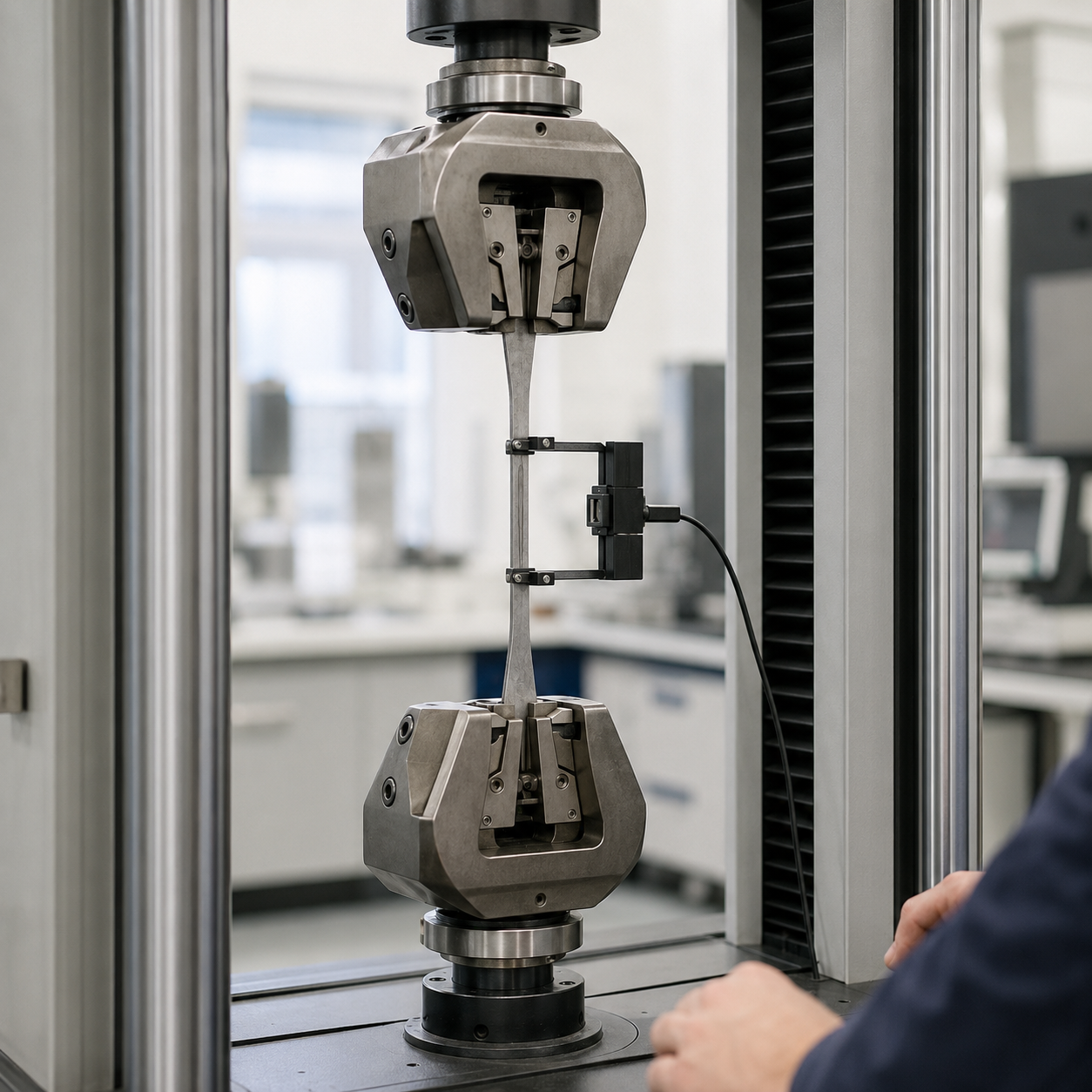
The specimen is taken from the material to be tested and machined to a standardised geometry: cylindrical for bars and forgings, flat for sheets and strips. The gauge length L₀ is proportional to the initial cross-sectional area S₀; for standard ISO specimens, L₀ = 5.65·√S₀.
Machining is critical: roughness, surface defects and misalignment can distort the results.
2. MOUNTING ON THE TESTING MACHINE
The specimen is gripped by the jaws of a universal testing machine, equipped with a load cell calibrated according to ISO 7500-1. An extensometer, either contact or optical, is applied to the gauge section to measure the actual elongation of the material.
A practical tip: to measure the elastic modulus and Rp0.2, crosshead displacement is not sufficient; an extensometer is always required.
3. TEST EXECUTION AND GRAPH INTERPRETATION: THE STRESS-STRAIN CURVE
The machine applies the load at a controlled rate. ISO 6892-1, Method A, specifies control by strain rate. The resulting curve shows four stages:
-
Elastic region: stress and strain are proportional, according to Hooke’s law; the slope is the material’s Young’s modulus (E).
-
Yielding: permanent plastic deformation begins.
-
Strain hardening: the material continues to withstand load up to the maximum stress, Rm.
-
Necking and fracture: deformation concentrates in a section that narrows until fracture occurs.
WHICH PARAMETERS ARE OBTAINED FROM A TENSILE TEST?
The test determines the parameters found in every inspection certificate (EN 10204 3.1) and every material datasheet:
-
Elastic modulus E [GPa]
-
Yield strength Re, ReH/ReL or Rp0.2 [MPa]
-
Tensile strength Rm [MPa]
-
Percentage elongation at break A [%]
-
Reduction of area Z [%]
Best practices
To ensure repeatable results and proper comparability, several key criteria must be followed:
-
Always specify the reference standard in technical specifications: ISO and ASTM results are not directly comparable.
-
Control the test speed: almost all materials are sensitive to strain rate; higher speeds increase the measured yield values.
-
Ensure correct alignment: a misaligned specimen is subjected to parasitic bending, which causes apparent yielding to occur earlier.
-
Respect the sampling direction: in rolled products, properties vary between the rolling direction and the transverse direction.
-
Check the fracture location: a fracture outside the gauge section invalidates the test measurement.
Why the tensile test is central to design
The tensile test is central to design because it provides direct knowledge of a material’s mechanical behaviour when subjected to stress.
The test provides fundamental properties such as elastic modulus, yield strength, tensile strength and elongation at break, which indicate how stiff, strong and deformable a material is. This data is essential for selecting the most suitable material, correctly sizing a component and predicting its behaviour in service.
In this way, the designer can avoid sudden failures, ensure structural safety and optimise the weight, cost and performance of the final product.
Conclusions
The tensile test is the foundation of mechanical characterisation: a standardised, fast and cost-effective test that provides the data on which design, simulation and quality control are based. Understanding how the test is performed, which standards regulate it and how to interpret the results makes it possible to design using reliable data, choose the right suppliers and prevent in-service failures.
Do you have a project that requires materials with guaranteed mechanical properties?
Upload your file
Manufacture with certified materials and receive your quote immediately.
Frequently Asked Questions About the Tensile Test


 Weerg staff: Aug 26, 2026