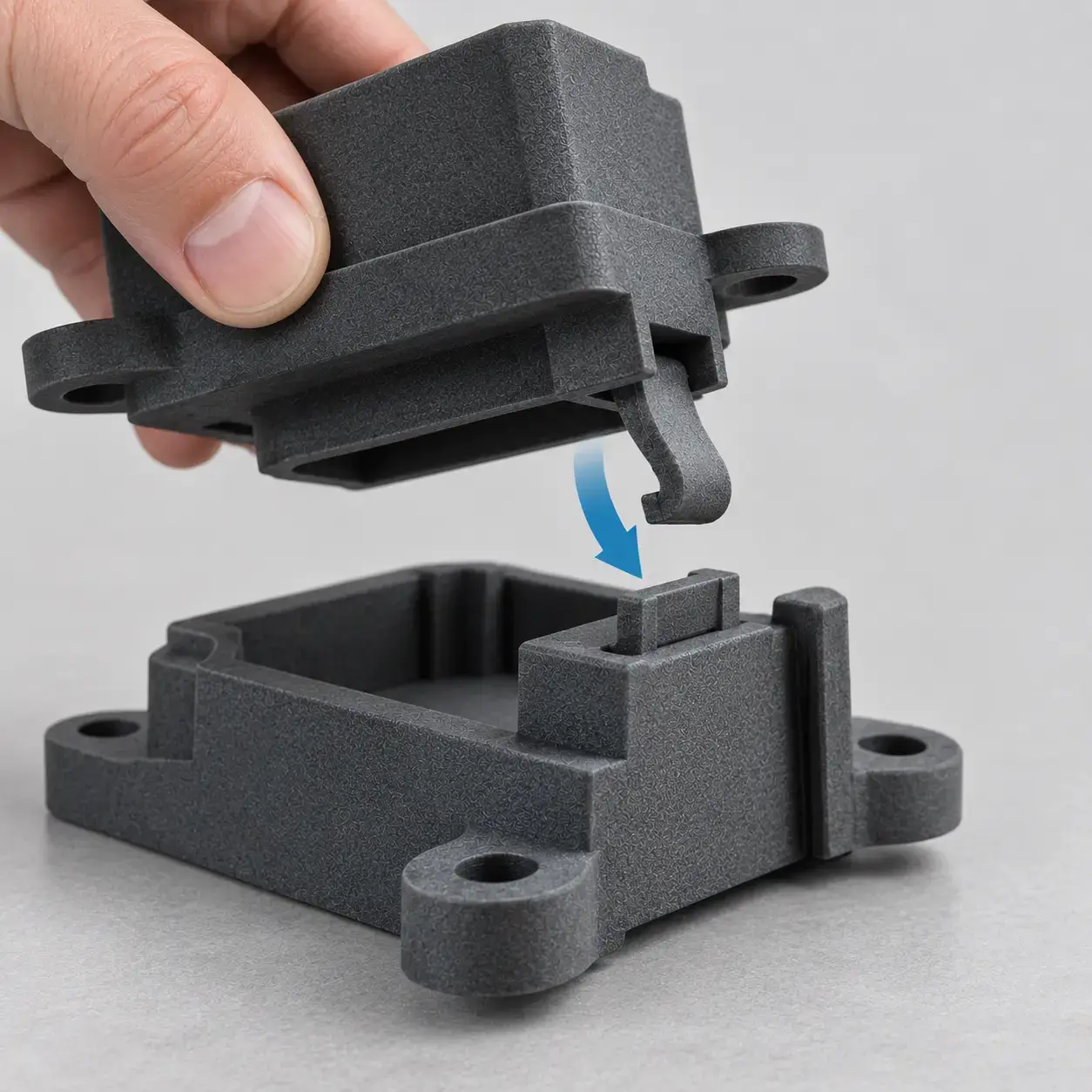
MJF, FDM or resin? It's the first question anyone with a 3D file to produce asks themselves. Each technology offers different performance, materials, tolerances and costs; choosing the most suitable one directly affects production times, budget and the final result of the project. A wrong choice can lead to rework, reprints or technical compromises that could have been avoided with an informed decision upstream.
This guide compares the three main families of 3D printing used today in the industrial field: Multi Jet Fusion (MJF), Fused Deposition Modeling (FDM) and MSLA resin printing, with a decision table, selection criteria by application and specific recommendations for sectors such as medical and aerospace.
The three technological families of 3D printing
In the industrial field, the dozens of existing additive technologies can be traced back to three large families based on the physical principle of material consolidation:
- Powder sintering → MJF, SLS: layers of polymer powder selectively fused by chemical agents and/or laser;
- Filament extrusion → FDM: thermoplastic filament heated and extruded layer by layer;
- Resin photopolymerisation → MSLA, SLA, DLP: liquid resin solidified by UV/visible light according to a pattern.
Each technology makes it possible to produce components with very different characteristics in terms of available materials, precision, surface finish, mechanical performance and cost. Knowing how to identify the solution best suited to a specific project is one of the fundamental skills of the designer who has mastered additive manufacturing.
Do you need to produce thousands of parts quickly, maintaining quality
and repeatability across the entire batch?
Upload your file and get an instant quote
Multi Jet Fusion (MJF)
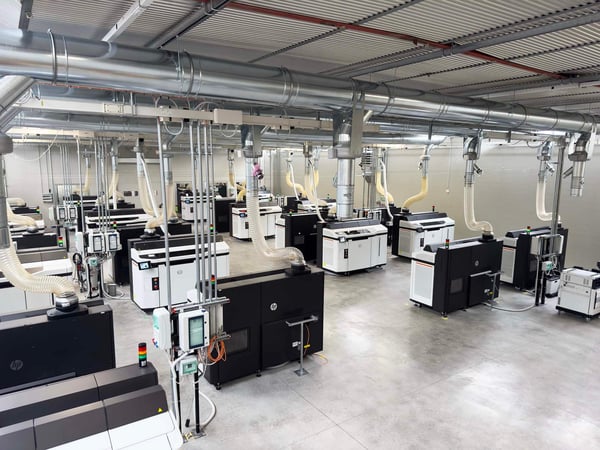
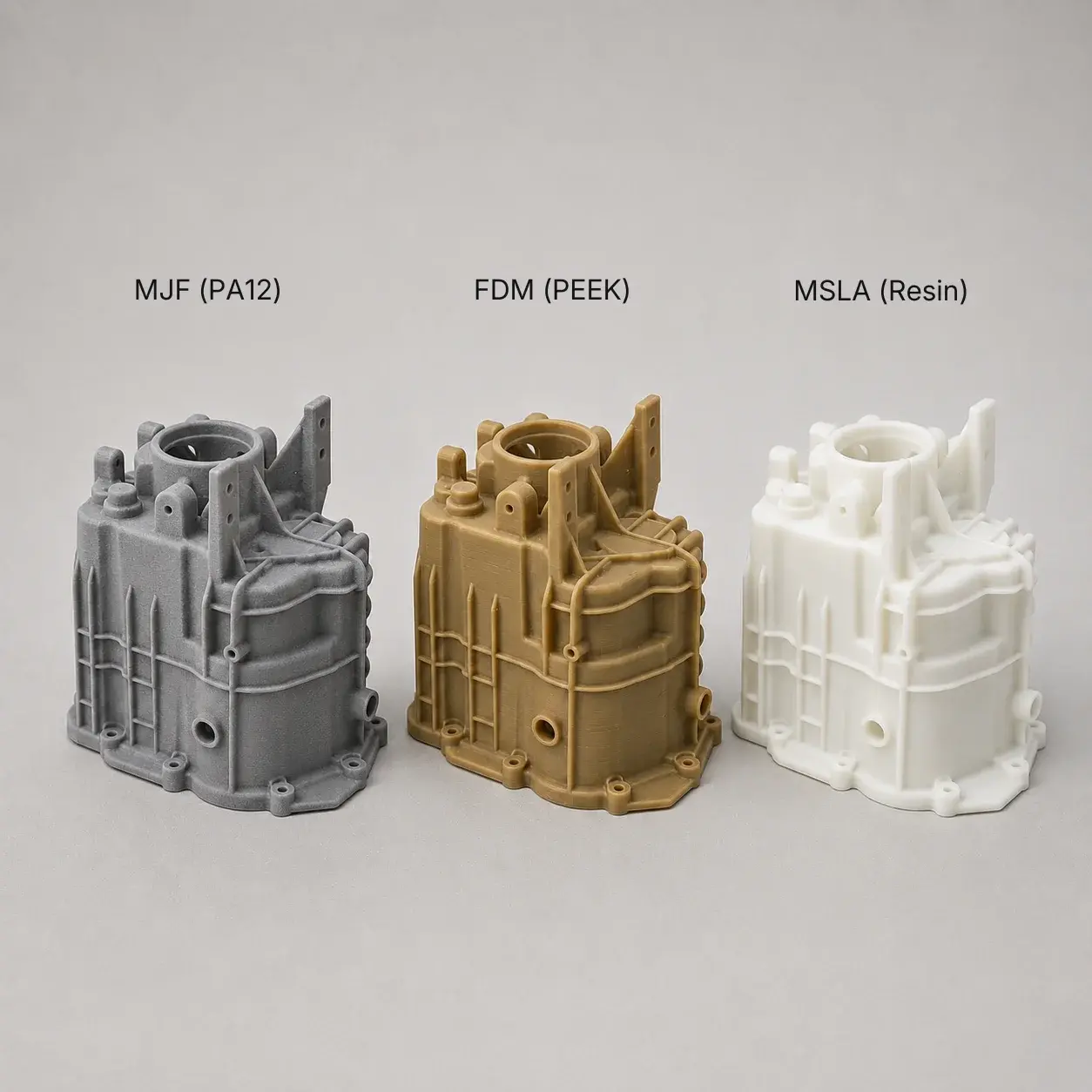
Developed by HP, the Multi Jet Fusion printer deposits fusing and detailing agents onto a bed of material powder, then consolidates the layers with infrared light. It's today the industrial standard for the production of functional parts in polyamide.
Main materials: PA12 nylon, PA11 Gen 2 nylon, PA12 GB nylon, polypropylene and TPU.
Key advantages:
- Near-isotropic mechanical properties: the part's performance is similar in all directions, unlike extrusion processes;
- No supports required: the unfused powder supports the part, allowing complex geometries and cavities;
- High productivity: dozens of parts can be stacked and printed together in a single build;
- Good dimensional precision and a uniform surface finish, suitable for many technical applications.
Limitations:
- A narrower range of materials than FDM (essentially polyamides);
- Limited operating temperature;
- Standard dark grey/white colour, with subsequent dyeing options.
When to choose MJF: functional prototypes that must behave like finished parts, small and large production runs, components with complex geometries (internal channels, lattices, interlocking features), applications requiring reliable and repeatable mechanical properties.
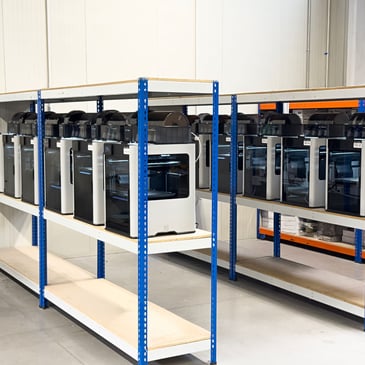
Industrial FDM
Fused Deposition Modeling is the most widespread additive technology in the world. In its industrial form, however, the use of heated-chamber machines, certified technical filaments and standardised post-production processes provides access to materials and performance far superior to those achievable with hobbyist FDM.
Main materials: ABS, ECOtech, PEEK (classic, GF, CF), Ultem, PPS CF, carbon-fibre-reinforced nylon and many other engineering polymers. It's the technology with the widest choice of materials in 3D printing.
Key strengths::
- An unrivalled range of materials, including super-polymers such as PEEK, PPS and their reinforced versions, indispensable for aerospace and metal replacement;
- High operating temperatures possible (up to 250 °C with PEEK);
- Excellent for structural applications thanks to fibre-reinforced materials.
Limitations:
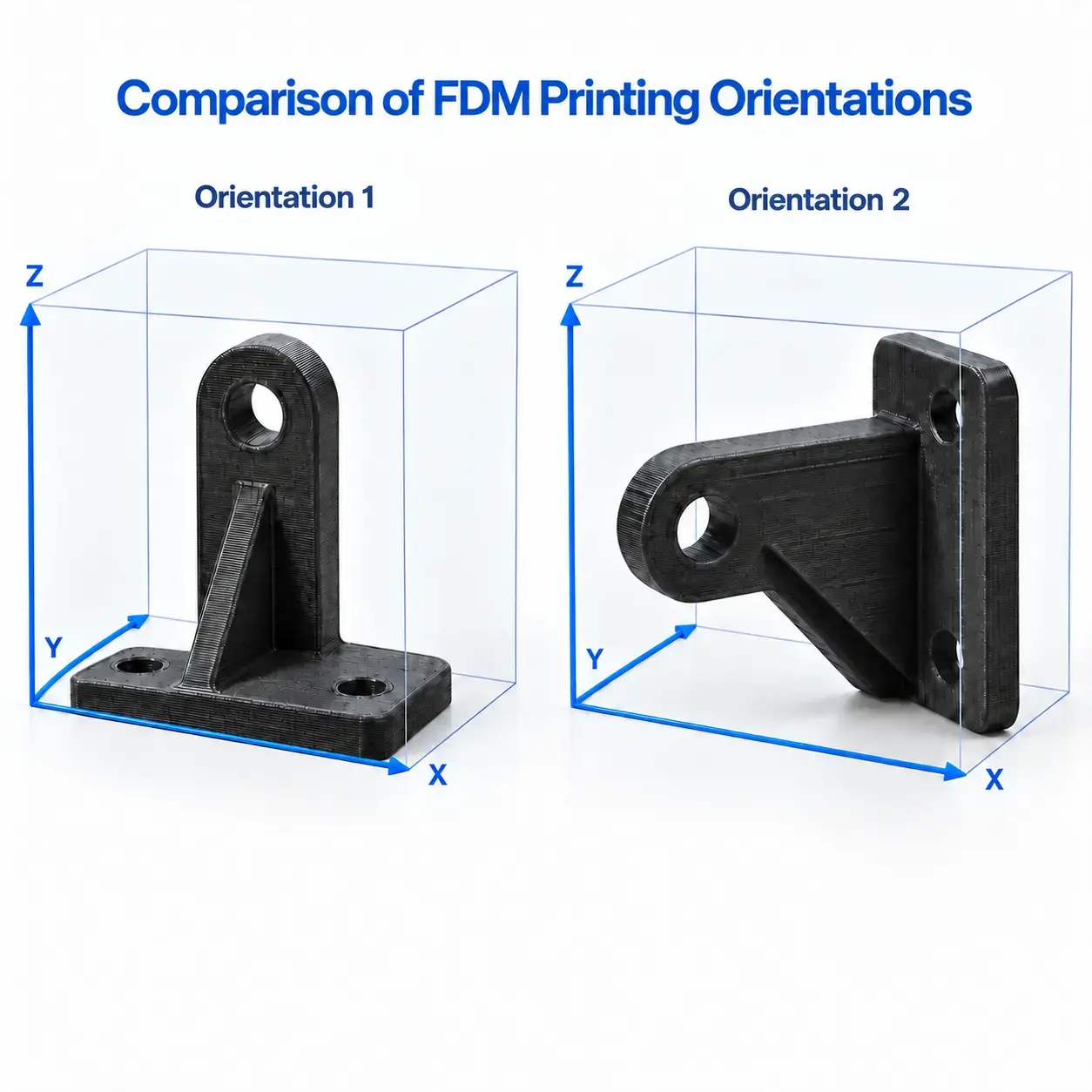
- Mechanical anisotropy: the strength in the direction perpendicular to the layers (usually the z axis) is lower than that in the plane;
- Visible layers: the surface finish requires post-processing for aesthetic applications;
- The need for supports;
- Lower dimensional precision than MJF and resin on very small features.
When to choose FDM: components in super-polymers (PEEK, PPS, Ultem), metal replacement in aerospace, high-temperature applications, prototypes with specific certifications (ABS Medical, ECOtech), low-volume projects where the variety of materials prevails over production speed.
MSLA Resin
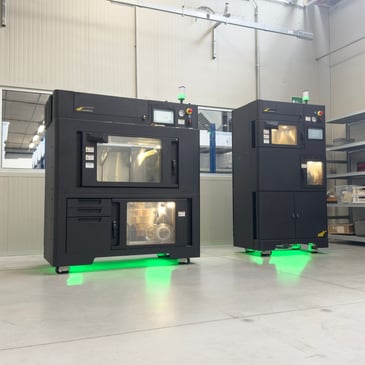
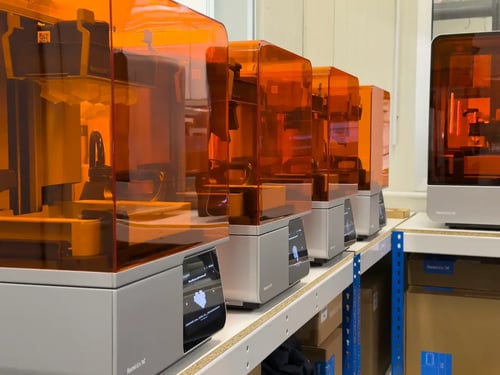
MSLA (Masked Stereolithography) resin printing uses an LCD screen to project light patterns that polymerise the liquid resin layer by layer. It's the most widespread evolution today of photopolymerisation technologies, alongside SLA (laser) and DLP (projector).
Main materials: photopolymer resins in a very wide range, such as classic, PP-like, flame-retardant, high-temperature, ceramic and ABS-like.
Strengths:
- Resolution and detail: features in the order of 25–50 µm are possible;
- Excellent surface finish;
- Isotropic properties: polymerisation occurs through light, not through directional extrusion;
- A wide range of specialist resins.
Limitations:
- Mechanical properties generally inferior to PA and super-polymers (the resins are more brittle);
- Sensitivity to UV/light over time for some resins;
- Mandatory post-processing (washing, UV curing) that lengthens the production cycle;
- Smaller print volumes;
- Handling of the liquid resin that requires safety procedures.
When to choose MSLA: audiology applications (earmoulds), jewellery and lost-wax casting, high-finish visual prototypes, ergonomic mock-ups, components with minute details (even below 1 mm), anatomical study models.
Comparison table: MJF, FDM and MSLA resin
The most direct way to get your bearings among the three technologies is to compare them on the key performance parameters:
| Parameter |
MJF |
Industrial FDM |
MSLA resin |
| Available materials |
Polyamides |
Very wide (ABS, PA, PEEK, PPS, PLA, ECOtech...) |
Photopolymer resins |
| Mechanical properties |
High, isotropic |
Medium to very high (with super-polymers), anisotropic |
Medium-low, isotropic |
| Dimensional precision |
Good |
Medium |
Excellent |
| Surface finish |
Porous |
Visible layers |
Smooth, high resolution |
| Operating temperature |
~90 °C (PA) |
Up to 250 °C (PEEK) |
40–120 °C depending on resin |
| Supports |
Not required |
Required |
Required |
| Effectiveness on large batches |
High |
Medium |
Low |
| Super-polymers |
No |
Yes |
No |
| Standard colour |
Dark grey/white |
Wide range |
White or black |
| Minimum post-processing |
Bead blasting |
Support removal |
Washing + UV curing |
Decision matrix: which technology to choose if...
The most practical way to guide the choice is to translate the project's requirements into a direct answer:
- If maximum isotropic mechanical strength and repeatability are needed → MJF
- If super-polymers or high temperatures are needed → industrial FDM
- If fine detail and surface finish prevail → MSLA resin
- If a small run of identical functional parts is needed → MJF
- If an economical and quick prototype is needed → FDM or MJF
- If metal replacement in aerospace is needed → industrial FDM with PEEK CF, PEEK GF, Ultem or PPS CF
- If a surgical guide or a functional anatomical model is needed → MJF or FDM
- If complex geometries with internal cavities are needed → MJF (no supports)
- If maximum colour freedom is needed → FDM (filaments in many colours)
- If large batches need to be produced → MJF
Which is the most widespread technology for industrial additive manufacturing?
MJF and industrial FDM are today the two dominant technologies for industrial additive manufacturing, each with a precise area of choice. MJF dominates for small and large functional runs in polyamide, FDM for components in super-polymers. MSLA resin occupies the high-resolution detail segment.
Which Technology for Which sector
Each industrial sector has combined the three technologies differently, depending on the dominant requirements.
3D printing in the medical sector
In the medical field, all three technologies coexist, with distinct applications:
- MJF: personalised surgical guides, hospital instrumentation, anatomical models for surgical planning, sample holders.
- Industrial FDM: housings for electromedical equipment, components of diagnostic devices and functional prototypes. Dedicated materials (ABS Medical, ECOtech) cover the medical FDM segment.
- MSLA resin: dominant in dentistry (aligners, temporary crowns, dental surgical guides) and audiology (personalised earmoulds), thanks to specific biocompatible resins.
For more on the choice of certified medical materials, on biocompatibility and on batch traceability in the medical field, consult our guides dedicated to the sector.
3D Printing in the Aerospace sector
In the aerospace sector, the choice is polarised between two technologies:
- Industrial FDM: it's the most suitable solution for flight components in super-polymers. Materials such as PEEK CF and PEEK GF are suited to structural brackets and satellite frames, while PPS CF is suited to components exposed to chemically harsh environments. ULTEM finds application in cabin interiors thanks to its compatibility with requirements such as FAR 25.853, OSU 55/55 and UL94 V-0.
- MJF: it's reserved mainly for non-structural components, such as housings, ducts, secondary brackets and functional prototypes. Materials such as PA12, PA11, TPU and polypropylene make it possible to produce lightweight, strong and functional parts, provided that operating temperature, chemical resistance and qualification requirements are compatible with the specific aerospace application.
MSLA resin in aerospace is typically relegated to aesthetic prototypes, ergonomic mock-ups and study models, rather than to components intended for flight.
Explore this topic further in our technical guide on materials for the aerospace sector.
Conclusion
Choosing between MJF, FDM and MSLA resin isn't an abstract technical decision, but an assessment guided by the specific requirements of the project: mechanical properties, available materials, component dimensions, level of detail, operating temperature, production volumes and budget. The three technologies occupy complementary spaces in the additive manufacturing ecosystem. Knowing their strengths and limitations is what distinguishes the use of 3D printing as a true production tool from its use as a mere fallback solution.
For most industrial projects, the reference technologies are MJF (for functional parts in polyamide, prototypes with injection-like properties, small and large runs) and industrial FDM (for super-polymers, structural components, specific aerospace and medical applications). MSLA resin remains irreplaceable in the dental and audiological fields and in all applications requiring an extremely high level of detail and surface quality.
Not sure which technology to choose for your project?
Upload your file and talk to one of our experts
Frequently asked questions about 3D printing technologies

 Weerg staff: Oct 14, 2026