Choosing the most suitable material for an aerospace component is one of the most delicate design decisions. Every gram affects fuel consumption, every limitation in thermal resistance can compromise suitability for certification, and every choice has direct consequences for the airworthiness certification. In the aerospace sector, material selection follows rigorous criteria: maximising the strength-to-weight ratio, ensuring reliable performance in extreme conditions, and complying with stringent regulations on flammability, toxicity and outgassing.
This guide compares the main high-performance materials available today for aerospace, from structural engineering polymers such as PA12 and PA11 to super-polymers such as PEEK, PEEK CF, PEEK GF and PPS CF. The comparison includes a comparison table and specific recommendations depending on the application.
Requirements for aerospace materials
A material intended for aerospace applications must meet several requirements simultaneously, often conflicting with one another. There are five fundamental criteria:
- Low specific weight → Every kilogram saved on a commercial aircraft can translate into thousands of litres less fuel over its operational life. In the case of a satellite, the advantage is even more significant, since the reduction in mass can directly affect launch costs, which can reach up to €20,000/kg.
- High strength-to-weight ratio → This is one of the main evaluation metrics in the aerospace field. Materials with high specific strength are favoured — that is, a high ratio between mechanical strength and density.
- Thermal resistance → Aerospace components can be exposed to extremely wide temperature ranges: from around −150 °C in deep space to over 200 °C in areas close to the engine or other heat sources.
- Chemical resistance → Materials must maintain their performance even in the presence of fuels, hydraulic oils, de-icing fluids, ozone, UV radiation and cosmic radiation.
- Certifications → Regulatory compliance is an essential requirement. For components intended for the cabin, the FAR 25.853 requirements relating to flammability, smoke and toxicity are relevant. For space applications, on the other hand, outgassing control according to ASTM E595 is fundamental, with TML values below 1% and CVCM below 0.1%. Added to these requirements are the EASA and FAA qualifications necessary for airworthiness.
In addition to these main criteria, fatigue resistance, impact resistance (for example in the event of a bird strike or micrometeoroids), compatibility with additive manufacturing (increasingly widespread in the sector) and full traceability of the material batch must also be considered.

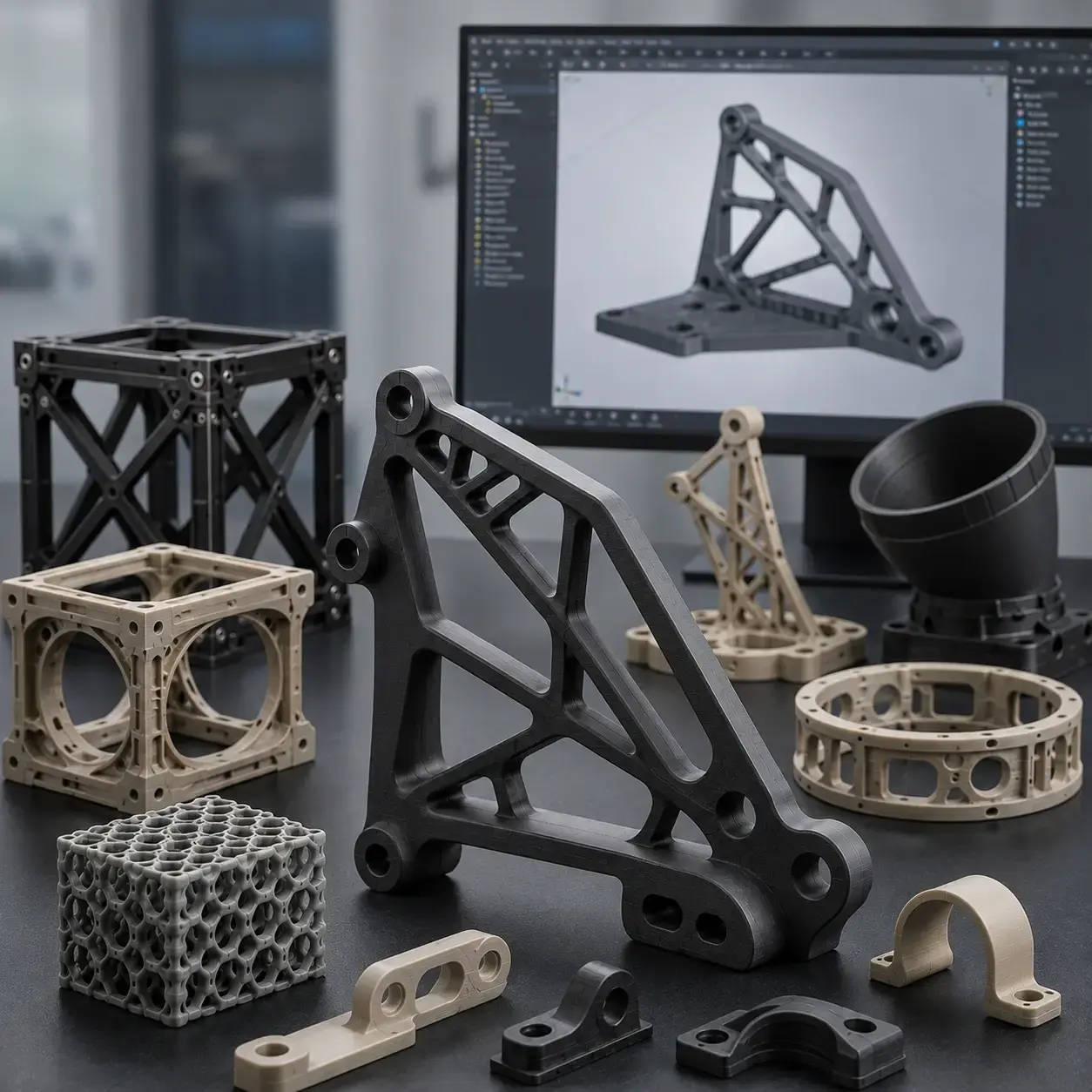
Structural satellite frame in carbon-fibre-reinforced PEEK
Why are polymers replacing metals in aerospace?
The metal replacement phenomenon — the substitution of aluminium, magnesium or steel components with high-performance engineering polymers and composites — is one of the strongest trends of the last decade. The reasons:
- weight reduced by 40–70% compared with metals;
- geometric freedom enabled by 3D printing, which eliminates machining and assembly;
- elimination of galvanic corrosion and anti-corrosion processes;
- intrinsic electrical and thermal insulation;
- reduced time-to-market thanks to the absence of tooling.
The main materials for aerospace components
Let's look in detail at the polymer materials most used in the aerospace industry, from "entry-level" structural grades to super-polymers for extreme applications.
PA12 and PA11: structural and versatile
Long-chain polyamides represent a reference solution for non-critical aerospace components: housings, ducts, secondary brackets, internal cabin components.
Distinctive characteristics:
- density 1.01–1.04 g/cm³ → among the lightest structural polymers;
- limited moisture absorption → dimensional stability guaranteed in all operating conditions;
- excellent fatigue and impact resistance, particularly PA11;
- full compatibility with MJF 3D printing, near-isotropic properties;
- PA11 of bio-based origin (castor oil), with a high proportion of renewable content.
The main limitation is the operating temperature, which in continuous use sits around 90–100 °C. For this reason, PA11 and PA12 are reference materials for functional prototyping, for the series production of non-structural components and for cabin applications not exposed to hot zones.
PEEK CF: satellite frames and aircraft structures
Carbon-fibre-reinforced PEEK is one of the most advanced super-polymers for high-performance aerospace applications. It combines the excellent properties of the PEEK matrix (polyaryletheretherketone) with the reinforcement of carbon fibres, giving rise to a material that competes directly with aluminium in many structural applications.
Key properties:
- density ~1.34 g/cm³ (compared with 2.70 for 6061 aluminium);
- high strength-to-weight ratio and specific stiffness;
- continuous operating temperature up to 250 °C;
- excellent chemical resistance, including fuels, hydraulic fluids and aggressive agents;
- UL94 V-0 flammability class;
- 3D printable with industrial FDM technology.
Typical applications: frames and structures for satellites, structural brackets, supports for onboard electronics, sensor housings and brackets for aircraft engines.
PEEK GF: durability in extreme operating conditions
The glass-fibre-reinforced PEEK version offers performance similar to PEEK CF with some important operational differences. Compared with PEEK CF:
- it maintains electrical insulation (glass fibres are not conductive);
- comparable density (~1.35 g/cm³);
- lower stiffness but better isotropy;
- UL94 V-0 flammability class and the same thermal resistance as PEEK CF.
It's the ideal choice for components requiring electrical insulation, such as high-temperature connectors, onboard insulators and brackets for non-conductive applications.
PPS CF: thermal stability and structural chemical resistance
Carbon-fibre-reinforced polyphenylene sulphide (PPS) combines the PPS matrix, known for its exceptional chemical resistance, with carbon fibres, which bring stiffness and dimensional stability. It positions itself as a complementary alternative to PEEK CF, with specific advantages in terms of long-term thermal stability and resistance to aggressive fluids. Distinctive properties:
- thermal stability up to 250 °C;
- exceptional chemical resistance: it offers extremely high resistance to most organic solvents even at temperatures close to 200 °C, including fuels, aviation oils and aggressive de-icing fluids;
- density ~1.34 g/cm³;
- electrical conductivity conferred by the carbon fibres (it's not an insulator);
- lower cost than PEEK CF.
Typical applications: structural components for fuel and hydraulic systems, sensor housings in high-temperature areas, brackets and supports for the engine compartment, pump and valve components intended for aggressive aviation fluids.
ULTEM (PEI): the reference for cabin interiors
Polyetherimide (PEI), known commercially as ULTEM, is one of the most used materials for internal cabin components made through 3D printing. Its use is favoured by a solid package of certifications and compliance, including UL94 V-0 for flame behaviour, EN 45545 for the rail sector, and FAR 25.853 and OSU 55/55 for aerospace applications.
Thanks to these characteristics, PEI represents a reference solution for panels, covers, housings and ducts intended for the passenger cabin. With a density of around 1.27 g/cm³, an HDT in the region of 190–210 °C and high dimensional stability, it offers a good balance between lightness, thermal resistance and certifications.
Comparison table of aerospace materials
|
Material
|
Density (g/cm³)
|
Rm (MPa)
|
E modulus (GPa)
|
Continuous Service Temperature (°C)
|
FST (FAR 25.853)
|
Spatial outgassing
|
Typical process
|
|
PA12
|
1.01
|
45–50
|
1.5–1.7
|
90
|
No (without additives)
|
Yes (qualified versions)
|
MJF
|
|
PA11
|
1.04
|
48–52
|
1.3–1.5
|
90
|
No
|
Yes
|
MJF
|
|
ULTEM 9085 (PEI)
|
1.27
|
70–80
|
2.2
|
190
|
Yes
|
Yes
|
FDM
|
|
PPS CF
|
1.34
|
70–230
|
up to 25
|
220–250
|
Yes
|
Partial
|
FDM
|
|
PEEK
|
1.30
|
95–100
|
3.7–4.0
|
250
|
Yes
|
Yes
|
FDM
|
|
PEEK GF
|
1.35
|
85–170
|
7–10
|
250
|
Yes
|
Yes
|
FDM
|
|
PEEK CF
|
1.34
|
85–250
|
8–25
|
250
|
Yes
|
Yes
|
FDM
|
|
6061-T6 Aluminum (reference)
|
2.70
|
310
|
69
|
150
|
—
|
—
|
CNC
|
|
Gr5 Titanium (reference)
|
4.43
|
950
|
114
|
400
|
—
|
—
|
CNC
|
Consult the individual product pages to access the specific technical data sheet for each material.
Which material has the best strength-to-weight ratio?
Considering specific strength, expressed as the ratio between mechanical strength and density, PEEK CF and PPS CF achieve the highest values among the engineering polymers analysed, with a density equal to about half that of 6061-T6 aluminium and significant mechanical performance in the reinforced grades.
In 3D printed versions, the comparison with structural aluminium depends on the material grade and the process conditions: the minimum values remain lower, while the reinforced grades can approach or exceed 6061 aluminium in terms of specific strength. The real value of metal replacement, however, derives from the combination of geometric freedom, topology optimisation, consolidation of multiple parts into a single component, chemical resistance and elimination of corrosion.
For high-temperature applications where maximum lightness is not the main requirement, unreinforced PEEK and PEEK GF represent balanced solutions in terms of performance, thermal resistance and regulatory compliance.
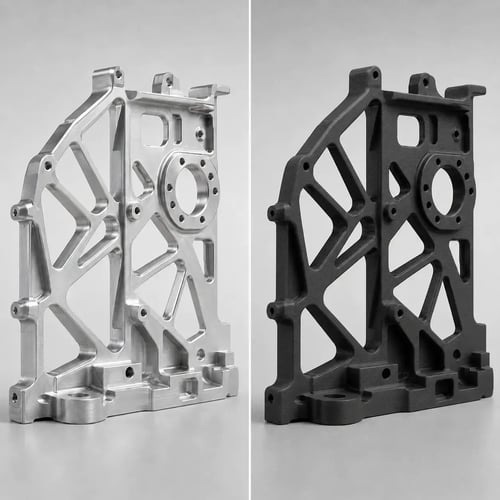 Metal replacement: aluminium aerospace component and PEEK CF version
Which material for which aerospace component
Translating technical data into a design choice is a central step in the aerospace designer's daily work. The following matrix offers a guide to material selection according to the main families of components.
- Internal cabin components (panels, covers, display housings, ductwork) → ULTEM 9085 printed in FDM. Native FAR 25.853, OSU 55/55 and UL94 V-0 certifications, low density, excellent finish.
- Air conditioning and climate control ductwork → PA11 / PA12 for cold zones, ULTEM for certifiable hot zones, PEEK for critical areas near the engine.
- Secondary structural brackets and supports → PEEK CF for maximum specific stiffness; PEEK GF where electrical insulation is needed; PA12 for low-cost non-critical applications.
- Satellite structures (housings, optics, frames for onboard electronics) → PEEK CF with ASTM E595 outgassing qualification. Weight reduction compared with aluminium through topology optimisation.
- Fuel and hydraulic systems (fittings, pump housings, valves) → PPS CF or PEEK CF. Chemical resistance a priority alongside structural capacity.
- Connectors and electrical insulators in hot environments → PEEK GF (insulating); avoid PPS CF and PEEK CF, which are electrically conductive.
- Sensor components under the bonnet/engine → PEEK GF or PEEK CF according to the conductivity requirement; PPS CF when exposure to aggressive fluids predominates.
- Functional prototyping and small runs → PA12 for speed and cost, PEEK CF for representative functional testing.
- Metal replacement of aluminium parts → PEEK CF with a design optimised for 3D printing (topology optimisation, lattice structure).
3D Printing in Aerospace Materials
Additive manufacturing has transformed the aerospace sector over the last ten years. Companies such as Airbus, Boeing and the leading space agencies now use 3D printing to produce numerous components intended for flight. The most relevant processes are:
- MJF for PA12 and PA11: the standard for non-structural parts, functional prototypes, non-critical cabin interiors;
- industrial FDM for ULTEM and PEEK (CF, GF, unreinforced): the process used for certified flight parts, from ducting to satellite frames;
- industrial FDM for PPS CF: a solution for technical components requiring combined chemical resistance and thermal stability.
The advantages of additive manufacturing in the aerospace field are difficult to replicate with traditional technologies: weight reduction through topology optimisation and internal lattice structures, consolidation of multiple components into a single part, on-demand production of spare parts for operational fleets, and rapid iteration during development phases.
Reference certifications and regulations
Aerospace materials are among the most regulated categories of all. The main regulations to consider during selection are:
- FAR 25.853 (Federal Aviation Regulations): flammability, smoke generation and toxicity (FST) for passenger cabin components;
- OSU 55/55: heat release testing for cabin interiors, required together with FAR 25.853;
- EN 45545: European standard on fire resistance (originally for rail, now also a reference in mobility and aerospace);
- ASTM E595 / ECSS-Q-ST-70-02: outgassing for space applications;
- AMS (Aerospace Material Specifications): material specifications of the American aerospace industry;
- AS9100: aerospace quality management system;
- NADCAP: accreditation for special processes (heat treatments, additive, non-destructive testing);
- OEM certifications: Airbus, Boeing, Lockheed Martin, ESA and other manufacturers have their own qualifications for flight materials.
Conclusion
Choosing the material for aerospace components requires a balance between weight, mechanical strength, operating temperature, chemical resistance and regulatory compliance. The comparison table and the application guide offer an initial orientation, but every project presents specific constraints (geometry, thermal cycle, operating environment and budget) that can influence the final choice.
Super-polymers such as PEEK CF, PEEK GF and PPS CF have made possible a new generation of lightweight, high-performance aerospace components. Additive manufacturing has further accelerated their adoption, changing the way designers and engineers develop components intended for flight.
Would you like to compare the materials best suited to your aerospace project and receive a quote?
UPLOAD YOUR FILE NOW
Frequently asked questions about aerospace materials

 Weerg staff: Sep 30, 2026