PEEK (Polyether Ether Ketone) is one of the most advanced engineering polymers available today.
Belonging to the polyaryletherketone (PAEK) family, it is often referred to as “the king of polymers” thanks to its exceptional combination of mechanical, thermal and chemical properties, which are difficult to match with other plastics.
Because of these characteristics, PEEK is widely used in highly demanding sectors such as aerospace, medical, automotive, electronics and chemical processing, often as a direct alternative to metal alloys.
What Is PEEK?
PEEK is a semi-crystalline organic thermoplastic polymer belonging to the PAEK family.
Unlike common polymers such as PLA, ABS or PETG, PEEK is designed to operate under extreme conditions, maintaining stability even when exposed to:
Its molecular structure gives it outstanding stability and strength, while maintaining a much lower density than metals.
What are the properties of PEEK?
PEEK combines metal-like mechanical performance with the light weight of a polymer.
Key Mechanical and Physical Properties
-
Tensile strength: up to approximately 100 MPa
-
Density: around 1.30 g/cm³ (for comparison: aluminium alloys ≈ 2.8 g/cm³)
-
Continuous operating temperature: up to 250–260 °C
-
High HDT (Heat Deflection Temperature)
-
Excellent fatigue and creep resistance
-
Outstanding chemical resistance
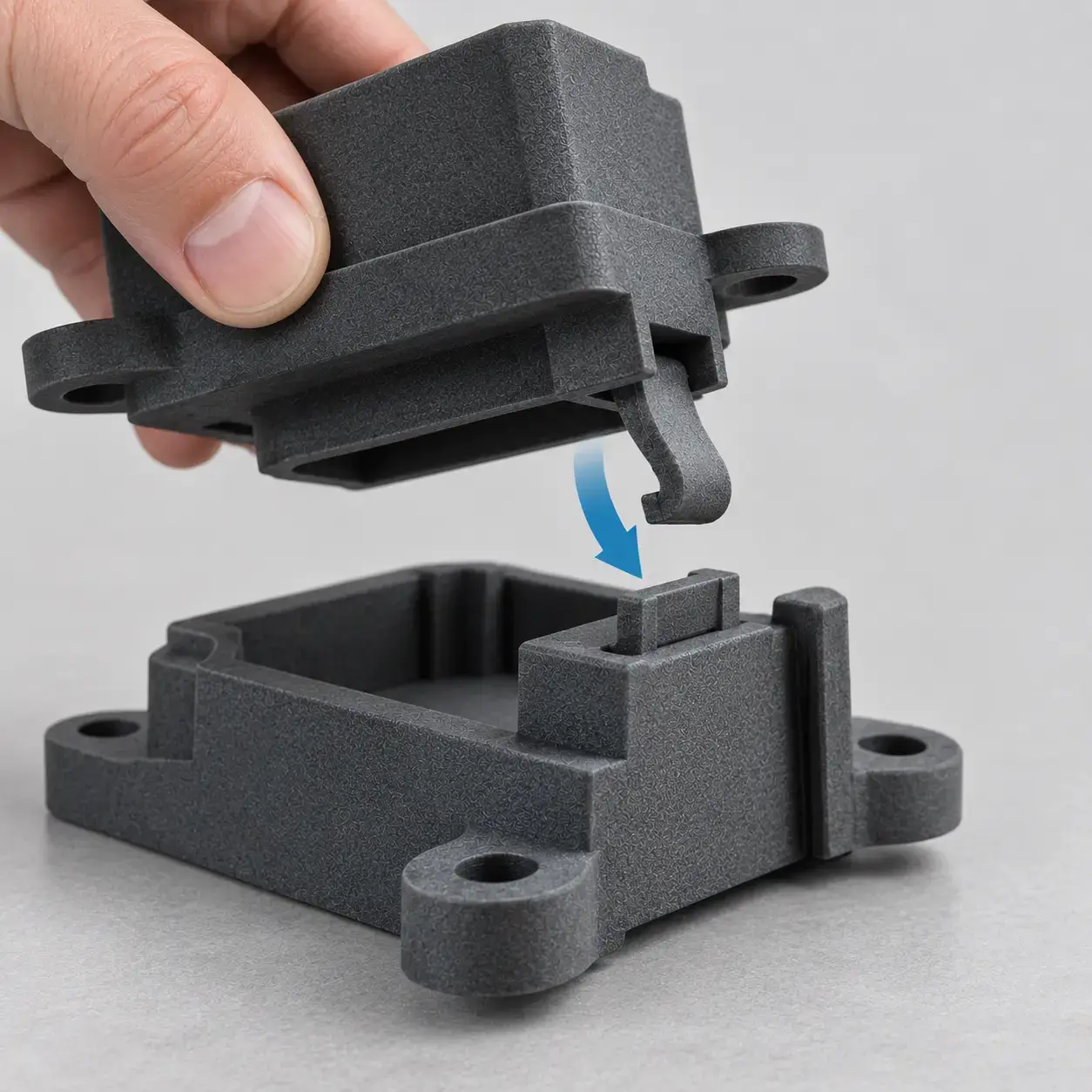
The combination of high mechanical strength and low density makes PEEK an excellent candidate for metal replacement, with the added benefit of enabling complex geometries through additive manufacturing.
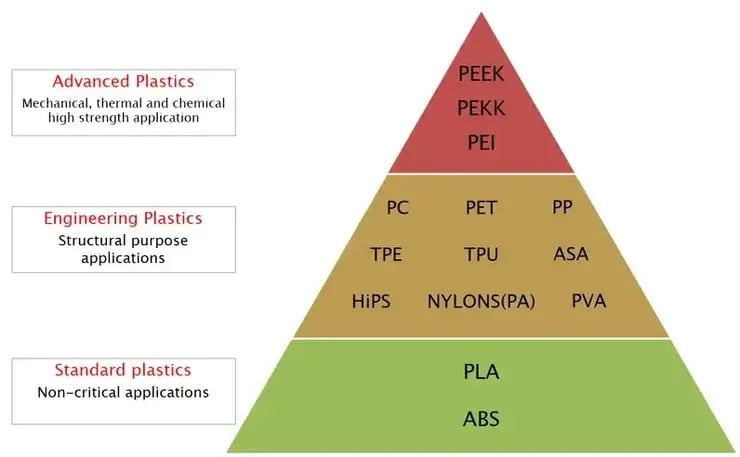
The “Property Pyramid” of PEEK
PEEK sits at the top of the engineering polymer hierarchy due to its balanced performance in:
-
thermal resistance
-
mechanical strength
-
dimensional stability
-
chemical resistance
-
biocompatibility
This makes it superior to most high-performance thermoplastics such as nylon, PPS or PEI when overall performance is required.
How is PEEK processed?
PEEK is challenging to process, but it can be successfully manufactured using industrial FDM 3D printing.
Requirements for FDM Printing PEEK
-
Nozzle temperature: above 400 °C
-
Heated chamber: at least 70 °C (often higher)
-
Industrial-grade printers only (not consumer machines)
These conditions are only achievable with dedicated industrial FDM systems designed specifically for high-performance polymers.
Advantages of FDM Printing with PEEK
-
use of dedicated, easily removable support materials
-
elimination of traditional design constraints such as:
-
production of fully functional end-use parts, not just prototypes
The Two Structural States of PEEK: Amorphous and Semi-Crystalline
PEEK can exist in two different crystalline states, which directly affect its performance.
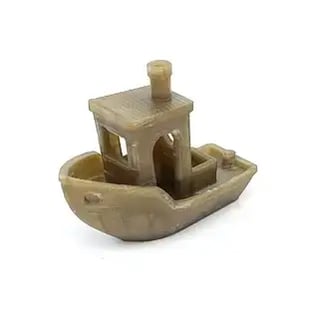
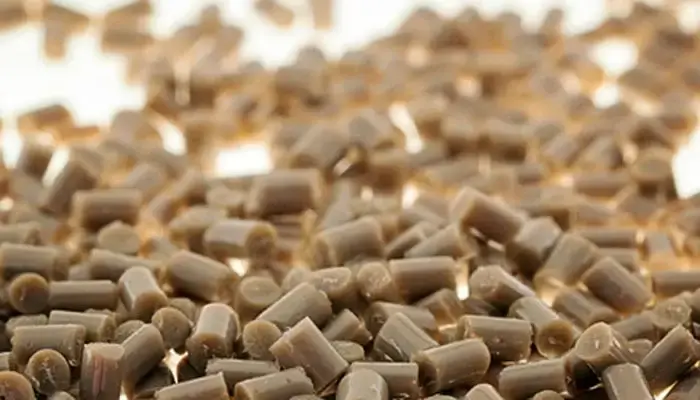
Amorphous PEEK
Ideal when:
-
impact resistance is required
-
some flexibility is beneficial
-
brittle behaviour must be avoided
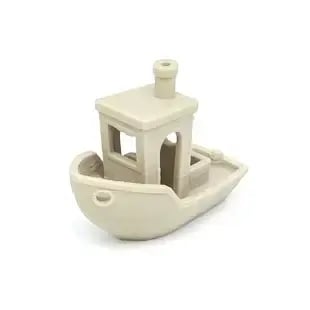 Semi-Crystalline PEEK
-
Beige / ivory colour
-
More ordered molecular structure
-
Improved mechanical and chemical properties
-
Stiffer and slightly more brittle behaviour
-
Operating temperatures up to ~250 °C
Preferred for:
Comparison Between Amorphous and Semi-Crystalline PEEK
| Property |
Amorphous PEEK |
Semi-Crystalline PEEK |
| Tensile strength [MPa] |
~70 |
~100 |
| Elongation [%] |
~12 |
~9 |
| HDT (0.8 MPa) [°C] |
~145 |
~180 |
| Behaviour |
More ductile |
More rigid |
| Ideal use |
Impact resistance |
High-temperature performance |
Where Is PEEK Used?
Thanks to its performance, PEEK is used in high-value, mission-critical applications.
Aerospace
Medical
Automotive and Motorsport
Chemical Industry and Oil & Gas
When Does PEEK Really Make Sense?
PEEK is not a universal material and should be selected when:
-
standard polymers are insufficient
-
metals are too heavy
-
high performance is required in compact designs
-
complex geometries are needed
-
reliability is critical
Conclusion
PEEK represents the pinnacle of engineering polymers.
Its ability to combine high mechanical strength, extreme thermal resistance, chemical stability and low weight makes it a powerful alternative to metal alloys in many advanced applications.
Thanks to industrial FDM 3D printing, PEEK can now be used to produce custom, complex and fully functional components, reducing weight, lead times and design constraints.
If you believe PEEK is the right material for your project, you can review the technical data sheets and instantly estimate costs by uploading your 3D file.
Upload your file now and get an instant quote

 Fabio Trotti
 Weerg staff: Oct 14, 2026