Powder-based 3D printing is one of the most advanced technologies in additive manufacturing. Used to create functional components, mechanical parts, industrial prototypes, and mass production series, it offers unique advantages in terms of precision, strength, and design freedom.
While technologies such as FDM or SLA are excellent for aesthetic or hobbyist prototypes, powder-based 3D printing is the true leader in professional production.
In this guide, you will discover:
What Is Powder-Based 3D Printing?
Powder-based 3D printing encompasses a set of technologies that build an object by layering powdered material, which is selectively fused or bound only in the necessary areas.
Unlike FDM and SLA:
-
It requires no supports: The powder itself supports the part.
-
It allows for extremely complex geometries.
-
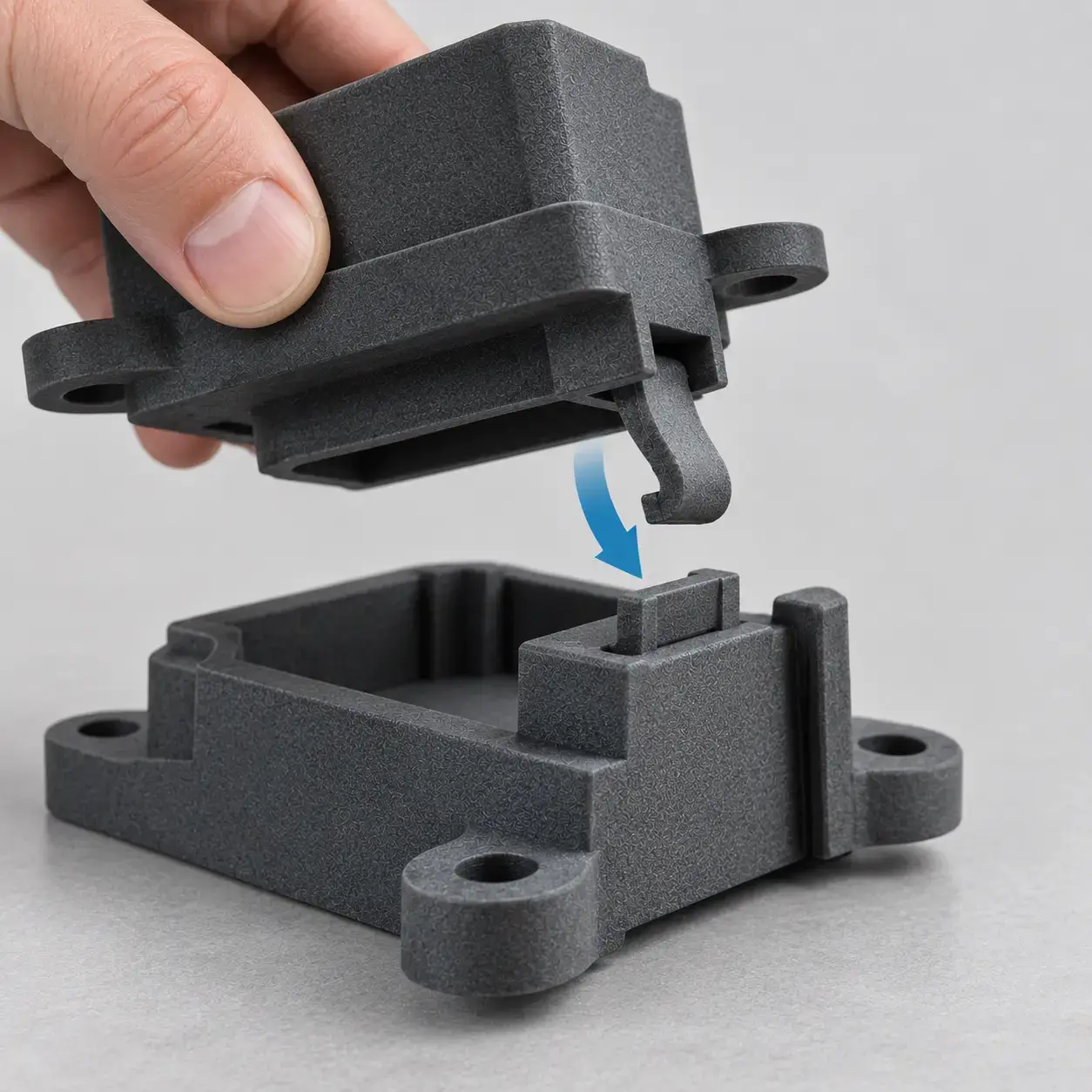
It produces robust, isotropic, and stable parts.
-
It is suitable for final production, not just prototyping.
It is the preferred technology for industrial components and small production batches.
How Does Powder-Based 3D Printing Work?
The principle is common to all variants:
-
A very thin layer of powder ($40\text{--}120\,\mu\text{m}$) is distributed across the build platform.
-
An energy system (laser, IR, or fusing agents) selects the areas to be melted or sintered.
-
The fused powder creates a solid layer.
-
New powder is spread, and the process repeats until completion.
-
The part is extracted from the "powder cake" and cleaned.
The result is a stable, precise component with excellent mechanical properties.
The Main Powder Technologies
SLS – Selective Laser Sintering (Polymers)
A laser selectively sinters Nylon powders (PA12, PA11).
Characteristics:
-
Good precision
-
High strength
-
No supports needed
-
Slightly rough surface
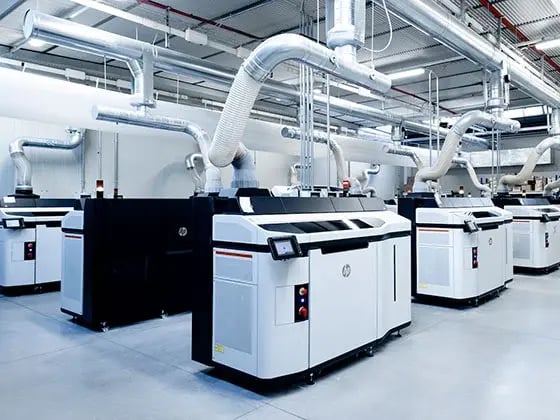
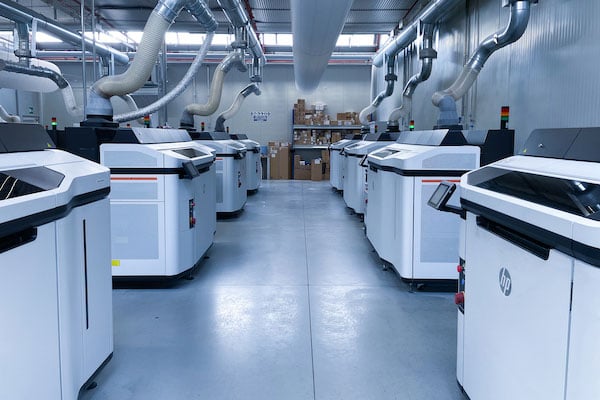
Technology developed by HP (2016). Considered the industrial standard today.
Characteristics:
-
Superior quality compared to SLS
-
Excellent mechanical isotropy
-
More uniform surfaces
-
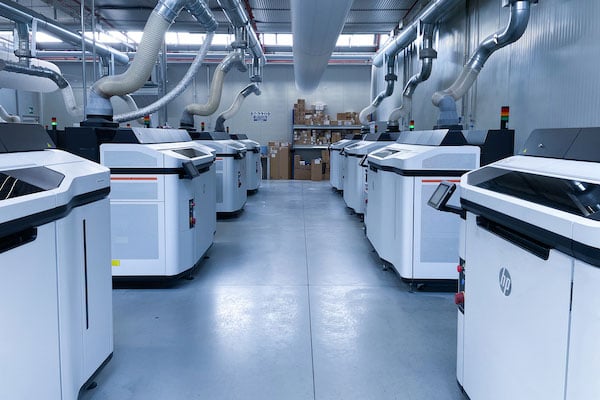
High productivity (ideal for series production)
-
Highly accurate details
-
Complex geometries without supports
Common materials: PA12, PA11, PA12 GF, TPU, PP.
SLM/DMLS – Selective Laser Melting (Metals)
A laser completely melts metal powders such as:
-
Stainless steel
-
Aluminium
-
Titanium
-
Inconel
-
Cobalt-chrome
Characteristics:
-
Highly resistant mechanical parts
-
Density close to 100%
-
Ideal for aerospace, medical, and automotive sectors
Advantages of Powder-Based 3D Printing
Powder-based 3D printing is currently the technology that comes closest to traditional industrial manufacturing, surpassing it in many aspects.
-
No Supports Needed
The powder supports the part --> total design freedom.
-
Complex and Organic Geometries
Perfect for internal channels, lattices, cavities, and topologically optimised designs.
-
High Mechanical Properties
SLS and MJF produce robust and reliable parts. SLM produces genuine structural metal components.
-
High Precision: Tight tolerances and excellent repeatability.
-
Series Production
Thanks to speed and part positioning density (3D nesting).
-
Technical Materials
Polymers: PA12, PA11, TPU, PP.
Metals: Steels, Titanium, Aluminium, Superalloys.
-
Advanced Post-Processing
Sandblasting, dyeing, vapour smoothing, mechanical and thermal treatments.
Which Materials Are Used?
Most common polymers:
-
PA12 (Nylon): Balanced, strong, stable.
-
PA11: More flexible, impact-resistant.
-
PA12 GF: Rigid, glass-filled.
-
TPU: Flexible.
-
PP: Lightweight and chemically resistant.
Applications of Powder-Based 3D Printing
The combination of strength + geometric complexity + repeatability makes it perfect for:
-
Mechanical Industry: Housings, brackets, structural supports.
-
Automotive: Ducting, lightweight parts, functional components.
-
Functional Prototyping: Mechanical testing, fatigue cycles, structural tests.
-
Medical: Personalised prosthetics, metal implants, surgical guides.
-
Aerospace: Lightweight titanium parts, complex ducting, topologically optimised brackets.
-
Consumer & Design: Finished products, complex architecture, technical decorative geometries.
Why Choose Powder-Based 3D Printing?
Compared to FDM and SLA, powder printing is:
If you are looking for industrial quality, powder printing (SLS/MJF/SLM) is almost always the best choice.
Conclusion
Powder-based 3D printing is the heart of modern additive manufacturing: it allows for the creation of robust, complex, and repeatable technical components, with reduced lead times and without the constraints of moulds or tooling.
From technical polymers to metal, from single parts to small series, this technology is now a standard for engineers, designers, startups, and companies requiring high performance and total design freedom.
Do you want to manufacture parts in MJF with industrial quality?
Upload your file now and get an instant quote

 Weerg staff: Oct 14, 2026