Young’s modulus, also known as the longitudinal modulus of elasticity, is one of the most important mechanical properties of materials. It is used daily in engineering, mechanical design and 3D printing to evaluate a material’s stiffness.
Understanding Young’s modulus means being able to predict how an object will react to loads, helping to avoid structural failure. In this 2026 guide we will cover the definition, formula and practical applications.
What is Young's modulus?
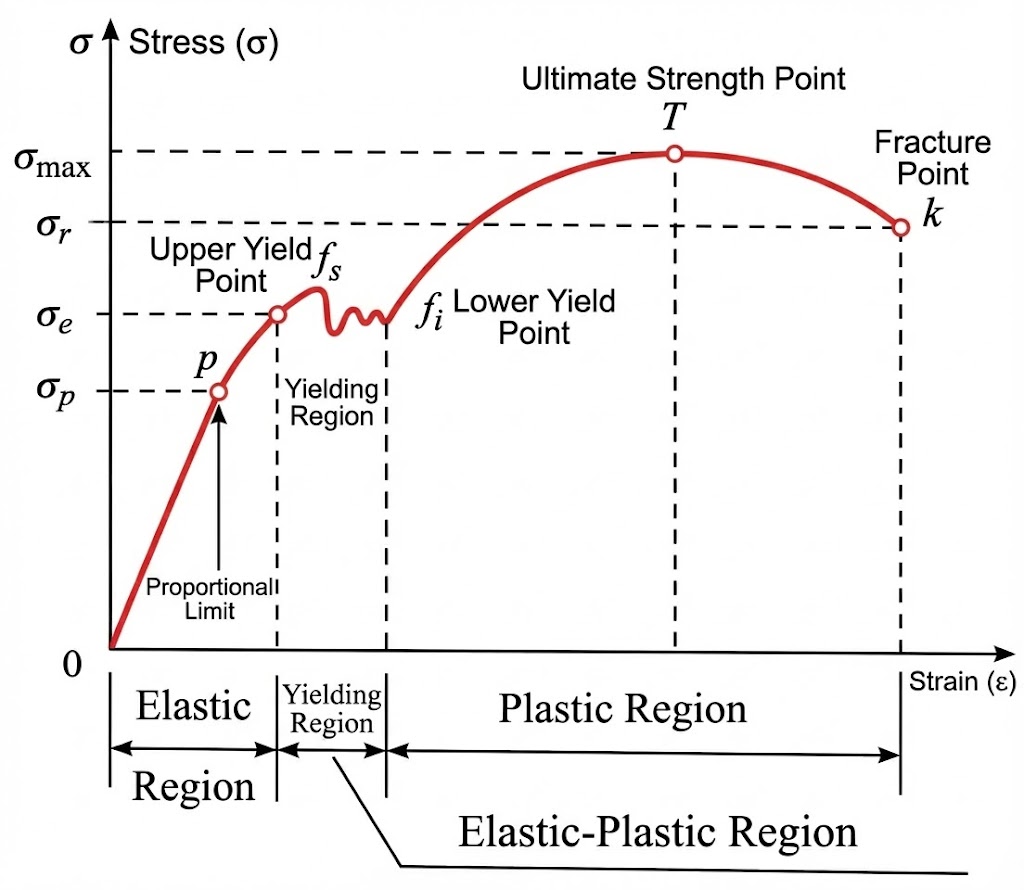
Young’s modulus (E) measures the stiffness of a material, that is, its ability to resist elastic deformation when subjected to tension or compression.
It describes behaviour in the elastic region: if the load is removed, the material returns to its original shape (Hooke’s law).
How is it calculated? Formula and Hooke's Law
Young’s modulus is the ratio between stress and strain, derived from Hooke’s law:
E = σ / ε
Where:
-
σ (Sigma) – Stress: the applied force per unit area (measured in pascals, Pa).
-
ε (Epsilon) – Strain: the relative elongation with respect to the original length (dimensionless).
The unit of measurement is the pascal (Pa), but in practice the following are commonly used:
What does it really indicate? (Stiffness vs Strength)
A common mistake is to confuse Young’s modulus with strength.
A material can be very stiff but brittle (e.g. glass), or not very stiff but extremely durable (e.g. rubber).
Young's Modulus Table: Comparison Materials
|
Material
|
Young's Modulus (GPa)
|
Behavior
|
|
Rubber
|
0,01 - 0,1
|
Very elastic
|
|
TPU (3D Printing)
|
0,02 - 0,05
|
Elastic
|
|
Nylon PA12
|
1,4 - 1,8
|
Flexible and tough
|
|
ABS
|
1,5 - 2,5
|
Moderately stiff
|
|
PLA
|
2,5 - 3,5
|
Stiff (but brittle)
|
|
Aluminum
|
~70
|
Structural stiffness
|
|
Titanium
|
~110
|
High specific stiffness
|
|
Steel
|
~200
|
Very stiff
|
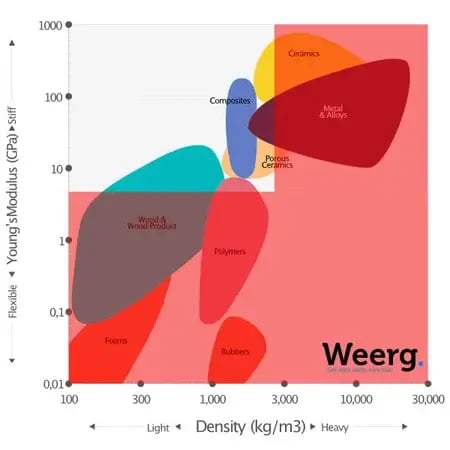
Young's modulus and Ashby charts
In Ashby charts, Young’s modulus is often related to:
-
density → to assess stiffness-to-weight ratio
-
cost → to optimise performance and budget
-
toughness → to avoid overly brittle materials
Typical example:
Young's Modulus in Design
Young’s modulus is essential for:
Predict deformations
It allows calculation of:
-
bending
-
elongation
-
elastic deflection
Ensuring dimensional accuracy
Fundamental for:
-
gears
-
supports
-
frames
-
mating parts
Choosing the right material
For example:
-
high stiffness → frames, structures
-
low stiffness → seals, dampers
Optimising weight and performance
Especially in:
-
drones
-
automotive
-
aerospace
Young's module and 3D printing: What changes?
In additive manufacturing, the nominal material value (from the datasheet) is not the only factor. You must also consider:
-
Technology: MJF and SLS offer more isotropic properties than FDM.
-
Orientation: in FDM, the modulus along the Z axis is often lower.
-
Process: Nylon PA12 printed with MJF behaves differently from injection-moulded PA12.
Material stiffness vs part stiffness
Young’s modulus is a material constant. Part stiffness depends on geometry.
Example: by increasing thickness or adding ribs, you can make a nylon part stiff, overcoming the intrinsic limits of the material itself.
Conclusion
Knowing the modulus of elasticity is vital for optimising weight and costs without risking failure.
Do you need to choose between flexibility and stiffness for your next project?
UPLOAD YOUR FILE
and get an instant quote with the materials best suited to your technical specifications.


 Weerg staff: Sep 23, 2026