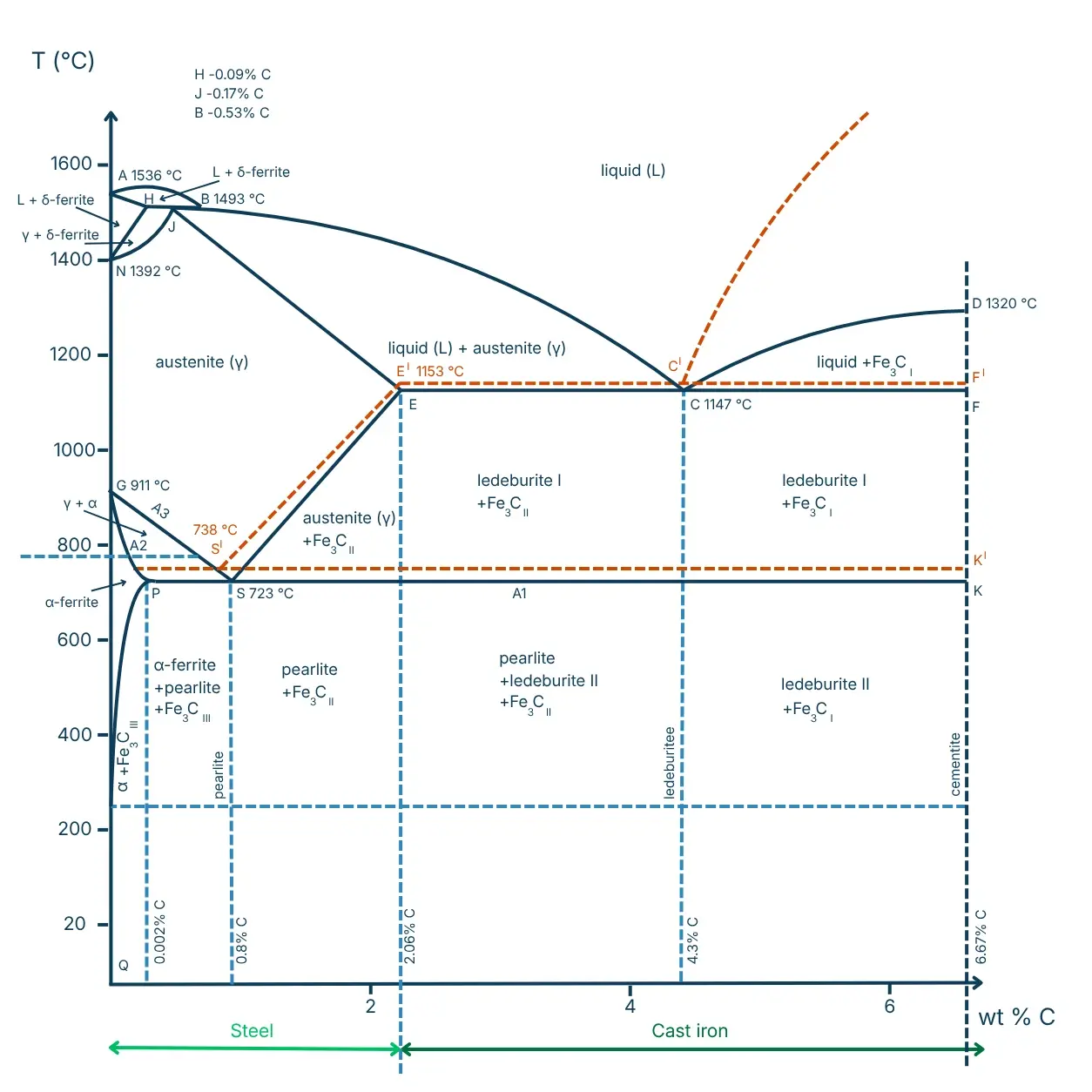
The iron-carbon diagram is one of the most important tools in metallurgy and metallic materials design. It is used to understand how steels and cast irons behave as a function of temperature and carbon content.
Understanding the iron-carbon diagram is essential for choosing the correct material, designing heat treatments, predicting mechanical properties, and checking hardness, strength and ductility.
It is the theoretical basis for much of the modern steel industry.
What is the iron-carbon diagram?
The iron-carbon diagram is an equilibrium diagram that describes the structural transformations of iron-carbon alloys as a function of temperature and carbon content.
It shows which metallurgical phases form during heating or cooling, thereby making it possible to predict the final microstructure of the material.
Why is carbon so important in steel?
Carbon is the element that most influences the behaviour of steel.
Small variations in carbon content modify: hardness, mechanical strength, toughness, weldability, and ductility.
In general:
- Carbon content above 2.06% → greater hardness and strength
- Carbon content below 2.06% → greater ductility and machinability
Structure of the iron-carbon diagram
The diagram relates the carbon percentage from 0% to 6.67% (horizontal axis) to the temperature up to 1,600 °C (vertical axis).
Within the diagram, various phases, critical lines, and eutectoid and eutectic points appear.
The main phases of the iron-carbon diagram
Ferrite (α and δ)
Alpha ferrite is the stable phase at room temperature and up to approximately 912 °C. It has a body-centred cubic (BCC) crystal structure, low carbon solubility (maximum 0.02% at 723 °C), and good ductility. Delta ferrite, stable at high temperatures (1,394–1,538 °C), also has a BCC structure.
Austenite (γ)
Austenite is the stable solid phase between 912 °C and 1,495 °C. It has a face-centred cubic (FCC) structure, which allows much greater carbon solubility than ferrite: up to 2.14% C at 1,148 °C. Austenite is the starting phase for most steel heat treatments.
Cementite (Fe₃C)
Cementite is iron carbide with the formula Fe₃C, containing 6.67% C by weight. It is an extremely hard and brittle phase with an orthorhombic structure. It is often found in lamellar form in pearlite or as an intergranular network in hypereutectoid cast irons.
Perlite
Pearlite is not a single phase, but a lamellar microstructure composed of alternating layers of ferrite and cementite. It forms during slow cooling of austenite at the eutectoid point (0.8% C, 723 °C) through the eutectoid reaction.
Ledeburite
Ledeburite is the eutectic microstructure of cast irons, composed of austenite and cementite. It forms at 1,148 °C with a carbon content of 4.3%. It is characteristic of white cast irons and is responsible for their high hardness and brittleness.
Steels and cast irons in the diagram
The diagram divides iron-carbon alloys into two main categories.
Steels
Carbon content up to approximately 2.06% They are:
- deformable
- machinable
- weldable
Cast irons
Carbon content above 2.06% They are:
- harder
- more brittle
- excellent for casting and founding
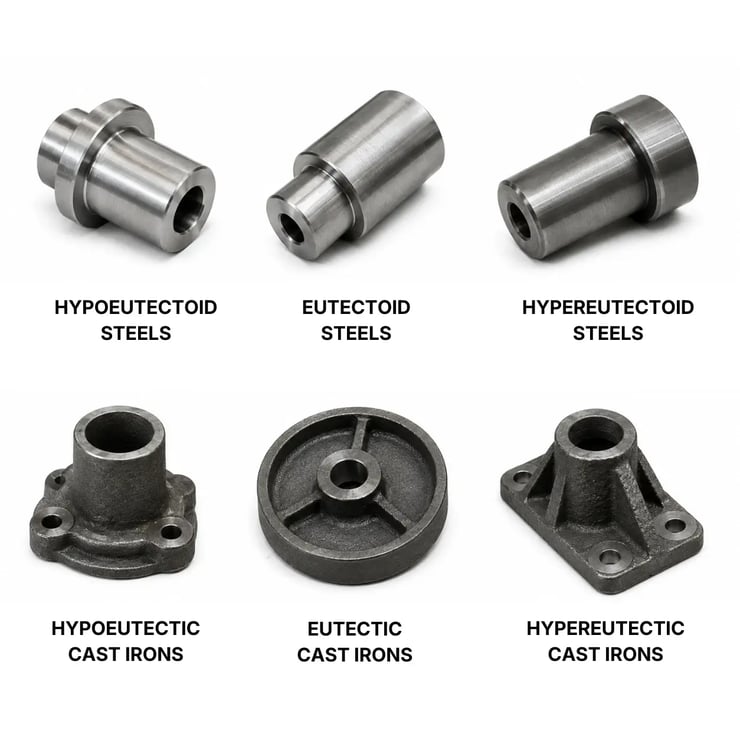
Classification of steels by carbon content
|
Type
|
Carbon content
|
Main characteristics
|
|
Hypoeutectoid steels
|
0,02-0,8%
|
Ferrite + perlite; good ductility
|
|
Eutectoid steels
|
~0,8%
|
Perlite; balance between hardness and ductility
|
|
Hypereutectoid steels
|
0,8-2,14%
|
Perlite + cementite; high hardness
|
|
Hypoeutectic cast irons
|
2,14-4,3%
|
Perlite + transformed ledeburite
|
|
Eutectic cast irons
|
4,3%
|
Pure ledeburite
|
|
Hypereutectic cast irons
|
4,3-6,67%
|
Ledeburite + primary cementite
|
Critical points of the Fe-C diagram
The eutectoid point
One of the most important points of the diagram is the eutectoid point:
- approximately 0.77% carbon
- at 727 °C
Here, austenite transforms completely into pearlite. It is the basic reference for many heat treatments.
The eutectic point
The eutectic point is located at:
- approximately 4.3% carbon
- at 1,147 °C
Here, the liquid solidifies directly into:
It is fundamental in the study of cast irons.
Peritectic point
The peritectic point is located at approximately:
- 0.16–0.17% carbon
- approximately 1,493 °C
At this point, the liquid and delta ferrite react to form austenite.
How to read the iron-carbon diagram
To read the diagram, one must:
- identify the carbon percentage
- observe the temperature
- verify in which area of the diagram the material is located
From this you can tell what phases are present, how the mechanical properties will vary, and how the material will react to heat treatments.
Why the iron-carbon diagram is fundamental
The diagram is used for:
- Steel design: It allows the prediction and identification of a specific microstructure in order to achieve the desired mechanical properties of the material.
- Heat treatments: Theoretical basis for quenching, tempering, normalising, and annealing.
- Mechanical property control: Helps predict hardness, strength, and ductility.
- Metallurgy and production: Essential in steelworks, foundries, CNC machining, and metallic additive manufacturing.
Iron-carbon diagram and heat treatment
Understanding the Fe-C diagram is indispensable for designing and controlling the main heat treatments of steels.
Annealing
Slow cooling that brings the microstructure towards equilibrium, reducing residual stresses and increasing ductility.
Normalising
Cooling in air from austenite; produces finer microstructures than annealing.
Quenching
Rapid cooling that prevents carbon diffusion, transforming austenite into martensite, a very hard metastable phase.
Tempering
Treatment following quenching that reduces brittleness and relieves internal stresses, slightly increasing ductility.
Carburising
Surface carbon enrichment process to bring a surface layer into the compositional range that favours martensite formation during quenching.
Limitations of the iron-carbon diagram
The diagram:
- represents equilibrium conditions
- does not consider real rapid cooling
- does not include all modern alloying elements
For special steels, more complex diagrams are used: TTT, CCT, or multicomponent diagrams.
Conclusions
The iron-carbon diagram is the foundation of the metallurgy of steels and cast irons. It allows an understanding of microstructural transformations, mechanical behaviour, and the effects of heat treatments.
Whether working in design, CNC production, heat treatments, or additive manufacturing, understanding the iron-carbon diagram means understanding the behaviour of metallic materials at the heart of modern industry.
Would you like to choose the most suitable metallic material for your project?
Upload your file and explore the available materials
Frequently asked questions about Fe-C diagram


 Weerg staff: Sep 30, 2026