Copper alloys are one of the most versatile groups of materials available to designers: they combine copper’s conductivity and corrosion resistance with mechanical strength and machinability that pure copper could never achieve. There are hundreds of standardised grades, from free-machining brasses to marine bronzes, right through to copper-beryllium alloys capable of competing with steels.
In this guide, we look at how copper alloys are classified, the main alloy families, the properties you can expect and how to choose the right grade for your application. If you already need to move from theory to production, you can rely on our CNC turning and CNC milling service using certified materials.
What is a copper alloy?
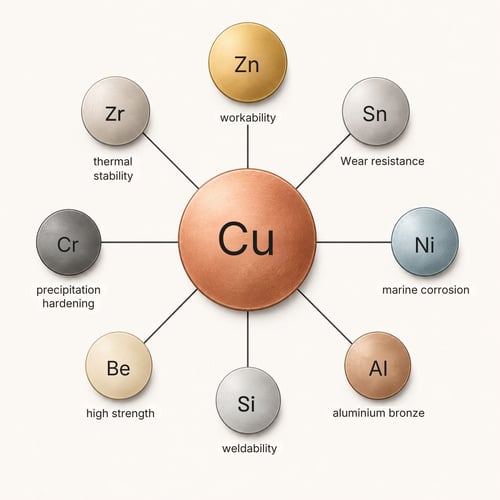
A copper alloy is a material in which copper remains the predominant element but is combined with one or more elements in quantities sufficient to significantly modify its properties. Each alloying element introduces a specific effect:
-
Zinc: improves cold workability and reduces cost (brasses);
-
Tin: increases mechanical strength and wear resistance (bronzes);
-
Nickel: provides resistance to marine corrosion and stability at high temperatures (cupronickel);
-
Aluminium: forms a protective film and provides mechanical strength (aluminium bronzes);
-
Silicon: improves weldability and fluidity during casting;
-
Beryllium, chromium, zirconium: enable precipitation-hardening treatment, achieving high hardness and strength.
In general, every alloying element reduces electrical conductivity but increases strength and machinability.
How are copper alloys designated?
The European standard UNI EN 1412 identifies each alloy with a code consisting of “CW” + three digits + a letter indicating the family. The final letter is the key to orientation:
A, B → pure and low-alloy copper
C, D → copper-aluminium alloys
E, F → cupronickel
G, H → nickel silver / maillechort (Cu-Ni-Zn)
L–S → brasses (Cu-Zn)
In parallel, symbolic designations are also used, such as CuZn37 or CuNi10Fe1Mn, as well as the UNS system for the American market, for example C26000 or C70600. Always specifying the grade and supply condition on drawings avoids ambiguity in production.
The main families of copper alloys
Copper alloys are grouped into families according to their main alloying element. Below are the most relevant families from an industrial point of view.
Brasses (Cu-Zn): copper-zinc alloys
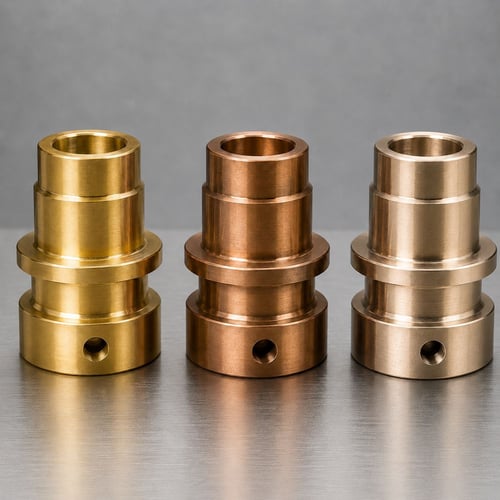
Brasses are copper-zinc alloys with Zn contents ranging from 5% to 45%. They are the most widely produced copper alloys in the world due to their low cost, excellent machinability and attractive appearance. They are divided into two groups:
-
α brasses (Zn < 37%): single-phase alloys, suitable for cold forming, such as sheet metal, wire and fittings;
-
α+β brasses (Zn 37–45%): stronger alloys, suitable for hot forming, stamping and turning.
Most common grades:
-
CW508L (CuZn37): yellow brass for stamping and cold forming.
-
CW614N (CuZn39Pb3): leaded brass, the global standard for automatic turning. Under regulatory pressure due to lead in drinking water.
-
CW724R (CuZn21Si3P): lead-free silicon brass, certified for drinking water applications such as taps and valves.
-
CW307G (CuZn40Al2): high-strength naval brass for marine environments.
Bronzes (Cu-Sn and derivatives): copper-tin alloys
Traditionally, “bronze” refers to copper-tin alloy, but today the term covers a broad family of alloys with high mechanical strength and corrosion resistance.
-
CuSn8 (CW453K): classic tin bronze, used for springs, bushes and stressed electrical contacts.
-
CuSn8P (CW459K): phosphor bronze, with excellent fatigue and wear resistance.
-
CuAl10Fe (CW303G) and CuAl10Ni5Fe4 (CW307G) – aluminium bronzes: among the mechanically strongest copper alloys, with excellent behaviour in seawater. Used for impellers, propellers, valves and pump shafts.
-
CuSi3Mn (CW116C): silicon bronze, with excellent weldability; a lead-free alternative for potable water applications.
Cupronickel (Cu-Ni): copper-nickel alloys
Copper-nickel alloys contain between 10% and 30% Ni, sometimes with small amounts of iron and manganese. They stand out for:
-
excellent resistance to marine corrosion, in many cases even better than stainless steels;
-
resistance to biofouling, meaning they are not encrusted by marine organisms;
-
good mechanical stability at high temperatures.
Standard grades include CuNi10Fe1Mn (CW352H) and CuNi30Mn1Fe (CW354H). They are the materials of choice for heat exchangers, seawater piping, desalination plants, power station cooling systems and shipbuilding.
Maillechort or nickel silver (Cu-Ni-Zn): copper-nickel-zinc alloys
Copper-nickel-zinc alloys are also known as “nickel silver”. They combine corrosion resistance with a silver-like appearance and are used for precision electrical components, cutlery, musical instruments and keys. A typical grade is CuNi18Zn20 (CW409J).
High-strength alloys: CuBe and CuCrZr
These are “special” copper alloys, hardened by precipitation. After solution treatment and quenching, controlled ageing causes very fine phases to precipitate, blocking dislocations and dramatically increasing hardness.
-
Copper-beryllium (CuBe2 – CW101C): tensile strengths of up to 1,300 MPa with conductivity of 22–28% IACS. Used for conductive springs, fatigue-resistant connectors, non-sparking tools for ATEX environments and plastic moulding dies with high thermal conductivity. Caution: beryllium is toxic during machining when dust is produced and requires specific safety protocols.
-
Copper-chromium-zirconium (CuCr1Zr – CW106C): hardness of approximately 150 HB and conductivity of around 80% IACS, maintained up to 450 °C. It is the standard material for resistance-welding electrodes, mould inserts and thermally stressed conductive bars.
Comparison of the main copper alloys
The following table compares the most representative grades of each family in terms of mechanical properties (Rm, Rp0.2 and elongation A%), electrical conductivity and machinability.
The values are indicative and vary according to the supply condition: they should always be checked against the material certificate.
|
Alloy
|
EN Designation
|
Rm (MPa)
|
Rp0.2 (MPa)
|
A%
|
Conductivity (% IACS)
|
Workability
|
|
CuZn37 (yellow brass)
|
CW508L
|
280–440
|
120–350
|
15–45
|
28
|
Good
|
|
CuZn39Pb3 (turning)
|
CW614N
|
360–470
|
140–310
|
12–30
|
27
|
Excellent
|
|
CuZn21Si3P (lead-free)
|
CW724R
|
530–650
|
280–450
|
12–25
|
12
|
Good
|
|
CuSn8 (bronze)
|
CW453K
|
380–700
|
130–560
|
8–65
|
13
|
Fair
|
|
CuAl10Ni5Fe4 (Al-Ni bronze)
|
CW307G
|
650–750
|
280–400
|
13–20
|
8
|
Fair
|
|
CuNi10Fe1Mn
|
CW352H
|
300–400
|
110–200
|
25–35
|
9
|
Good
|
|
CuBe2 (TF00-treated)
|
CW101C
|
1,150–1,350
|
1,000–1,250
|
2–5
|
22
|
Fair
|
|
CuCr1Zr (heat-treated)
|
CW106C
|
400–500
|
350–450
|
12–18
|
75–85
|
Good
|
Heat treatments for copper alloys
Unlike steels, most copper alloys do not harden through martensitic quenching. The main hardening mechanisms are:
-
Work hardening / cold working: cold plastic deformation by rolling, drawing or stamping. This applies to brasses, bronzes and cupronickels. Supply conditions are designated with codes such as H070 or H080, meaning half-hard or hard.
-
Annealing: heats the material to restore ductility and homogeneity after work hardening.
-
Precipitation hardening / age hardening: typical of CuBe and CuCrZr. The sequence is solution treatment → water quenching → controlled ageing. This allows the part to be machined in the soft condition and hardened only at the end of the production cycle.
Applications of Copper Alloys
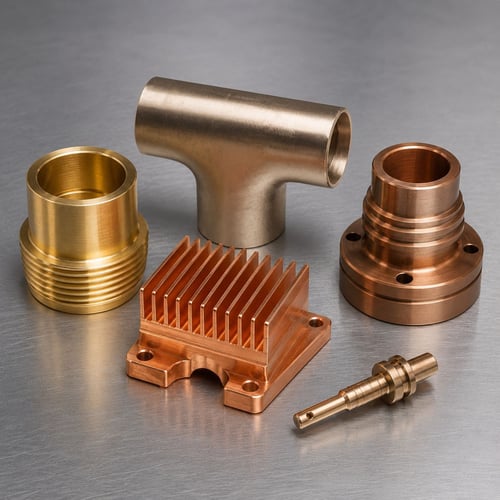
Copper alloys are found in virtually every industrial sector:
-
Automotive: CuBe connectors, brass fittings, bronze bushes and cupronickel heat exchangers;
-
Electronics and electrical engineering: CuBe springs and contacts, CuCrZr conductive bars;
-
Plumbing, heating and sanitary systems: lead-free brass taps and brass fittings
-
Marine and offshore: cupronickel for piping, aluminium bronzes for propellers and valves;
-
Moulds and tools: CuBe and CuCrZr for high-thermal-conductivity inserts and welding electrodes;
-
Furniture and design: brasses for finishes, handles and lighting; bronzes for artistic castings.
How to choose the right copper alloy
To choose the most suitable copper alloy for your project, the following factors should be analysed in order of priority:
- Operating environment
Marine → cupronickel or aluminium bronzes;
Potable water → lead-free brasses;
ATEX atmosphere → CuBe, due to its non-sparking properties.
-
Required mechanical strength
Standard → brasses and bronzes;
High → CuBe, CuCrZr, Al-Ni bronzes.
-
Electrical or thermal conductivity
High → CuCrZr;
Medium → CuBe;
Low acceptable → brasses and bronzes.
-
Main machining or forming process
Automatic turning → CW614N;
Cold forming → α brasses;
Welding → silicon bronzes.
-
Regulatory compliance
RoHS, REACH, DM 174/2004 for drinking water, biocompatibility.
-
Cost and Availability
Standard brasses and bronzes are the most readily available;
CuBe and CuCrZr have longer lead times and higher prices.
Conclusion
Copper alloys cover an enormous performance spectrum: from economical free-machining brasses to marine cupronickels, right through to copper-beryllium alloys that can compete with steels.
Choosing the right alloy for your project requires just a few steps: defining the operating environment and required performance, translating those requirements into the right alloy family, specifying the grade and supply condition according to UNI EN 1412, and checking compliance on the certificates.
The result is a component that truly performs, both in production and in service.
Do you need to manufacture components in copper alloys with a certified grade and guaranteed properties?
Upload your file and receive your quotation immediately
Frequently asked questions About Copper Alloys

 Weerg staff: Sep 23, 2026