Galvanisation is one of the most effective and widely used surface treatments for protecting steel and other metals from corrosion, oxidation and wear.
Used for over 150 years in construction, mechanical engineering and the automotive industry, it is now an essential industrial standard for increasing the durability, strength and reliability of metal components.
In this guide you will find:
What is galvanisation?
Galvanisation is a metallurgical process that consists of applying a protective layer of zinc to the surface of steel or another metal.
The name derives from Luigi Galvani, the discoverer of bioelectricity, but modern industrial application is based on the principle of electrolysis.
Zinc acts as a corrosion barrier and also provides electrochemical protection, preventing the underlying steel from rusting.
In practice, galvanisation:
-
protects the metal from atmospheric agents
-
prevents rust
-
increases component lifespan
-
improves aesthetic appearance
-
reduces maintenance costs
The principle behind it is galvanic action: zinc, being more reactive, corrodes in place of the steel (sacrificial protection).
How does galvanisation work?
The process varies depending on the technique used, but generally includes:
Surface preparation
Application of zinc
This can be done by immersion, electrodeposition, spraying or thermal diffusion.
Cooling and solidification
The zinc adheres to the surface, forming a uniform protective layer.
Final inspection
Checking adhesion, thickness and coating uniformity.
Types of GALVANISATION AND ZINC COATING
There are several techniques, each with specific characteristics and applications.
| Type of galvanising |
How it works |
Typical thickness |
Corrosion resistance |
Main advantages |
Limitations |
Ideal applications |
| Hot-dip galvanising |
Immersion of the part in molten zinc at ~450°C |
50-150 μm |
Very high (decades) |
Durable protection, resistance even in marine environments |
Possible aesthetic irregularities, not suitable for tight tolerances |
Metal fabrication, construction, outdoor structures, guardrails, poles |
| Electroplated galvanising (electrodeposition) |
Zinc deposition using electric current |
5-20 μm |
Medium |
Uniform and highly aesthetic finish, precise thickness controls |
Lower resistance than hot-dip galvanising |
Small hardware, screws, bolts, precision mechanical parts |
| Spray galvanising (metallisation) |
Molten zinc sprayed using thermal guns |
40-80 μm |
High |
Suitable for very large parts, ideal for repairs |
Requires thorough surface preparation |
Large structures, local repairs, construction sites |
| Sherardising (thermal diffusion) |
Zinc diffusion in rotating drum at 350°C |
20-80 μm |
High |
Very uniform coating, excellent for threads |
Not ideal for large parts |
Fasteners, complex components, parts subject to friction |
| Mechanical galvanising |
Application of zinc particles through mechanical processes |
8-30 μm |
Medium |
Excellent for small batch components |
Not suitable for aggressive environments |
Bolts, small components or heat-sensitive parts |
Difference between ELECTROPLATED AND HOT-DIP GALVANISING
It is important to distinguish electroplated galvanising (ideal for controlled thicknesses and precision) from hot-dip galvanising, which involves immersion in molten metal.
In precision engineering, the electroplated process is often preferred to avoid altering critical dimensional tolerances.
HOT-DIP GALVANISING
Immersion in molten zinc produces a thick layer composed of metallurgical alloys that integrate with the steel.
This characteristic gives the coating:
It is therefore a solution aimed at maximum protection rather than aesthetic precision.
ELECTROPLATED GALVANISING
In the electroplating process, zinc is deposited by electric current as a thin, uniform film.
The thickness can be precisely controlled, and the resulting finish is much cleaner and more aesthetic than hot-dip galvanising.
Corrosion protection is good but lower, and it is intended mainly for mechanical components or parts with tight tolerances.
In short:
-
Hot-dip → more protective, thicker, more resistant
-
Electroplated → more precise, more aesthetic, less protective
The two techniques do not compete: they meet different needs.
WHICH METALS CAN BE GALVANISED?
Galvanisation works best with steel and cast iron, as zinc adheres stably and provides very high corrosion protection.
Metals THAT CAN BE GALVANISED
- Carbon steel - the ideal material for zinc coating.
- Mild steel/rolled steel - excellent zinc adhesion.
- High-strength steel (HSS) - galvanisable, preferably hot-dip or sherardised.
- Cast iron - requires careful cleaning but galvanises well.
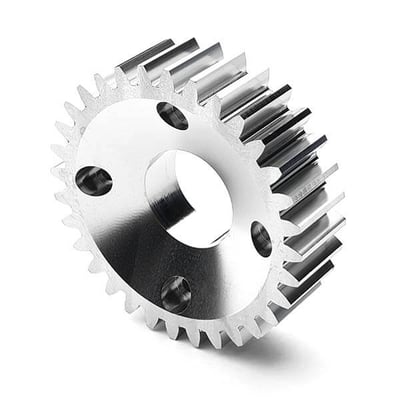
Metals GALVANISABLE ONLY WITH SPECIFIC TECHNIQUES
- Aluminum - possible only with electroplating on specific alloys.
- Zinc and zinc alloys - treatable to even out the surface.
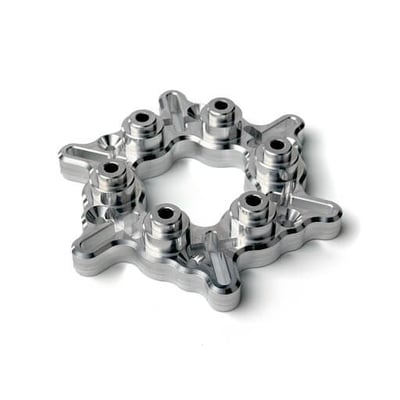
Metals NOT RECOMMENDED FOR GALVANISING
In summary: galvanisation is ideal for steel, useful in some cases for cast iron and a few other metals, but generally not recommended for non-ferrous alloys.
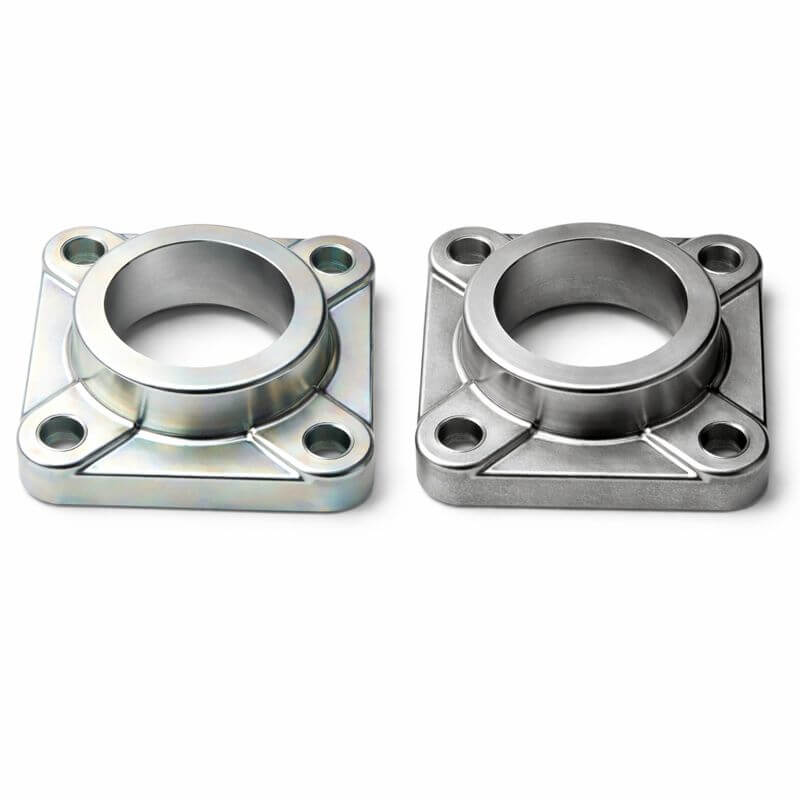
Where is galvanisation used?
-
Automotive: Fasteners, brackets, chassis components exposed to salt and moisture
-
Electronics: Often used with gold or silver plating not for corrosion protection, but to improve contact conductivity
-
Construction and metal fabrication: External load-bearing structures
-
Marine environments: Pontoons, barriers, equipment exposed to salinity.
Conclusions
Galvanisation is a fundamental process for protecting steel from corrosion, improving durability and reducing maintenance costs.
Between hot-dip, electroplated and thermal diffusion zinc coating, each method offers specific advantages for different requirements.
If you need to manufacture metal parts intended for outdoor use, aggressive environments or long service life, galvanisation is one of the most reliable and cost-effective solutions available.
Do you want to manufacture CNC components?
Upload your file now and get an instant quote with professional finishes

 Weerg staff: Aug 26, 2026