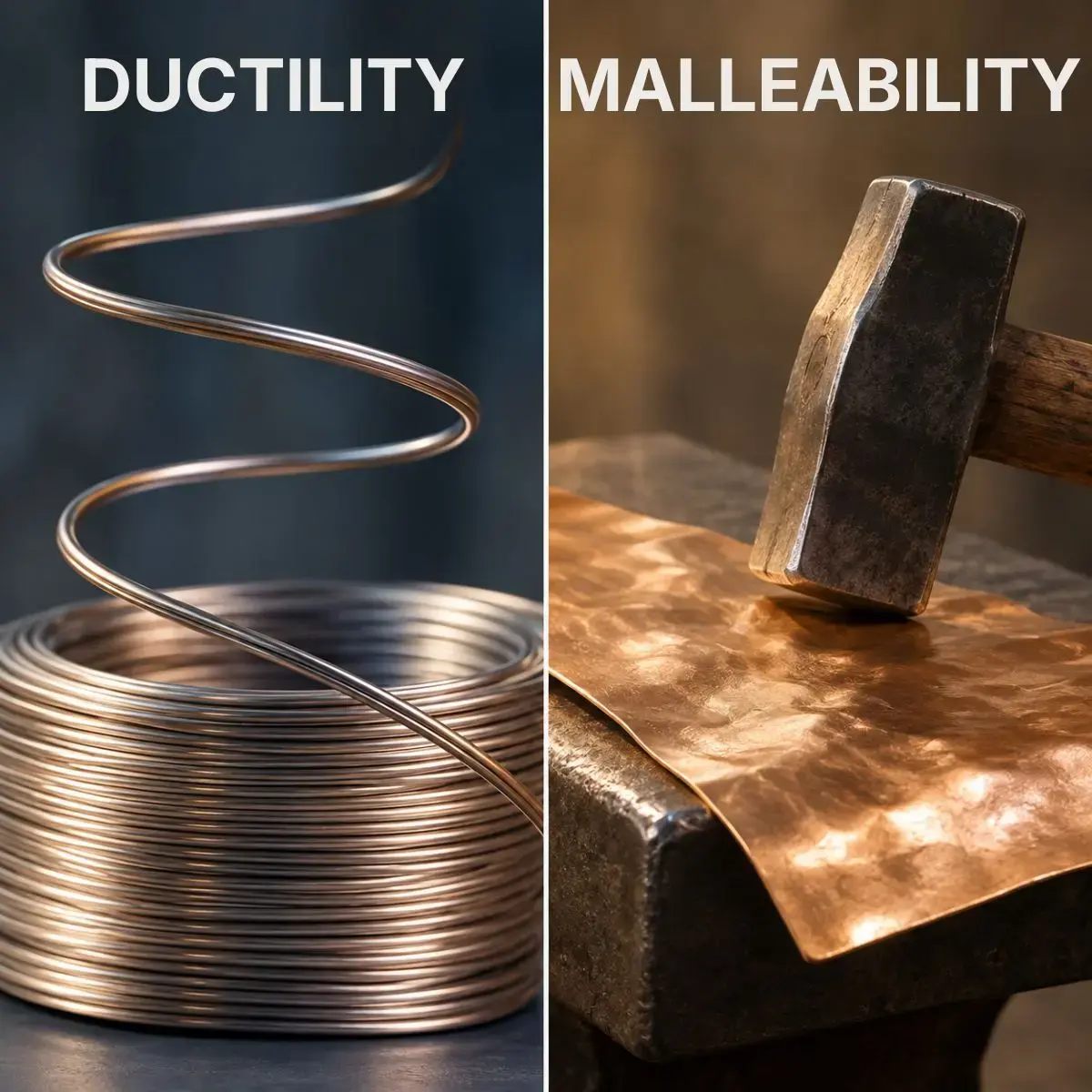
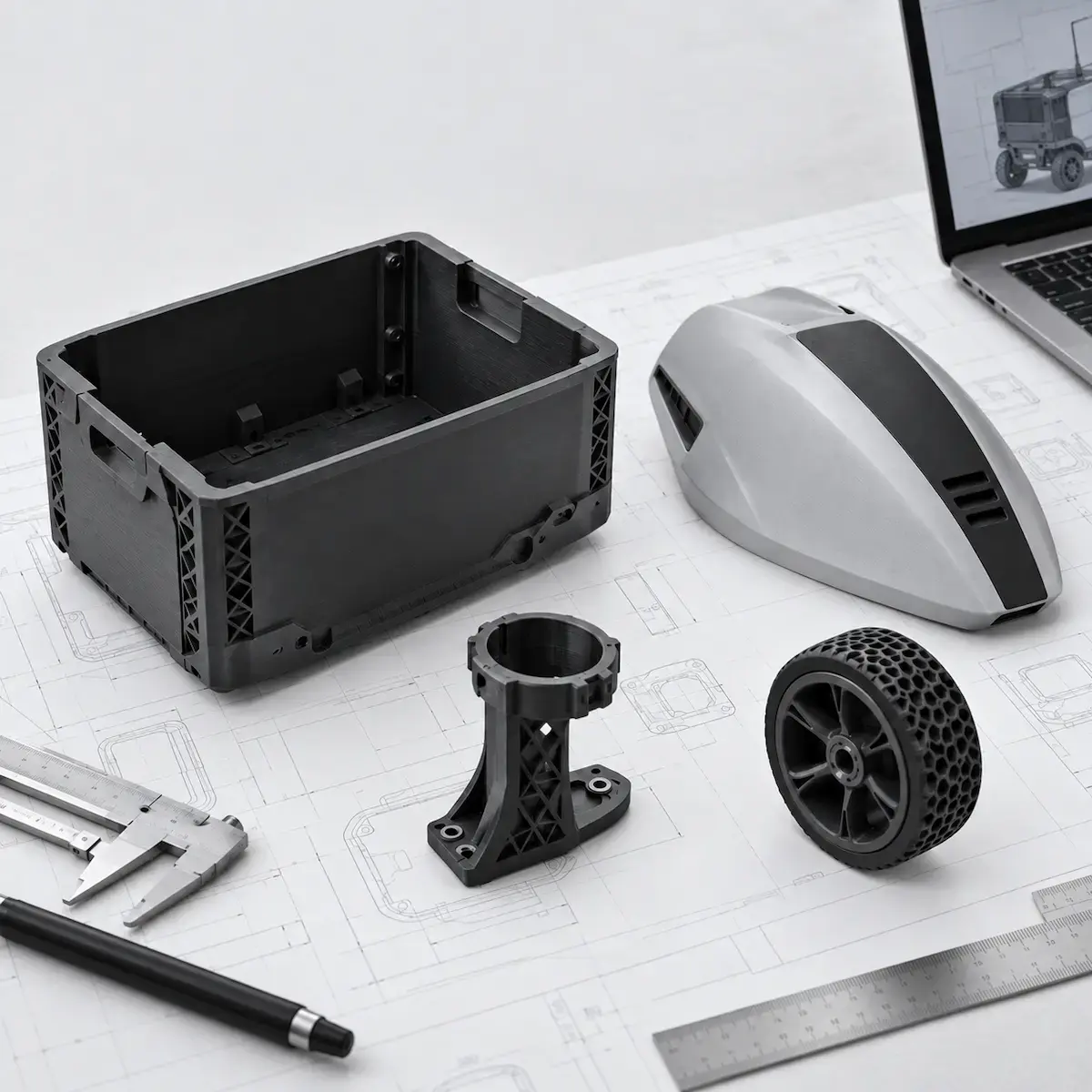
The galvanisation of an SLA resin print triples its breaking load, quadruples its stiffness, and improves flexural resistance by nearly 10 times. This is the finding that convinced Volkswagen to choose SLA 3D printing — rather than a metal printer — to produce the wheel covers for the "Type 20" prototype. Ford uses it to build prototypes for the new Explorer. Unilever and Serioplast use it to print moulds for blowing real bottles, cutting costs by 90%.
Three global brands, one material: SLA resin. But what exactly is it, how does it work, and when does it make sense to use it in your workflow? Let's find out in this article.
What is SLA 3D printing and HOW DOES IT WORK
SLA 3D printing (Stereolithography) is an additive manufacturing technology that uses an ultraviolet laser to solidify successive layers of liquid photopolymer resin. It is the first 3D printing technology ever commercialised — patented in the 1980s — and remains today one of the reference standards for surface quality and dimensional accuracy.
How SLA printing works:
- A vat is filled with liquid photopolymer resin.
- A build platform is submerged in the resin.
- A UV laser traces the profile of each individual layer, selectively solidifying the resin.
- The platform moves down (or up, depending on the system) by the thickness of one layer — typically 25–100 microns.
- The process repeats until the part is complete.
- The part is removed, washed with solvent to remove residual resin, and then post-cured with UV light to achieve its final mechanical properties.
The result is an object with an extremely smooth surface finish, fine details, and complex geometries that would be difficult to achieve with other processes. Large-format SLA printers allow parts of significant size to be produced whilst maintaining the same quality.
SLA vs FDM vs SLS - the COMPARISON TABLE YOU'VE BEEN MISSING
Choosing the right 3D printing technology depends on the application. Here is a direct comparison of the three most widely used technologies in the industrial world:
| Feature |
SLA |
FDM |
SLS |
| Principle |
UV laser on liquid resin |
Melted filament layer by layer |
Laser on nylon powder |
| Surface finish |
Smooth, nearly isotropic |
Layer lines visible |
Granular, but uniform |
| Dimensional accuracy |
Very high |
Medium |
High |
| Geometric detail |
Excellent |
Limited |
Good |
| Waterproof |
Yes |
No (porous parts) |
No (porous parts) |
| Galvanic compatibility |
Excellent |
Poor |
Poor |
| Materials available |
Standard rigid, flexible, biocompatible, heat-resistant resins |
PLA, ABS, PETG, TPU, composites |
PA-12 (Nylon), PA-11, TPU |
| Ideal for |
Aesthetic prototypes, moulds, galvanisation, jewellery, medical parts |
Rapid functional prototypes, internal use |
Functional mechanical parts, mass production without supports |
| Cost per part |
Medium-high |
Low |
Medium-high |
| Post-processing |
Required (washing + UV) |
Minimal |
Necessary (powder cleaning) |
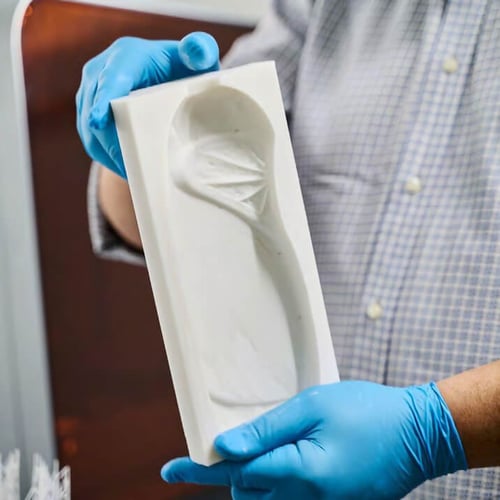
The key difference between SLA and FDM lies in porosity: FDM and SLS parts are not watertight, whereas SLA parts are. This makes them ideal for galvanisation — as Volkswagen did — and for moulds in contact with liquids or high-pressure materials, as in Unilever's case.
Volkswagen, Ford, Unilever: what they do with SLA resin
Volkswagen - Galvanised WHEEL COVERS THAT LOOK (AND PERFORM) LIKE METAL
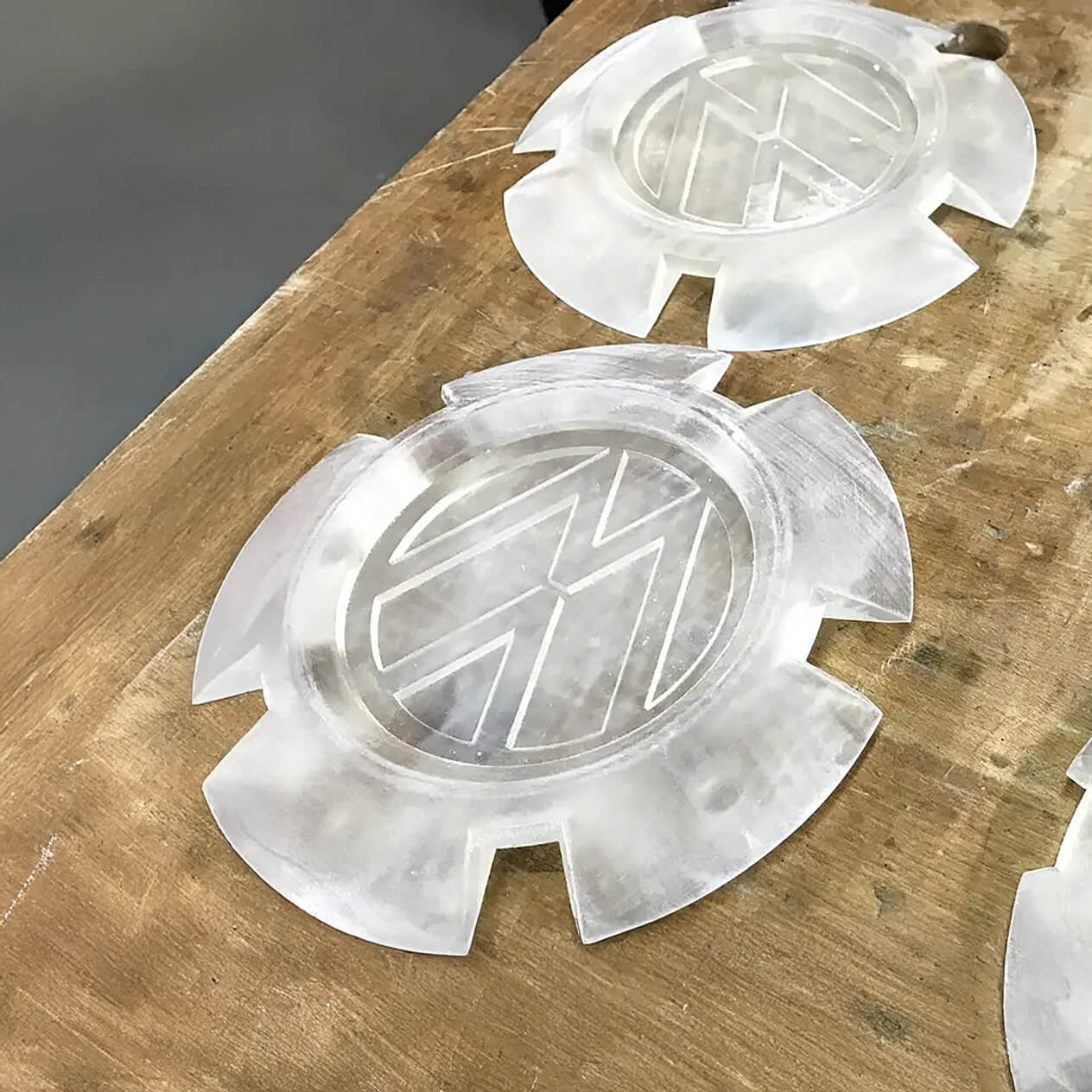
For the "Type 20" prototype — a modern reinterpretation of the classic 1962 VW Microbus — Volkswagen's designers faced a challenge: the cast aluminium wheels, produced with generative design in collaboration with Autodesk, required wheel covers with organic geometries that were impossible to produce quickly in metal.
The solution: print the wheel covers in resin using a Formlabs desktop SLA 3D printer, then galvanise them with a nickel layer approximately 10 microns thick.
The result? Parts that look entirely metallic, produced rapidly to keep pace with every design iteration, with minimal geometric constraints. Tests demonstrated that galvanisation on SLA:
- Triples the breaking load
- Quadruples stiffness
- Improves flexural resistance by nearly 10 times
Metals suitable for galvanisation on SLA include nickel (corrosion resistance), copper (electrical conductivity), and gold (low-cost aesthetic finish). Raised surfaces can be polished to a mirror finish, whilst textured areas remain matt — as on the VW wheel covers — creating sophisticated visual contrasts.
Ford - From Form 2 to Form 4: faster prototyping, better vehicles
Ford's Merkenich facility, near Cologne, is the heart of the brand's European vehicle development — from the Fiesta to the new Explorer, Ford's first fully electric vehicle for Europe. Merkenich was also the first European facility to adopt an SLA printer, back in 1994.
Today, the rapid technology centre uses SLA printers primarily for design prototypes requiring high surface quality and fast iterations. Among the components prototyped in SLA for the new Explorer: wing mirror caps, exterior body panels, and interior components.
"A few years ago it took days to print parts; today we can do it in a few minutes," said Bruno Alves, additive manufacturing expert at Ford. "This means the engineering teams are not afraid to create new designs or new iterations."
The Form 3L — with its large build volume — allows body panel prototypes to be produced in a single piece. The Form 4, for which Merkenich served as a beta tester, has further accelerated the workflow, enabling the team to fulfil urgent requests across borders, with overnight shipments to the technical centre in Dunton in the United Kingdom.
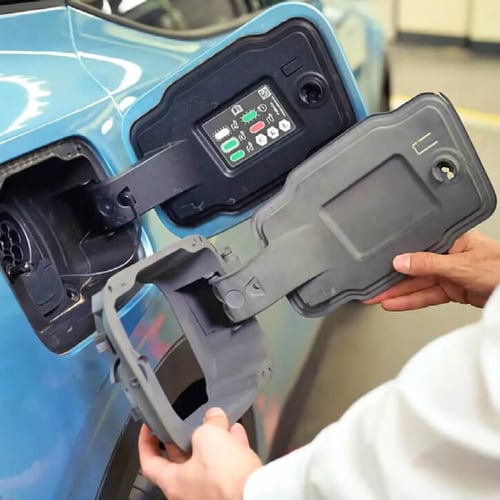
For more complex mechanical parts, such as the charging port cover — an assembly so intricate that it cannot be produced by other methods — Ford uses SLS printing (Fuse 1+ 30W with PA-12). The two technologies complement each other: SLA for aesthetics and finish, SLS/MJF for mechanical functionality.
Unilever & Serioplast - 3D MOULDS THAT REPLACE STEEL (AND SAVE 90% OF COSTS)
Unilever — the group behind Dove, Domestos, Cif, Knorr, and dozens of other brands — must constantly develop and test new packaging. For a PET bottle, the transition from digital design to the production line traditionally required 6–12 weeks and costs between £2,500 and £10,000 for a metal mould.
In collaboration with Serioplast Global Services — one of the world's leading manufacturers of rigid plastic bottles, producing 4 billion units per year — Unilever developed a new workflow based on 3D-printed moulds produced using a Form 3L and Rigid 10K Resin, for use directly in industrial stretch blow moulding (SBM) machines.
The Rigid 10K Resin - a glass-filled material with a heat deflection temperature of 218 °C and an elastic modulus of 10,000 MPa — withstands pressures of up to 30 bar and the temperatures of the SBM process, delivering hundreds of cycles with high repeatability.
The results:
| Metric |
CNC metal mould |
SLA resin mould |
| Pilot test lead time |
6-8 weeks |
2 weeks |
| Tooling cost |
£2,500–£10,000 |
£500–£1,000 |
| Time reduction |
- |
-70% |
| Cost reduction |
- |
-90% |
"With the 3D-printed mould, we can reduce lead times by 70% and costs by 90% compared to a standard mould. Where previously you had to wait up to 12 weeks for a single design, we can now produce five," said Flavio Migliarelli, Design Manager at Serioplast.
Bottles produced with SLA moulds are visually indistinguishable from those made with metal moulds, and can be used for real consumer testing, filling line validation, and capping tests.
When to choose SLA resin in your workflow
Based on the three case studies and the technological characteristics, SLA resin is the right choice when you need:
high surface quality
If the part needs to be presented to a client, photographed, exhibited, or galvanised, SLA guarantees a finish that FDM and SLS cannot replicate without intensive post-processing.
PARTS SUITABLE FOR GALVANISATION
The smooth, impermeable surface of SLA is the ideal base for nickel, copper, or gold galvanic treatments. As demonstrated by Volkswagen, the final result has mechanical characteristics superior to resin alone and a fully metallic appearance.
MOULDS OR LOW-VOLUME TOOLING
With high-rigidity resins, you can produce injection, blow, or thermoforming moulds in 2 days instead of 6–8 weeks — just as Unilever did.
complex geometries
SLA does not have the deposition limitations of FDM and supports thin structures, fine details (down to 0.5 mm, as in Unilever's bottles), and freeform organic shapes.
RAPID ITERATION
With the current generation of SLA printers, print times are measured in hours, not days. Ford uses this capability to respond to urgent requests within a single working day.
To help you choose the most suitable material for your specific application, you can use Weerg's materials assistant, which guides you through the available options based on your part's characteristics.
Weerg PROMOTION: ORDER NOW AT -50%
You've seen what the engineering teams at Volkswagen, Ford, and Unilever do with SLA resin. Now imagine what you can do — with the same materials, the same technology, and without having to invest in your own equipment.
With Weerg, you can upload your 3D file, get an instant quote, and receive industrial-quality SLA resin parts delivered directly to your home or office. Today with a 50% discount.
CONFIGURE YOUR RESIN PART AT -50%

 Weerg staff: Sep 30, 2026