The mechanical orientation of materials is a critical factor in the design of components for 3D printing and CNC machining. The distinction between isotropic vs anisotropic behaviour directly affects structural performance, reliability and costs.
Definitions and Characteristics
Isotropic materials: uniform properties
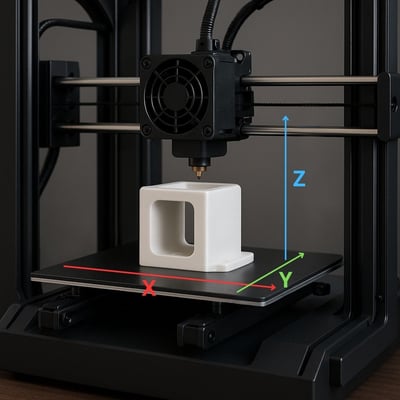
An isotropic material is one whose mechanical properties remain constant regardless of the direction of the applied load. Strength, stiffness, and deformation remain unchanged along the X, Y and Z axes.
Operational advantages:
Common examples of isotropic materials:
Anisotropic materials: Direction-Dependent Properties
An anisotropic material shows significant variations in its properties depending on the direction of the load. Strength ratios may range from 1:0.3 to 1:0.8 depending on the process.
Key characteristics:
-
Complex stiffness matrix
-
Direction-dependent strength
-
Requirement for tensorial analysis
-
Potential for weight/performance optimisation
Examples of anisotropic materials:
-
Fibre-reinforced composites (CFRP, GFRP)
-
Layered FDM parts
-
Natural materials (wood, bamboo)
Mechanical behavior in 3D printing
FDM: controlled anisotropy
- XY plane: strength 80-100% of nominal value
- Z axis: strength 60-80% → critical point
- Key parameters: layer height 0.15-0.3 mm, temperature +10 °C, orientation ±45°
MSLA/DPL: near-isotropy
SLS: advanced isotropy
CNC machining: preserving isotropy
Advantages of CNC machining:
-
Preservation of original material properties
-
High dimensional accuracy (±0.05–0.1 mm)
-
Controlled surface finish (Ra 0.8–3.2 µm)
-
Excellent process repeatability
Optimal materials:
-
Aluminium 6061-T6 → machinability and lightweight
-
C45 steel → versatility and cost-efficiency
-
PEEK → thermal and chemical resistance
Selection Criteria.
Multi-axial loads:
Directional loads:
Development costs:
-
Isotropic → standard design, simple testing
-
Anisotropic → advanced FEM, full characterisation
Production costs:
-
CNC → hourly costs but guaranteed precision
-
3D printing → cost based on volume, complex geometries feasible
-
Series → break-even typically 50–100 units
Applications by sector
- Aerospace → structural brackets in Al 7075, PEEK components, resin prototypes
-
Automotive → isotropic engine mounts, ABS-CF covers, aluminium tooling
-
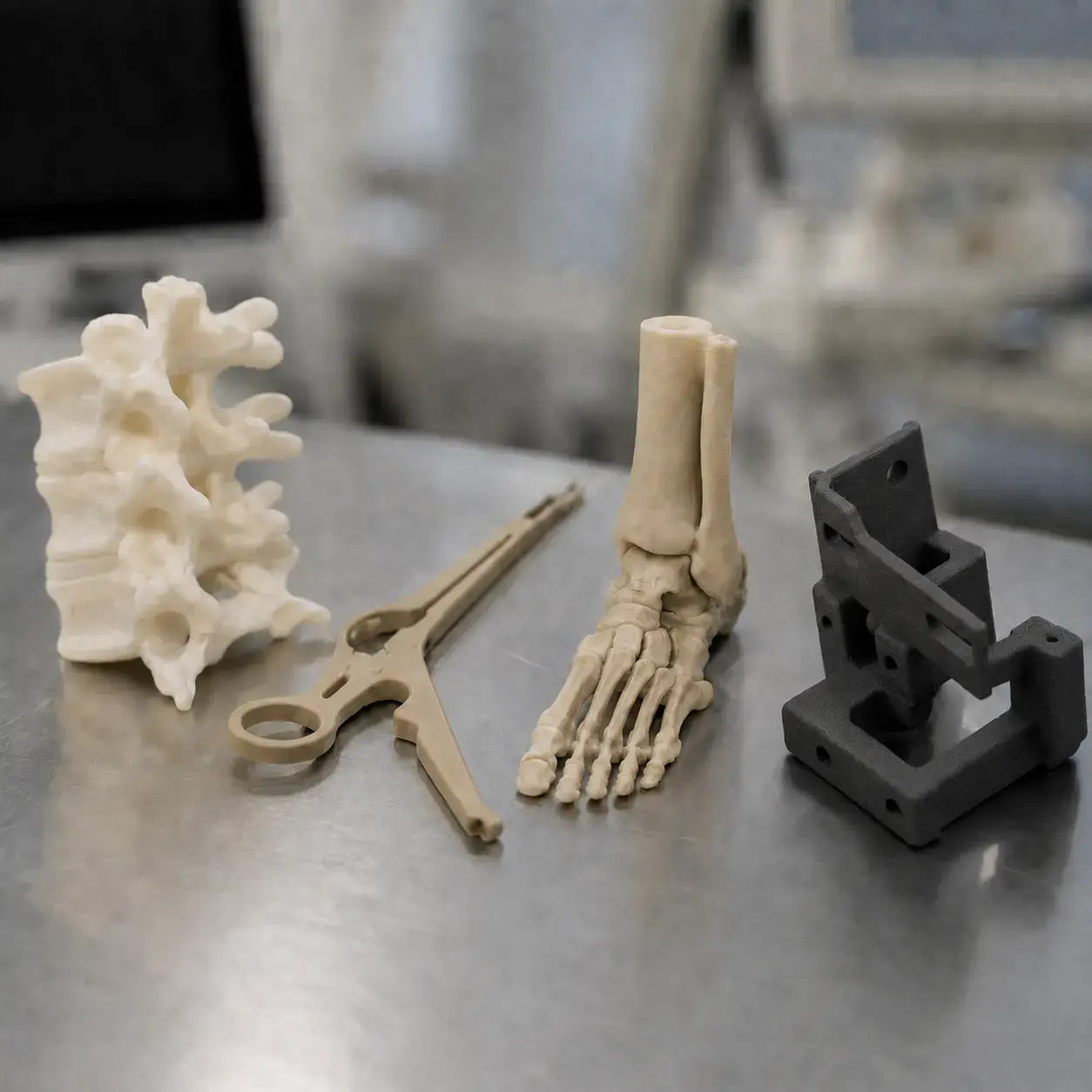
Medical/Dental → titanium prostheses, 316L surgical tools, biocompatible resin models
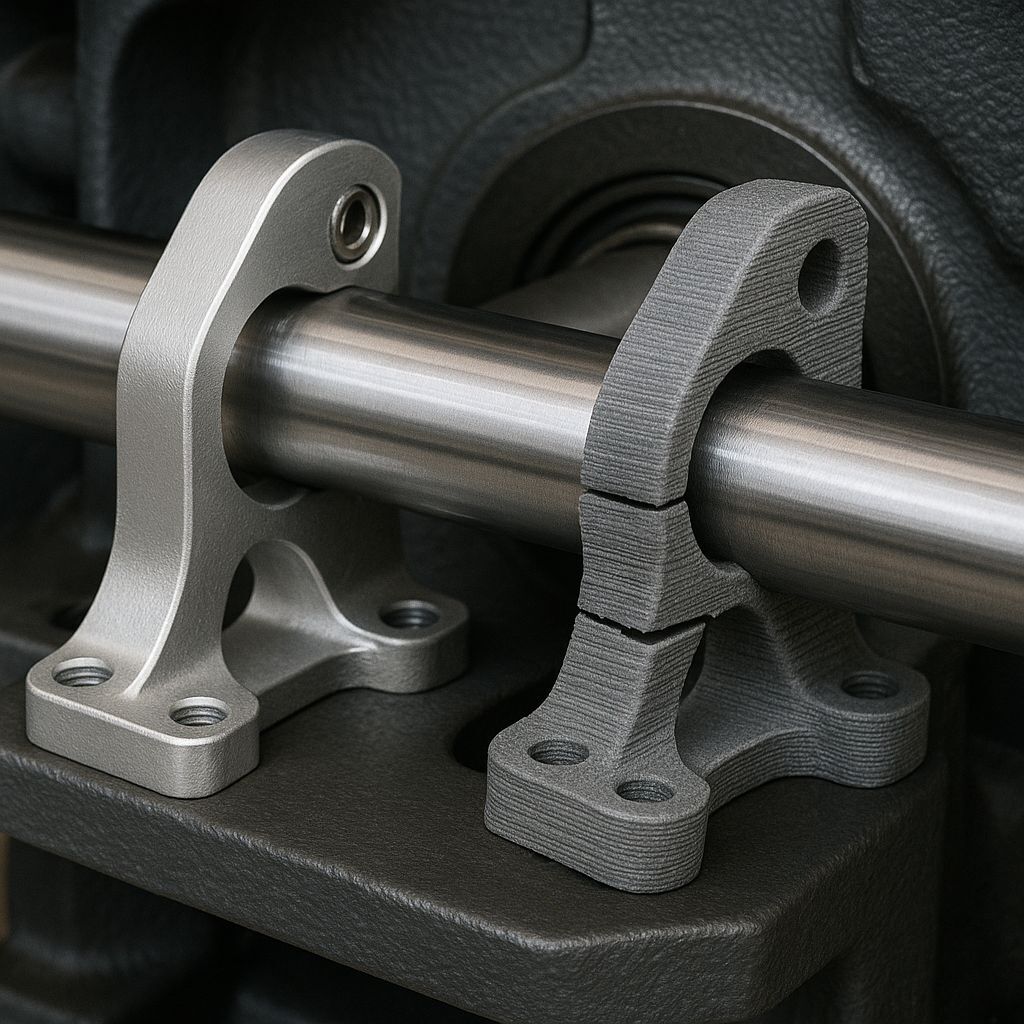
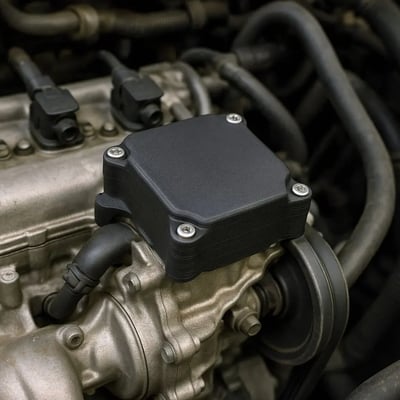 Polycarbonate part produced by FDM 3D printing: a tough, nearly isotropic material suitable for functional components exposed to loads in multiple directions, such as engine parts.
Quality control
Isotropic testing:
Anisotropic testing:
Typical tolerances:
-
CNC: ±0.05–0.1 mm
-
FDM: ±0.2–0.3 mm
-
Resin: ±0.1–0.15 mm
-
SLS: ±0.15–0.2 mm
Future trends
-
Hybrid materials with isotropic/anisotropic zones
-
Multi-material printing and thermal post-processing
-
Selective surface treatments
-
Integrated topology optimisation
Technical Conclusions
Understanding isotropic vs anisotropic materials is fundamental to:
-
Optimising design according to real loads
-
Selecting the most cost- and performance-efficient material
-
Reducing premature failure risks
-
Ensuring production quality and reliability
Every project requires a specific analysis of performance, costs, and risks.
At Weerg, we support designers in transforming these choices into real, safe, and high-performance components.
CHOOSE THE RIGHT MATERIAL FOR YOUR PROJECT

 Weerg staff: Aug 26, 2026